In early 2025 a Reddit meme emerged featuring the producer/influencer Rick Rubin, eyes closed, seemingly lost in something deep, truthy and intuitive in his headphones, with the neologism “LettingTheVibes BeYourGuide” as its caption.[1] This briefly became an image metonym for vibe coding – the act of using LLMs to help the process of writing computer code. Vibe coding could be the punk rock of the day, the meme implied. Here was a new, deskilled way to be creative. Beyond this meme, ideas from art are doing a lot of work in building technological narratives today – some of which I unpack in this text. This work is sometimes far from obvious, and not always as clearly coded as one might imagine. Below is an attempt at a descriptive trail through the dense layers of publications, podcasts and interpersonal networks that are vibing a cultural path forward#vibecoding, #LLM
Vibe-histories of the present
Ten years ago, I made an exhibition for the New Zealand pavilion at the Venice Biennale which tried to reframe images ripped from restricted government documents leaked by Edward Snowden as artworks (Denny 2015a). Part of my monumentalizing of these motifs implied that they might be authored by an underacknowledged ‘deep state’ artist, David Darchicourt, who worked as Creative Director, Defense Intelligence at the NSA from 2001–2012, according to his LinkedIn profile. My installation put the leaked images and other images interpreted from Darchicourt’s online portfolios into dialogue with art from another place and time. I made objects after these images, placed them in sculptural server-rack-modded display cases and arranged these cases inside Sansovino’s High Renaissance Marciana Library in San Marco (Denny 2015b). Below mannerist masterpieces by Titian, Tintoretto and Veronese; among the terrestrial and celestial globes and maps from the Renaissance, the clip-art translations felt connected. It was a vibe. Art was doing work for the state, connecting knowledge across time.#NSA, #art
It’s interesting to look back now and see that Darchicourt’s clipart-y aesthetic, which already felt retro in 2015, is still weirdly contemporary within US government departments. Musk’s DOGE logo proposal[2] for his activity within government departments used exactly this style – presumably with the irony I sensed in the leaked material from the 2010s thoroughly intended. Also consistent is the most lasting insight from the Snowden releases; that commercial tech is and was deeply integrated with Government and military activities. This trend has seemingly only accelerated since that moment.#art
I didn’t realize it back in 2015, but one of the pioneers for this type of collaboration was the company Palantir (named after an all-seeing orb from the Lord of the Rings) – cofounded by Peter Thiel, Alex Karp and others. Like Thiel, Karp is a rhetorical innovator in political language. Venture capitalist Ben Horowitz recently described Karp’s “tremendous” political tactics, where “like 99% of things he says are like Republican, and then he says he’s a Democrat.” (Horowitz 2025). I made a wall relief depicting Karp in 2021, 3d-printed using an out-of-date 3d printer which used standard copy paper and glue instead of plastic as its filament. The raw material for the Karp relief was a Palantir patent for facial recognition – that researcher Kate Crawford highlighted in her Atlas Of AI book as particularly significant.#palantir, #surveillance
That relief was exhibited in 2022 in Auckland alongside collages made by Karp’s mother forty years before. Karp’s mother is an artist – and we were able to borrow beautiful collages made by her in the early 1980s from the High Museum in Atlanta. These delicate and lyrical works take the brutal Atlanta Child Murders that happened between 1979 and 1981 as their subject. Their titles are as moving as their subject matter – for example, ‘Reward for Information Victim Eulogized Yesterday’.[3] We exhibited her works in a group exhibition called ‘Creation Stories’ that I co-curated with indigenous space scholar, artist and architect Karamia Müller. Leah Jaynes Karp’s collages hung alongside my relief of her son, along with collaborative works that Kara and I produced together (Denny and Müller 2022).#art, #palantir
In February 2025, Alex Karp published ‘The Technological Republic; Hord Power, Soft Belief and the Future of the West’ (Karp and Zamiska 2025), which partly employs art and his interpretation of artist figures to argue his cultural and political position. The book rehearses talking points that echo messaging Musk and other contemporary technologists enmeshed in the US government under the second term of Trump have used with increasing frequency, resonance and visibility. ‘The Technological Republic’s’ epitaphs encapsulate the scope of Karp’s message – which is basically advocating for a new, harder version of nationalist liberalism, in Karp’s terms, that critics have interpreted as evidence that CEOs in Karp’s orbit have “made [their] peace with centralized authoritarianism” (Slobodian 2025). In the same piece professor of international history at Boston University Quinn Slobodian argues that the Trump-adjacent iteration of politics is not a departure from classical Hayekian Neoliberalism, but a bastardisation of it – and that these newer Neoliberals are against the emergent nature of capitalism and against the unknown – and more comfortable with a predictable authoritarianism that “emphasizes control, force and determinism over uncertainty or emergence” (ibid.). Slobodian describes their invocation of hardware production in domestic factories as replacing the older Silicon Valley ideal of the decentralized emergent swarm as their dominant metaphor for society. This switch, he argues, aligns with a new militarism, and protectionism visible in government and business today.#nationalism, #neoliberal, #tech-fascism
Karp ends his book with a claim that resonates with Slobodian’s interpretation. In a chapter called ‘An Aesthetic Point of View’ Karp argues that we can’t be wishy-washy and tolerant any more of anything-goes cultural policy – we need to decide on a cultural position, keep it and defend it aggressively. This is like the position of an artist, he claims. We need “aesthetic communities” to build this cultural core of a newly confident (and aggressive) “us”. ’The Technological Republic’ invokes art often and constantly conflates the role of the artist with the role of the company builder. He has a chapter that talks about the ideological bankruptcy of 90’s and 2000’s Silicon Valley culture – claiming the era’s founders got “lost in toy land”. Using the famously failed DotCOM company etoys.com as the exemplar of companies that did unimportant stuff (like selling toys), he contrasts it with authentic innovators that work today defending the “West”, in companies like Palantir. The work of 1980s painter Jean-Michelle Basquiat, who Karp describes as creating a new aesthetic language by incorporating street art into his work, is proposed as an analogy for this kind of innovation.#palantir, #Silicon Valley, #tech-bro, #artist
There was an amazing art group known in the Net.Art circles of the ‘toyland’ web 1.0 era: Etoy.[4] They made incredible networked performances starting in the 1990s, in the form of a ‘toywar’ with the company etoys.com – Karp’s exemplar of frivolous weakness. Etoy, the art corporation, organised a kind of mass art-world-initiated denial-of-service attack on the ecommerce company that was their almost-namesake. Commercial etoys.com tried to first buy, and when that was unsuccessful, take the etoy.com domain name the art group owned. As response, a ‘swarm’ of users clogged the etoys.com checkout with custom activist software and made it hard for users to buy toys on it. Somewhat resultantly, the share price crashed, and the company failed. Arguably this ‘aesthetic community’ could point to a deeper artistic idiom for technologists to draw from – but I guess the example more supports the older, swarm metaphor that Karp is in the business of replacing with fantasies of aesthetic nationalist factories.#net.art, #denial-of-service-attack
Vibe Discoursing
Another product of the internet of the 1990s now more excited by factories than swarms is prominent entrepreneur, venture capital donor and public intellectual-fluencer Marc Andreessen. Andreessen invented the first commercial browser which etoys.com built its business on, Netscape, and became the poster boy for young ambitious founders in the dotcom boom. Andreessen is also the cofounder of A16Z, maybe the most influential venture capital firm active today, and a prominent thought leader of the tech right. A16z does a lot of public-facing publishing – which they see as a core part of their project. I’ve even been interviewed on one of A16Z’s podcasts in, talking about the possibility for NFTs as a networked artwork format (Denny and Chokshi 2024). As a part of the firm’s media production package, the cofounders of A16Z do their own pod, the Ben & Marc Show. Which brings us back to where I started this text, with the Rick Rubin Vibecoding meme – which was talked about with Rick himself on an episode in May. Below is an excerpt from the playful banter in the pod with Andreessen recalling sending the meme to Rubin, who at first thought it was AI generated, which it wasn’t. On that podcast Andreessen says: “I believe, Rick, I think I may have sent you that photo of you at the keyboard. I believe you said, oh, that’s not me, that’s AI generated… And so it was like an inverse deep fake, right? Your immediate reaction was, oh, that’s AI generated. And then it turned out to be real. You often talk about your great love of professional wrestling; you often talk about how it’s actually more real than other sports. Are we entering a world in which things that are AI generated are more real real? Is there the inversion of the deep fake?” (Andreessen et al. 2025).#venture capital, #NFT, #vibecoding, #creativity, #generative
After the meme became the metonym for Vibe Coding, Andreessen and Rubins back-and forth about how it ultimately spurred a collaboration with A16Z-invested company Anthropic to produce Rubin’s AI assisted re-animation of the Lao Tzu text, ‘The Way of Life’. Rubin’s resultant ‘The Way of Code: The Timeless Art of Vibe Coding’ is a website, a book and a piece of software – and is sort of promoting the idea of creative and de-skilled access to writing code thanks to AI (Rubin 2025).[5]In the conversation on the Ben & Marc show, Rubin advocates for a kind of intuitive creativity, ignoring the rational and going with the vibe – claiming the process as “not intellectual at all” (In: Andreessen et al. 2025) and that the artwork as an agent “shows us, it tells us what it wants to be” (Rubin 2025).#vibecoding
‘The Way of Code – The Timeless Art of Vibe Coding’ has a kind of mystification poetics at its core. Typical of the language are phrases like “the model is the mystery, the gateway to all understanding” (ibid.). To me, it reads as a kind of contemporary futurist poetry, poeticizing code and AI. In its layout, the stanzas are paired with animated vector-art spirals, that for me are immediately reminiscent of the kind of artwork made using mainframe computers and early plotting machines in the 1960s, like those shown in seminal exhibitions of this work like 1968’s ‘Cybernetic Serendipity’ at the ICA, London.[6]#poetics, #futurism
This incredible exhibition was one of many during the mid-century showcasing art by artists that were technology-literate and excited to make work using computational processes. Arguably, you could also say that the work featured in this and other exhibitions like it poeticized and even mystified what was going on at the time in those large liberal research institutions that artists had to enter to make these works. This work has a kind of politics embedded in it – it’s hard to think about artists inside of Bell Labs and MIT without also recalling the liberal military-industrial backbone of that era’s liberalism that often justified and funded these kinds of activities. Which is why where Rubin and Andreessen go later in the Pod provides such a contrast to this imaginary – despite their graphic revival of the style in their publications. Alongside celebrating intuition in the process of working with AIs, the Rubin interview also strays into politics – and again warns of the supposed hubris that Karp speaks of in ‘The Technological Republic’ – saying “Like, who’s to say this way, that any one way is the best way? We don’t know. Who’s to say democracy is the best? You know, it’s an experiment” (ibid.).#MIT, #laboratory
Techno-optimism and plottertwitter
Which brings us to another invocation of art from this community, which came out a couple years before the recent chat between Andreessen and Rubin, this time in a conversation on Rubin’s own podcast Tetragrammaton in 2023. In this dialogue Andreessen spoke about his thinking being inspired by the Italian Futurist Manifesto from 1909: “I was inspired by a lot of prior manifestos, one in particular that I enjoyed tremendously, which is the Futurist Manifesto from the Italian Futurist Art Movement and maybe around 1910. So I don’t know that I hit the bar of the Futurist Manifesto, but that was kind of my inspirational starting point” (Andreessen in: Rubin 2024). Here Andreessen is referring to writing perhaps his now best-known text – the ‘Techno-Optimist Manifesto’(Andreessen 2023).#futurism
The physical copy of the Manifesto that founders from A16Z investments and friends of Andreessen received, was also adorned with a plotter-drawing style spiral motif embossed on its slipcase cover – alongside ‘Lord Of the Rings’-font metal on its inside cover, something I imagine Alex Karp would love. The full manifesto is also published on a16z’s website for all to read and ends with a list of ‘Patron Saints’ of Techno Optimism – which indeed namechecks, among many others, the author of the 1909 ‘Futurist Manifesto’, Filippo Tommaso Marinetti. Andreessen’s text uses a quote from the Marinetti manifesto in its body – one which feels again in tune with this turn that historian Quinn Slobodian highlights, of this community becoming more comfortable with hard power. “We can advance to a far superior way of living and of being. We have the tools, the systems, the ideas, we have the will. We believe this is why our descendants will live in the stars. If only we place our faith in the techno-capital machine and recent promises, we will become technological supermen. We are the apex predator. We believe in greatness. We believe in ambition, aggression, persistence, relentlessness, strength” (ibid.).#venture capital, #futurism, #military, #tech-bro, #tech-fascism
Sticking with podcasts, and public intellectuals that have embraced the pod medium, this exact excerpt was highlighted by Jill Lepore, a journalist and Professor of American History at Harvard – perhaps the institutional opposite of A16Z; liberal, old and in conflict with the current US administration. Lepore, in a series about the politics and philosophy of Elon Musk, which the above excerpt of Andreessen’s Manifesto comes from, identifies a problem that I want to pause on here (Lepore 2025). A problem that seems hard to resolve, which her podcast spends a lot of time with, is that of identifying and making parallels between Fascism of the past, and contemporary political developments. It’s hard to not feel a bit stuck always talking about Fascism when those who are charged with its revival shrug it off and even weaponize such accusations in a series of ‘boy who cried wolf’ manoeuvres. It’s also hard to know – as many public commentators from both left and right have said – how useful these analogies with the past are for reading the world today.#tech-fascism, #tech-bro
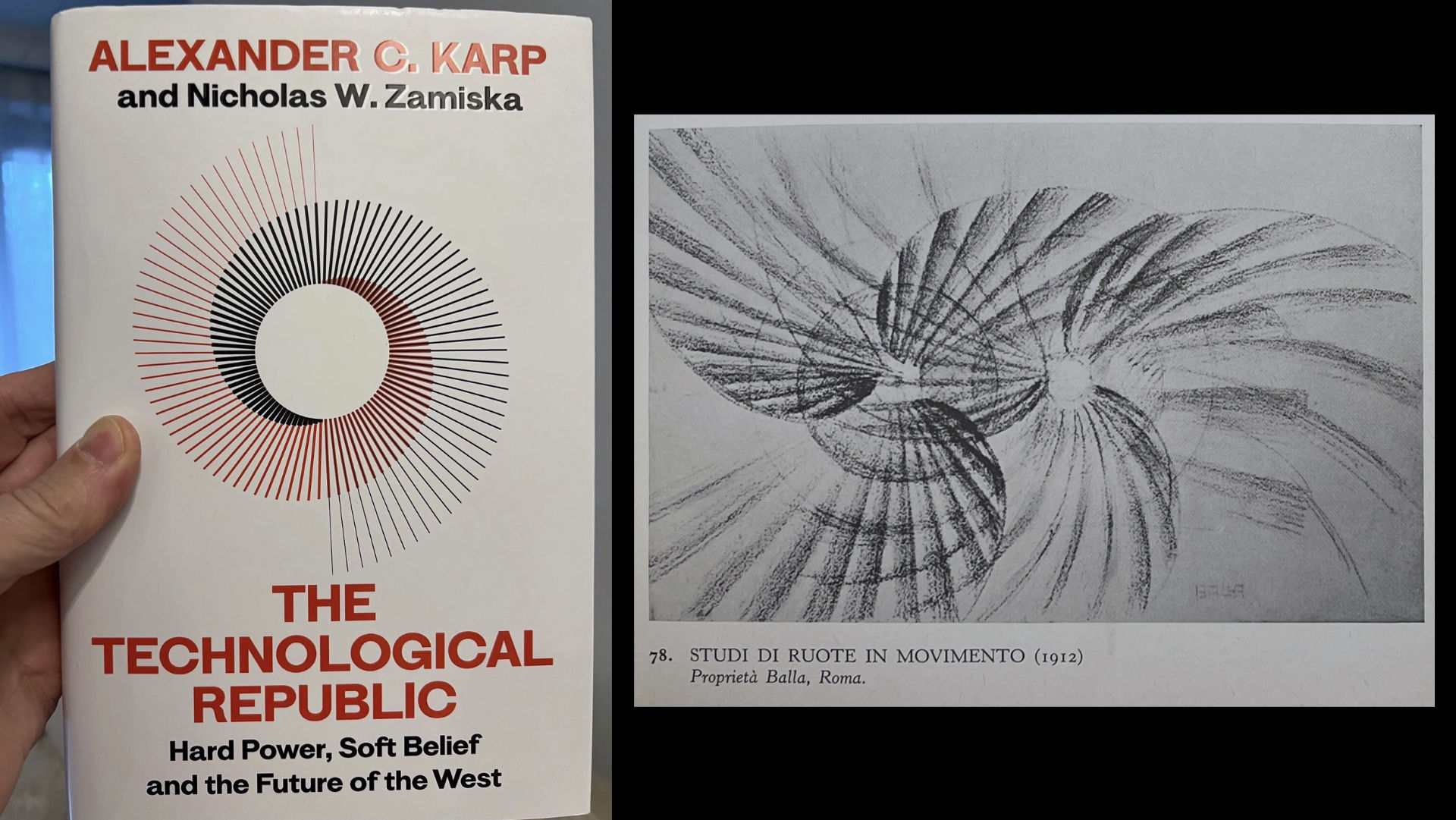
Is it helpful context, or a distraction from what’s actually going on? I find this challenging to deal with as well. You don’t want to just talk about “Fascism” all the time, but you also don’t want to not talk about it – especially when the figures you are trying to understand are actively invoking culture that is closely aligned with its birth and ascendance. As mentioned before, Andreesen, Rubin and Karp’s book all use these motifs on their covers that are at least modernist and early computational art reminiscent. But put Karp’s ‘Technological Republic’ cover motif alongside some of the canonical work of the Italian Futurists that Andreessen alludes to in his manifesto, for example, a drawing like by Giacomo Balla’s ‘Studi di routi in movimento’ from 1912, and it is hard not to see the parallels. The tendency to echo artwork as well as language from this movement merits going into deeper.#tech-fascism, #futurism
As some kind of participant in an NFT-centered art world for the last few years, I pay attention to some of it’s visual and technical trends. For whatever reason, the goings on in this discourse seldom reach other art worlds with much scale, beyond the artists Beeple and Rafik Anadol. This self-described ‘digital’ art world mostly meets and exchanges on X, and it recently has had a plotter moment – where artists who make NFTs also make artwork using plotters like those used in the early computational art I mentioned before. It’s quite easy to keep up with the fascinating and beautiful work made in this sub-community if one tunes into what’s referred to as ‘Plottertwitter’. If you go into X with that hashtag, you’ll see how big this community is.#digital art, #art scene, #NFT
Plottertwitter has coincided with another development in the consumer hardware world – a kind of post-Shenzhen cheap-and-innovative gadget explosion that has paved the way to a general wider availability of tech tools – from 3D printers to CNC machines, to drawing plotter machines. I see plotters like those made by Bantam Tools and Uuna Tech as the younger cousin of the plotters from the Cybernetic Serendipity era. With these tools, NFT artists have been experimenting with making plotters do a range of things – from intricate and detailed generative drawings to various kinds of robotic painting. One of my favorite artists working in this space is an artist based in London named Licia He.[7] When I saw images of the paintings she produces with plotters and inks on X, while reading and thinking about the ‘Techno Optimist Manifesto’, I couldn’t help but think of their indebtedness to the language of Italian Futurism – intentional or not. I have not heard He speak of her work in terms of the language of historical modernism – and certainly not of Futurism. But for me her work had all these associations, and it opened up many thought processes in my mind. I thought about the older flatbed plotters that were used to make the liberal plotter art of the 20th century and the context they were made in – about the works of Charles Csari, Georg Nees, Frieder Nake and Vera Molnar.#cybernetics, #art, #futurism, #digital art
I was thinking about these also in the context of recent shows retelling that history – including Michelle Cotton’s beautiful 2025 exhibition ‘Radical Software’,focusing on art made by women with computers before the commercial web. Included in that show were 1980s plotter artworks by Charlotte Johannseen that were also exhibited a few years earlier at the Venice Biennale curated show by Cecilia Alimani. I’ve been thinking about the context of work that was made with plotters before the Web, especially those that were more overtly political like the ‘Diffused Kennedy’ portrait by Masao Kohmura, made just after President Kennedy was assassinated. Centering on Kennedy’s ear, thin black plotter strokes blast outwards to create a drawing of his face. Another work of Charles Csuri, ‘Random War’ much more explicitly alluded to the military context that must have been everywhere in these artists lives at the time, including inside the institutions they had to interface with to produce these works. Using a random number generator the work generated battle scenarios, building on the drawing of a toy soldier to constitute the data set. Csuri’s plotter drawings outputting several stages algorithmic distortion applied to a single motif clearly owe something to Italian Futurism – particularly the early work trying to capture the feeling of movement made by Giacomo Balla in the 1910s. Putting a Balla drawing from 1913 that uses the motif of a bird moving through space alongside a Csuri plot like ‘Chaos to order’, where he uses repeated motifs of a Hummingbird form, there’s an undeniable dialogue.#futurism, #art, #digital art
Exhibiting Futurism
Giacomo Balla’s work and others like it were shown in the most visible U.S. exhibition of Futurism – MoMA’s Futurist overview show ‘Futurism’ from 1961. It’s interesting to think of how Futurism was framed at this time, and even earlier in MoMA’s 1949 exhibition ‘Twentieth-century Italian art’ – celebrating artwork made alongside the emergence of Fascisim, in a new liberal world, for its formal innovation and Avant-Gardeness. A trope that has been important in Futurist historiography is perhaps typified in this exhibition – the separation of pre-WW1 and WW1 adjacent so-called first-wave Futurism, and that of the presumably more Fascist-complicit second-wave Futurism that was prevailed until the end of WWII. The 1961 Moma show didn’t show the work made in the second-wave period. However, it does celebrate works of Balla and the others that participated in the first-wave moment after 1909 as a central part of its story of progressive and maybe implicitly liberal modernism.#Modernity, #futurism, #military
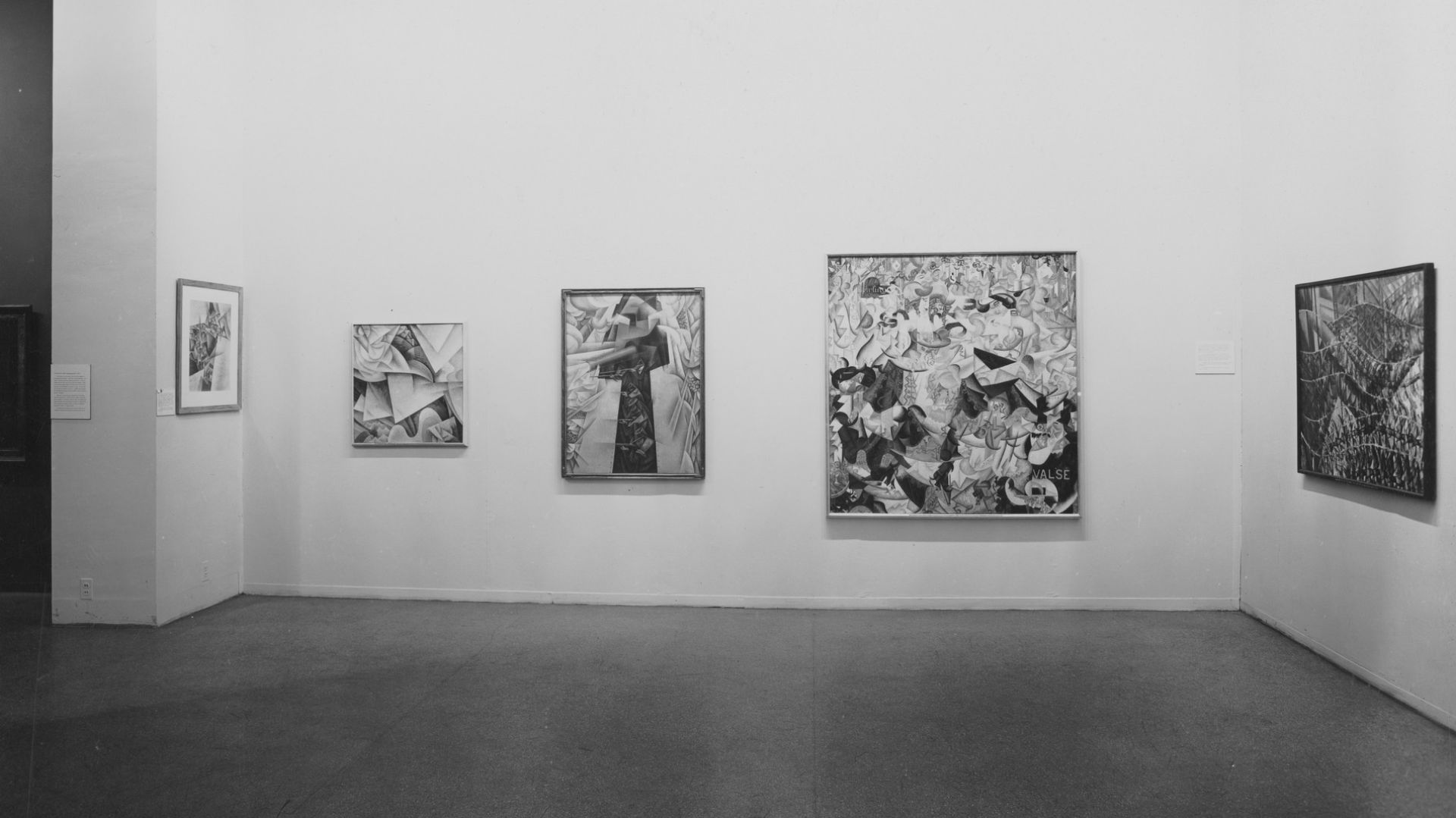
This is not to say militarist works are not included in this first ‘progressive’ story of Futurism – like the canonical 1915 Severini paintings ‘Canon in Action’[8] and ‘Armored Train in Action’[9] – depicting the glory and dynamism of armored trains and artillery. Right from the beginning, Futurism was anti-feminist, pro war, imperialist and nationalist. These tropes were discursive, but they also lived, and artists fought and died in the WWI in their performance, such as Boccioni. But what of the contextualization of Futurism in the 21st century? The next biggest New York show of Futurism happened quite recently: ‘Italian Futurism, 1909–1944: Reconstructing the Universe’ near the end of the Obama era, in 2014. On the cover of its catalogue is a work by Tullio Crali, very much a second-wave Futurist who only made his first works in the 1920s when Futurism was already fully embedded within a Fascist Italian regime.#futurism, #military
This is to say nothing of the way this material has been treated in Italian exhibitions. The publication ‘Curating Fascism: Exhibitions and Memory from the Fall of Mussolini to Today’editied by art historians Sharon Hecker and Raffaele Bedarida focuses on ethical questions around presenting art from this period (Hecker and Bedarida 2022). It starts with Foundazione Prada’s 2018 exhibtion ‘Post Zang Tumb Tumb: Art Life Politics: Italia, 1918–1943’. It includes reflections from the curators of exhibitions like the 2014 Guggenheim example above and insists on a lineage in Italy from the 20th century, especially from shows like ‘Annitrenta’ (1982) and ‘Arte Moderna in Italia 1915–1935’ (1967). But Hecker‘s and Bedarida’s critical study was published before the most recent example, ‘Il Tempo del Futurismo’ (2024–25) at the National Museum of Art in Rome. This exhibition also included both waves of Futurism – including a lot of its most explicitly militarily propagandistic work – that of ‘Aeropittura’ or Aero-painting, made by artists like Tullio Crali. These artists were so integrated into military life that they often even accompanied fighter pilots on active missions to experience the dynamism of bombing raids. Their paintings seem like records of the rush of these experiences – and artists like Crali, who died in the year 2000, never abandoned the Futurist idiom – continued to defend these kinds of methodologies long after the end of WWII.[10]#art, #futurism
Different from Crali, so-called first-wave artists like Giacomo Balla went through multiple idioms in their career where the relationship to the emergence of Fascism, and the support of it is harder to determine. This also makes the first-wave disentanglement with the political context it witnessed harder to perform. In ‘Curating Fascism’ Hecker and Bedarida detail an object that exemplifies this challenge. The authors refer to Balla’s painting ‘Velocità Astratta’ (1913)[11] that in 2000 was on display at the Scuderie del Quirinale in Rome in an exhibition called ‘Novecento, Arte e storia in Italia’: “For the first time since the fall of Benito Mussolini, this canonical futurist artwork publicly revealed its unsettling verso: on its back, upside down, was a previously unseen hyper-realistic painting by Balla that commemorated Il Duce’s March on Rome.”[12] The authors reveal that “Balla had probably painted this celebration of fascism on the occasion of the 1932 ‘Mostra della rivoluzione fascista’, which commemorated the tenth anniversary of the fascist power grab” and described the two-sided painting as “the highlight of the 2000 show”, despite “that it clearly showed the enmeshment of this major figure of Italian modernism with fascism” (Hecker and Bedarida 2022).#art, #futurism, #Modernity
The ‘Il Tempo del Futurismo’ exhibition at National Museum (2024/25) was also popular despite quite some negative commentary from the international press – much of the commentary focused on the apparent inviting and subsequent uninviting of a number of prominent international historical scholars, and the uncritical nature of the exhibition’s accompanying language – summarized by this review from Artforum: “Some of these controversies appear to resonate with ongoing accusations from critics and former members of the museum team that the institution had become a propaganda arm of the current right-wing government. Troubling contexts aside, the approach the exhibition took to celebrate Futurist art—sidestepping its dark sides and excluding any critical evaluation—did a disservice both to art history and today’s audience” (Zhang 2025).#art, #futurism, #propaganda
There’s also been speculation from the Italian press on the use of artworks as a tool by Giorgia Meloni’s cultural arm at attracting attention from supposedly Futurist admiring international political and technology figures like Elon Musk and J.D. Vance. And commentary about the government explicitly controlling the narrative of ‘Il Tempo del Futurismo’, playing down the violence of work like ‘Aeropittura’ and focusing on naturalizing a smooth, uncontroversial arc that leads from Mussolini to Meloni with advanced culture. Meloni supposedly also pushed for an exhibition at the same institution a couple of years prior celebrating Lord of the Rings author J.R.R. Tolkien in the 2023 exhibition ‘Man, Professor, Author’ – again, surely in tune with Karp’s invocation of Middle Earth as the West in his writing and the usage of Lord of the Rings in so much defense tech startup lore.#art, #futurism, #Modernity
Imaging Defense Tech
Which brings us back to another recent Andreessen Horowitz investment program formalized in 2024 that seemingly doubles down on Andreessen’s Futurist commitment – dynamism being one of the key obsessions of Futurism – and is maybe the most explicitly nationalist and militarist of their rhetoric to date. ‘American Dynamism’, introduced in a series of posts on the A16Z website, is a framework that underlines the importance of funding defense tech and bundles this urgency in with infrastructure and domestic production of strategic assets like AI chips etc. It begins stating “WHAT WE BELIEVE: The American Dynamism practice invests in founders and companies that support the national interest: aerospace, defense, public safety, education, housing, supply chain, industrials, and manufacturing” and describing the US government “as a customer, competitor, or key stakeholder” (A16Z 2022). Perhaps the signature investment linked to American Dynamism is another company, modelled on Palantir even down to being named after a Lord of the Rings object; Anduril, an AI weapons company co-founded with Palmer Luckey, the founder of Oculus Rift. The AR glasses company was acquired by Meta, then Luckey was fired from Meta, allegedly for funding a Trump Superpac in 2016. Vibes have truly shifted since then in Menlo Park and Meta is now working with Anduril on joint projects.#hegemony, #palantir, #anduril, #tech-company, #nationalism
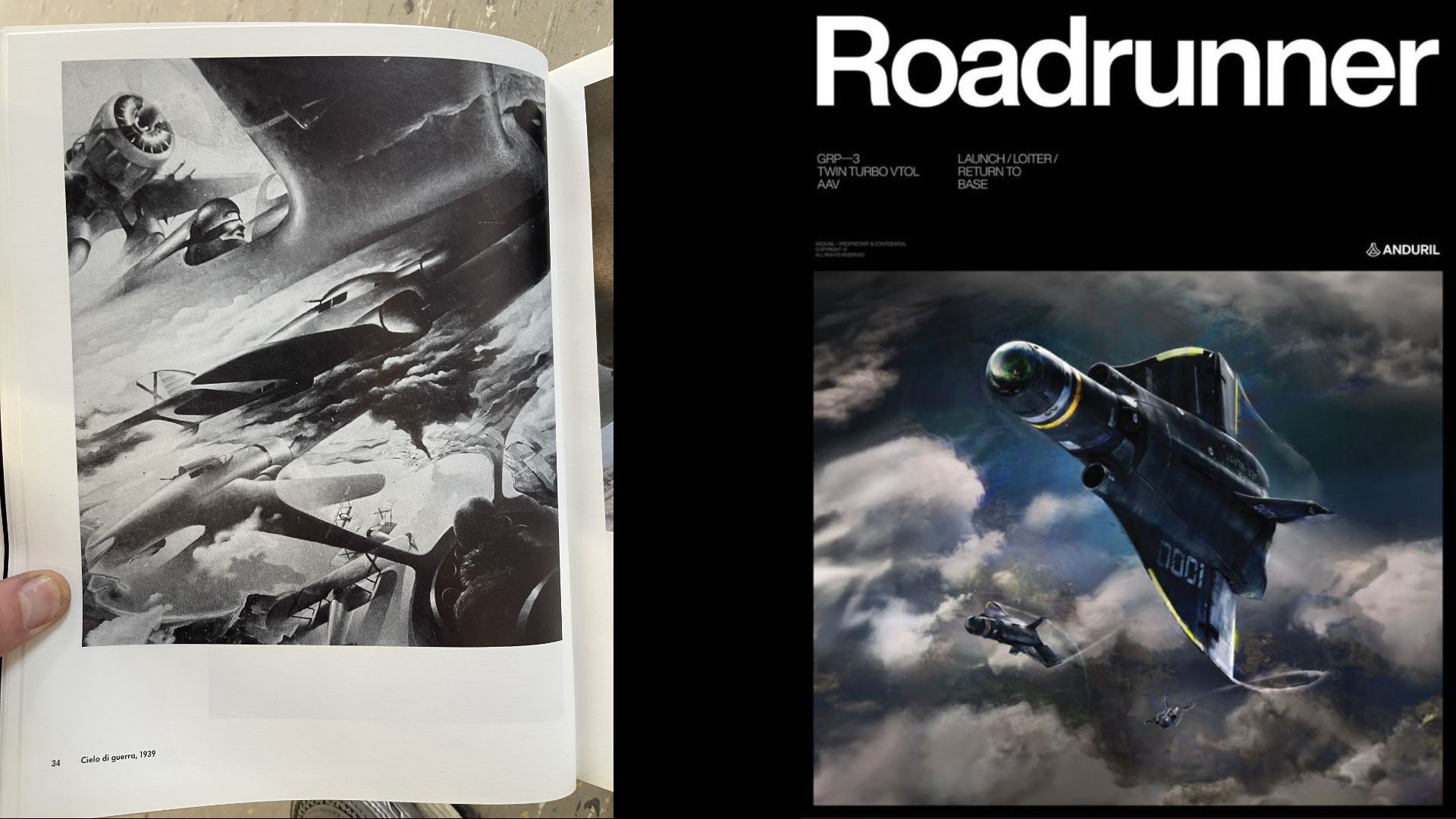
The advertising imagery that Anduril produces of its AI-enabled weapons systems to my eye also owe a lot to Aeropittura, whether intentional and studied, or not. Dynamic, painterly renders of their futuristic, polished air and sea drones use compositions reminiscent of the most evocative of Tuilo Crali’s work, even down to lines of force and discombobulating perspective exaggeration. A recent render of their Roadrunner drone that ended up on US billboards was even furnished with a quote from Trump, proudly celebrating its form as “A Nasty Looking Thing”. Anduril’s creative directory is a Stanford graduate named Jen Darhy Bucci, and I see in her as kind of an analogous figure to the NSA director David Darchicourt I focused on in my Venice project (Denny 2015b). It’s not only their static imagery but also their high end and very graphic video production viscerally demonstrating the rush and advanced-ness of their products which seemingly draws from Aeropittura conventions.#anduril, #creativity, #futurism
As is the overt strategy of many Defense Tech companies, Anduril publishes a lot targeted to the general – possibly retail investing – public, in contrast with say Lockheed Martin, an incumbent Defence manufacturing ‘prime’ of yore. Anduril’s text production fits the Karp ‘Technological Republic’ idiom, invoking the honor, urgency and realism of an era of patriotic weapons production. In this spirit another important touch point for Luckey and Bucci is designs for 1940s American Rearmament posters – compositions from which they work with very closely for their Airopittura-ish images. On X Bucci describes the graphic design: “‘The Grind That’ll Win’ is part of our Rebuild the Arsenal series re-imagining war-era posters. We loved the flying sparks emulating the stripes of the American flag in the original and wanted to make that a vibrant first-read of our composition.” (Bucci 2025). This new style of weapons marketing has even become kind of an international defense tech marketing trend. I was surprised to see this kind of painterly imagery featuring dynamic drones on billboards advertising German AI weapons startup Quantum Systems in Berlin a few months ago, and Helsing in Munich at the airport during the Security Conference in February 2025. They are a part of the same family of imagery, promoting the same kinds of products – with companies starting to use similar narratives as Anduril in Europe.#anduril, #futurism, #tech-company
One can of course see why language and attitudes around Defence here is changing – with pressure from threats of the Trump administration abandoning Nato, Germany has raised its Debt ceiling explicitly to spend on defense – with Quantum Systems and Helsing will be some of the prime beneficiaries. With Russia’s stray drones and threats of direct bombs to Berlin in the wake of chancellor Friedrich Mertz’s increasing support for Ukraine, and deployment of troops for the first time outside of Germany, you can see why these companies are relevant here – and their image production important. I personally find these issues not so easy to navigate – especially coming from a Quaker pacifist background and growing up in an effectively demilitarized country like Aotearoa New Zealand.#armed drone, #tech-company, #military
Fake Futurism
To address these conflicting forces in my artwork, I have been taking these cues from the post-NFT art world I mentioned before but applying some of their potter techniques to this more explicitly charged material. Staring with simple plotter drawing with a pen on paper, I worked through re-rendering imagery produced by Italian Futurists, trying to give context to the worlds and intellectual histories being invoked by those advocating for Defence Tech today. With one of the most explicit Severini paintings depicting war – 1915’s ‘Canon in Action’,[13] I did a translation into English of the French phrases featured in the original, updated some of the idiomatic language, changed the country’s patriotism it was supposed to be representing, subbed out the WWI canon for a contemporary Anduril drone launcher and added an Anduril logo. The resultant drawing is a chilling image – and has something between the liberal ‘Cybernetic Serendipity’ era plotter art, meme culture of today as well as Severini’s first-wave Futurist celebration of war (Denny 2025a). Then I bought an industrial-scale printer that is literally used for making packages legible to machines – its primary use being printing QR codes directly on boxes in warehouses. It weirdly also looks like a gun – and when you use it to print, is actually hard not to capture traces of movement with. I started using this ‘operational’ device to produce canvases I made using promotional images from German drone company Helsing’s website of their flagship HX-2 drone.#futurism, #art, #Simon Denny
I have also tried painting with plotters inspired by artists like Licia He. I worked with artist Harris Rosenblum to hack together software that made plotters hammer out painting layers – rendering AI assisted compositions into objects. For the AI image starting points that feed these machines, I altered pre-trained generative Comfy AI diffusion models using Balla and Crali paintings, mixed them with defense tech imagery, and ran a series of outputs. What comes out is a kind of weird, fake Futurism – somehow both conservative and contemporary, containing the language of today’s defense tech, a mix of first and second-wave futurism, as well as the post-war liberal visual language of midcentury plotter art, mixed with contemporary plotter-twitter’s more ambiguous positioning (Denny 2025c).#futurism, #art, #Simon Denny
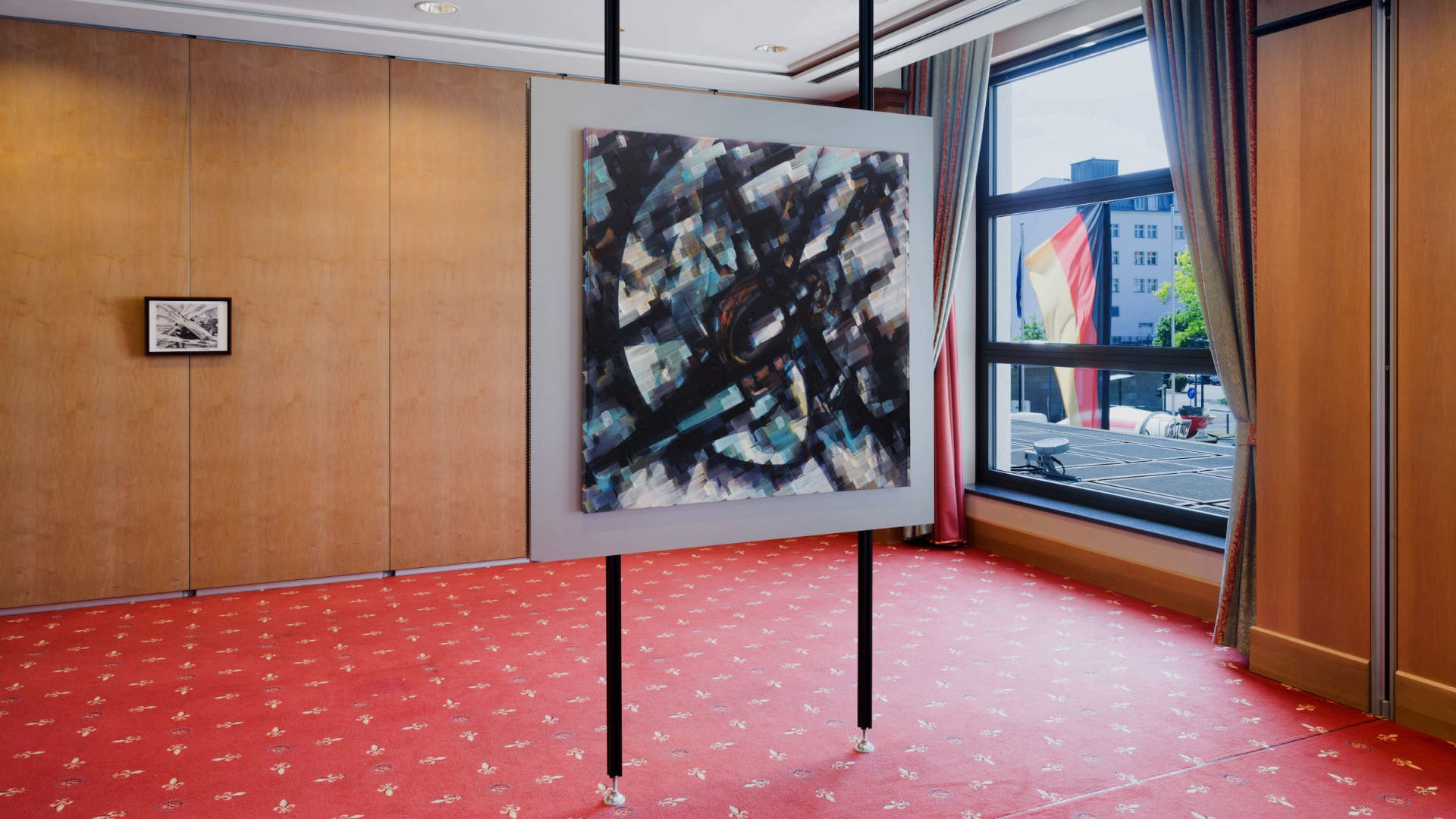
I exhibited some of these works for the first time in June 2025 in Berlin – in a conference room inside a hotel room near Potsdammer Platz on Stauffenbergstraße, which faces across the street the German Ministry of Defense headquarters – known as the Bendlerblock. The street that the hotel and the Bendlerblock share is named after the officer that used the office over the road during the National Socialist period. Which is in a building, which now partly serves as the German Resistance Memorial Center or Gedenkstätte Deutscher Widerstand. The Shellhaus, an icon of 1920s international style modernism that is also used by the Ministry of Defense today is the only other building on the section of the street the hotel is on. The hotel is also only a few streets away from where the first Futurist show in Germany took place in 1912, in a version of the storied Der Sturm gallery – in two sites that are now the Saudi embassy and the head of an SPD adjacent Stiftung. Just across the river was also the site of the second Futurist show to happen in Berlin in 1934 – one that focused on the later Aeropittura[14] – and became entangled in the rejection of the Futurists from Nazi-approved art, although Aeropainting was highly contested and supported by many inside the Nazi regime.#futurism, #art, #berlin, #Simon Denny
There is an issue with relegating the work done by futurists to a place where artists with contrasting politics should avoid any dialogue with their legacy. A similar sentiment is implied in a quote from Jill Lepore’s Musk-story podcast I quoted earlier. While she rejects the retrograde models of the future that figures like Musk and Andreessen may have in their heads she admits: “The 21st century is an age of technological wonder. It is in many ways tremendously thrilling. Tesla and SpaceX are engineering marvels” (Lepore 2025). I wonder if there’s a way to use what has been compelling to telling other stories about technology and the unknown that can be salvaged and productively used from the Futurist project. If it’s possible that we don’t just give the role of technology’s cultural narrativizing to authoritarian-enabled storytellers, that we find a way to use the transgressive appeal of the histories of Futurism to open up other stories – as the 20th Century’s post war liberal-aligned artists and art-historians once did.#futurism, #art
[1] See https://programmerhumor.io/agile-memes/letting-the-vibes-be-your-guide-am3a.
[2] See https://commons.wikimedia.org/wiki/File:Musk_DOGE_logo.jpg.
[3] See: https://high.org/collection/reward-for-information-victim-eulogized-yesterday/.
[4] See: https://etoy.com/.
[5] See: https://www.thewayofcode.com.
[6] See: https://monoskop.org/Cybernetic_Serendipity.
[7] See: https://www.eyesofpanda.com/.
[8] See: https://www.mart.tn.it/mostre/gino-severini-1883-1966-138731.
[9] See: https://www.moma.org/collection/works/79418.
[10] For more details and context on Crali in English, see the catalogue ‘Tullio Crali – A futurist life’ published alongside a recent exhibition of his work in London that details much of his attitude to his work during the Regime and after (Adams and Martorelli 2019).
[11] See: https://www.pinacoteca-agnelli.it/en/collection/velocita-astratta/.
[12] See: https://www.analisidellopera.it/tst-marcia-su-roma-di-giacomo-balla/.
[13] See: https://www.mart.tn.it/mostre/gino-severini-1883-1966-138731.
[14] ‚Italienische futuristische Luft- und Flugmalerei‘, Lützowufer 13, 28 March – 27 April 1934