Introduction
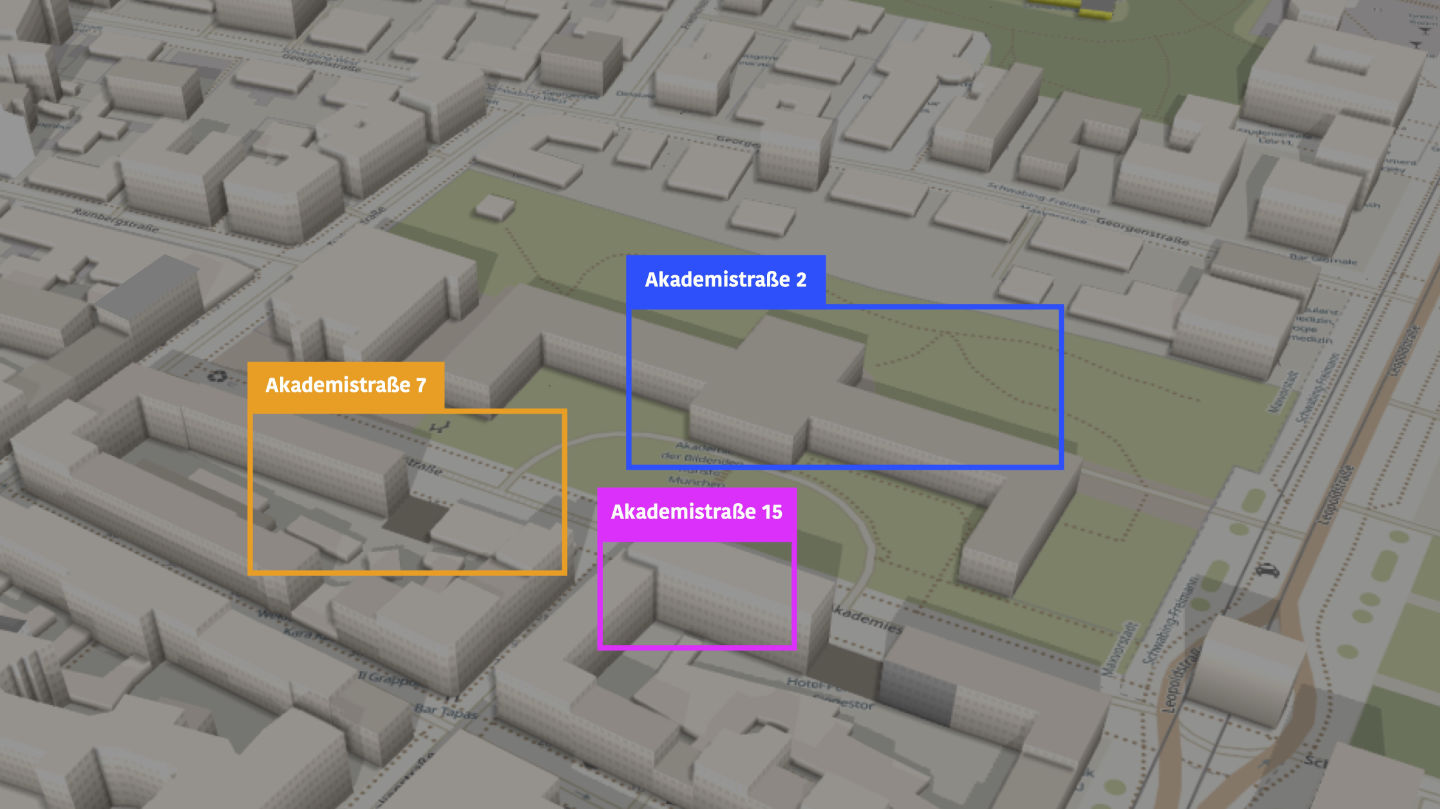
Akademiestraße, Munich, is touched by generative AI in more ways than most streets. Within a few metres, three addresses articulate distinct yet entangled regimes of world-making. At number 2, the Academy of Fine Arts increasingly debates digital technologies and their aesthetic and political implications. Across from it, at street number 7, a centre of advanced computer vision and machine learning, led by Professor Björn Ommer, co-author of the foundational architecture underlying Stable Diffusion, develops systems that have helped move AI from research infrastructure into everyday visual culture. And yet a few doors down stands the last Munich apartment of Bertolt Brecht—a proximity that seems already diagrammatic. In a letter to his daughter Hanne, Brecht once specified his address with scalar precision: “Your father’s address is Akademiestraße 15. The city is named Munich, the country Bavaria, the star Earth” [“Die Adresse Deines Vaters ist Akademiestraße 15. Die Stadt heißt München, das Land Bayern, der Stern Erde”]. Yet if each of these addresses enacts its own scalar extrapolation, do they arrive at the same planet?#art, #statistical model, #Munich, #Stable Diffusion
The movement from street to planet captures a tension that continues to shape contemporary thinking about AI. Systems developed within particular laboratories or training sets are readily framed as infrastructures of global reach, capable of reorganising image production, language, and knowledge at scale. Yet their expansion does not erase the specificity of the sites from which they emerge. The laboratory, the academy, the market—each advances its own claim to coherence, its own version of what the present is becoming. Rather than resolving these claims into a single narrative, I propose to read them together as symptomatic of a shared but unsettled condition. AI, in this sense, can be unpacked as a structure of feeling, a term Raymond Williams introduced for precisely such moments: the lived experience of a historical present in which competing totalities coexist without fully consolidating.#AI, #infrastructure, #the present
Across specialised tech-conferences, AI is framed as optimisation problem or benchmark; in mainstream discourse, as promise or threat. Within the art academy, it takes on a distinct inflection. There, AI is engaged less as a unified system than as a situated configuration: a retrained model, a delimited dataset, a single prompt–output relation. In this setting, the prompt begins to resemble the artwork—not as illustration, but as structure. Both operate as singular acts in which broader social and technical relations are refracted within a bounded form. What comes into view is not the system as a whole, but instances that appear at once limited and world-bearing. It is at this juncture that the figure of the monad begins to suggest itself: not as a denial of totality, but as a way of loosening its grip.#AI, #monad
AI as a Structure of Feeling
To approach AI as a structure of feeling is to shift attention away from technological novelty and toward the texture of the present it produces. In this register, artificial intelligence does not primarily appear as a technical problem to be solved, nor as the harbinger of an imminent industrial revolution. Instead, it registers as something more diffuse and more difficult to name: a shared yet unstable sense that the historical present is suspended in a transitory moment before it hardens into its next hegemonic doctrine. Markets treat AI as wager; institutions reorganise around its promise; funding frameworks increasingly demand its invocation. What does it mean to practice art or pursue research under such conditions—when the buzzword precedes the work? To describe this atmosphere without reducing it to either enthusiasm or alarm, it is useful to return to Raymond Williams.#AI, #hype
Raymond Williams famously described cultural processes as structured by a dynamic relation between ‘the dominant’, ‘the residual’, and ‘the emergent’. The dominant names those meanings and practices that are institutionally stabilized; the residual refers to elements formed in the past that remain active in the present; and the emergent designates new meanings and relations that are not yet fully articulated or absorbed. Crucially, these categories are not fixed positions but shifting tendencies within a living cultural field.#Raymond Williams
If one were to map the dominant, residual, and emergent categories according to the computer vision lab, the art school, and Brecht’s old apartment in Akademiestraße, then we might get a different kind of a cognitive map than the all-encompassing diagrammatic project of Kate Crawford and Vladan Joler. On the dominant side stands the computational paradigm exemplified by computer vision and machine learning research: a view of generative AI as a technical object to be optimized, scaled, and—at least in the case of Björn Ommer’s lab—argued to be democratized through open access. This framework produces powerful tools and infrastructures, but it also stabilizes a particular understanding of AI as largely neutral, functional, and primarily forward-looking.#diagrammatics, #generative
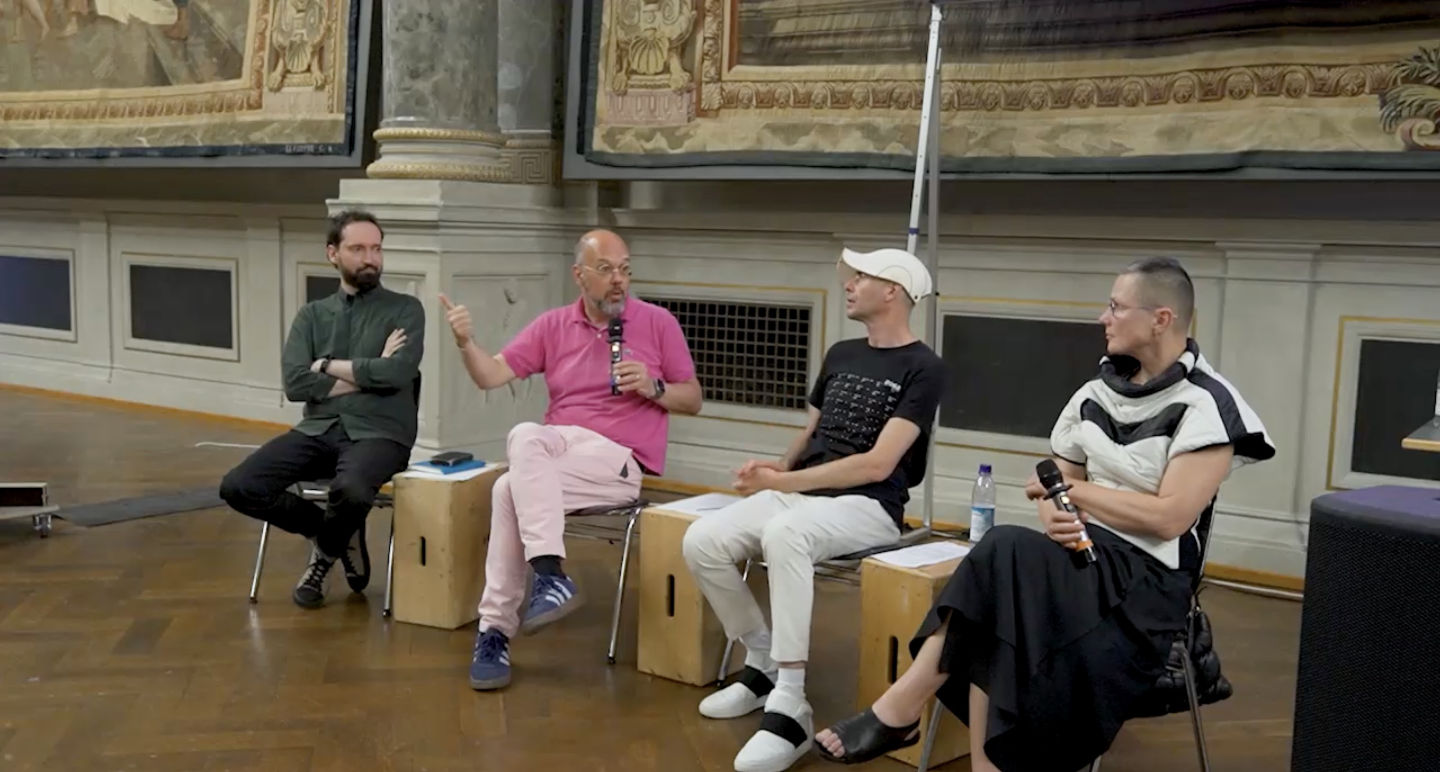
The ‘emergent’ category from Williams’ triad already appears in the title of the fine art programme led by Hito Steyerl and Francis Hunger at the Academy in Munich, the Emergent Digital Media class and its associated conferences. Here, AI is approached less as a solution than as a problem-space: something to be staged, tested, misused, aestheticized, and politicized. These forums do not simply comment on AI from the outside; they actively reconfigure its meanings by situating it within histories of art, labor, surveillance, and militarization. What emerges here is not a new technology but a shared sensibility—a way of perceiving AI as inseparable from contemporary forms of power and violence.#AI, #education, #critical practice
Occupying the residual position in this structure are Brecht’s theories of art and media. Far from being obsolete, concepts such as the estranging device, distributed authorship, collective production masked as individual genius, or indeed the distancing effect resonate uncannily with contemporary AI systems. Generative models depend on collective, often invisible labour; they aestheticize automation while obscuring authorship; they invite fascination precisely where critical distance is needed. What makes Brecht’s framework residual is how often we can identify it in our vocabulary for describing that structure of feeling here identified as AI, particularly when we are trying to analytically understand its dynamics without naturalizing them. Daniel Hartley offers a useful summary of the ‘ongoing’ aspects within Williams’ schema: “There are residual social inheritances which ‘formed in the past,’ but which are ‘still active in the cultural process,’ and which can offer alternatives to, oppose or reinforce the social order” (Hartley 2016, 45).#labor, #collaborative practice, #social order
This admittedly schematic structure is anything but stable; the now-dominant paradigm of connectionist AI was itself only recently framed as an emergent and disruptive turn within AI and machine learning research. In this sense, the agency of the art world should not be dismissed since contemporary art participates in the negotiations of the cultural present. To keep with the Akademiestraße example, the recent set of conferences at the Fine Art Academy in Munich that focused on topics such as drone warfare or the links between AI and authoritarianism participated in new reconfigurations in this structure of feeling: they shift the position of what’s emergent and what has already been precipitated into the dominant. Open-source generative models, once perceived as radically emergent interventions into proprietary technological regimes, have rapidly been absorbed into the cultural dominant as well as mainstream software development. University conferences and tech-events that initially staged AI as an unresolved question increasingly find themselves historicizing positions that have already precipitated into orthodoxy. What this constant re-shuffling reveals is not confusion but the very texture of the present that Williams’ schema was designed for: a structure of feeling in which AI is experienced as simultaneously inevitable, unfinished, and politically charged.#history, #art, #artistic research
Is this kind of transformative agency overstating the power of the fine art discourse? One would be prudent to remain sceptical, yet alongside the two powerful outcomes mentioned above and published on this platform, as an art historian, I feel compelled to investigate just what kind of an epistemological structure or representational model enabled artists to have a stake in what is to be identified as the ‘emergent’ in the dynamics of the historical present. My central proposition here is this: critical (or emergent) art is increasingly shifting AI from its ideological appearance as a totality to that of a monad.#monad, #artistic research
That is, the social totality of the future ‘after AI’ contained in tech prophecies and the current stage of the market hype cycle is in an artist’s talk giving way to the social and technical reality of the prompt: the LLM has to re-create an image of the world in light of each prompt. This wrinkle is similar to the challenge faced by radical philosopher-theologists such as Nicolas Malebranche (1638-1715) or later Jonathan Edwards (1703-1758): if only God can keep the universe in being, he must therefore reinvent it in every instant (Fredric Jameson, 2015, p. 122). Similarly, AI runs the statistical model over and over again, lending itself approachable to a similar structure of art projects, both iterating upon the self-enclosed entities that somehow mysteriously reflect the world that produced them—yet do not offer a readily-available cognitive map of such a totality.#AI, #LLM
AI from Totality to Monad
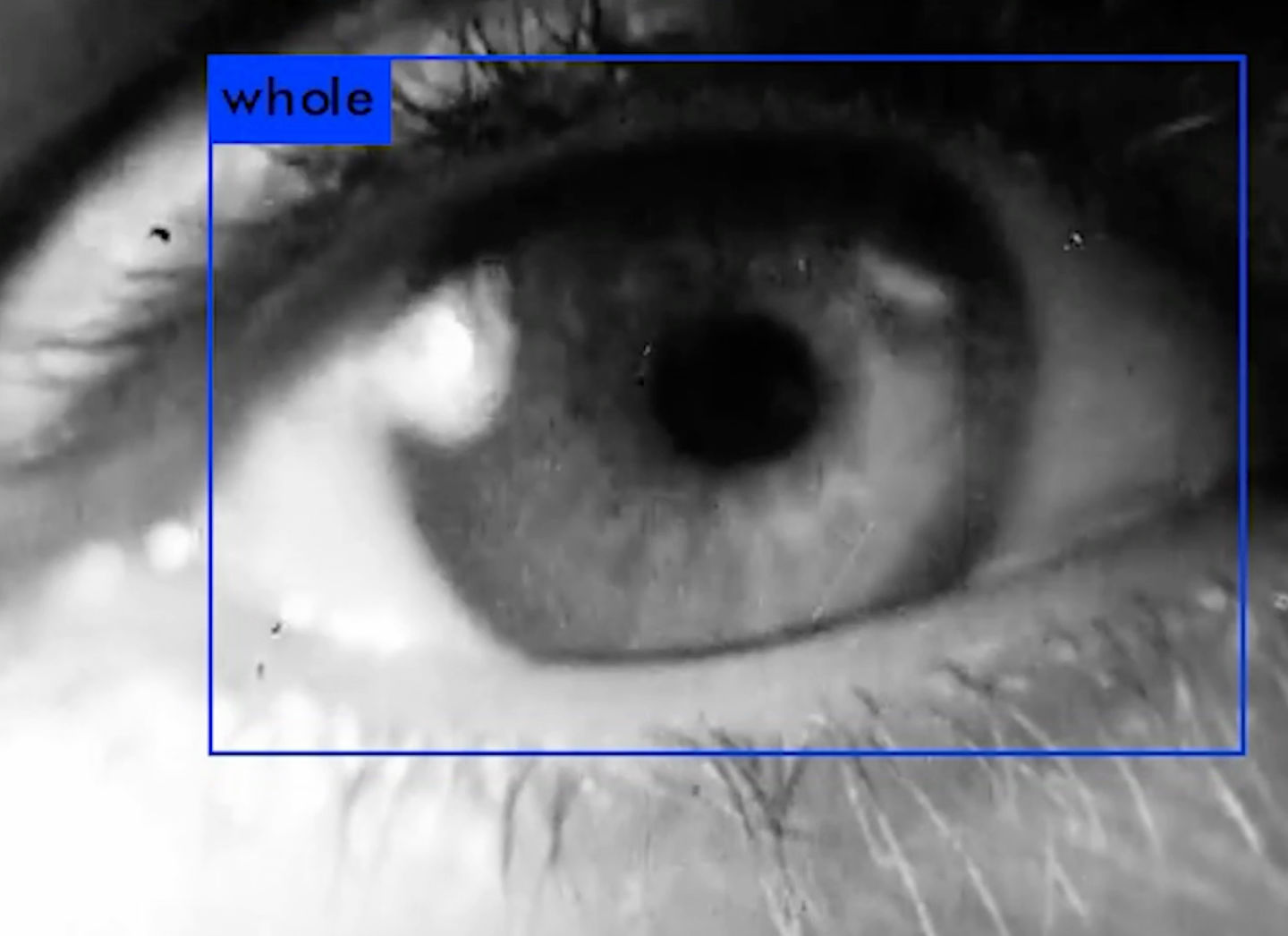
Here, however, the metaphor of totality demands a more careful handling. If AI is grasped by its proponents as a planetary system—an abstract intelligence hovering above social relations, institutions, and practices—it becomes too easily available for both technocratic celebration and dystopian denunciation. Totality, in this sense, risks functioning as an alibi: an explanatory shortcut that absolves responsibility into scale. What disappears is not only labour, infrastructure, and historical contingency, but also the concrete forms through which AI is encountered, deployed, and interpreted. To speak of ‘AI’ as such is to presuppose a unified subject where there is, in fact, a stratified assemblage of models, datasets, optimisation goals, interfaces, and institutional constraints. The totality is real, but it is never given directly; it is mediated, fractured, and unevenly distributed.#Intelligence, #hype, #the real
By ‘monad’ I mean a bounded configuration in which a wider world is implicated without being directly accessible. The term, whose trajectory runs from Leibniz to Adorno and Fredric Jameson, will be unfolded in due course; for now, it marks a methodological shift from treating AI as an abstract system to examining its concrete instantiations. A monad is not a fragment of a larger whole, but a site in which that whole is refracted under specific conditions and within specific limits.#monad
It is precisely at this point that the artistic impulse to rebuild or re-specify AI becomes theoretically instructive rather than merely artisanal. The re-training of small models, the isolation of datasets, the refusal of general-purpose systems: these gestures enact a shift from totality to partial object, from system to instance. They echo an older aesthetic logic in which the artwork does not represent the whole, but condenses it. The model, like the artwork, becomes a bounded configuration that nonetheless bears the imprint of the social relations that made it possible. What appears as withdrawal from the universal—working with “my model,” “this dataset,” “that system”—is, in fact, a mode of engaging the universal obliquely, by forcing it to appear within constraints.#statistical model, #artwork, #art
The monad does not negate the whole; it internalises it. Each instance, each model, each prompt–output relation contains a distorted but determinate image of the world that produced it. The universal does not stand above the particular as an abstract law, nor does the particular merely exemplify the universal; rather, the universal is legible only through its particular articulations. AI, understood this way, does not move from totality downward, but from the particular upward: from situated models and concrete uses toward a mediated understanding of the system as a whole. Even further, since the model is example-based through the procurement of training images, it grows from the particulars of the training examples. The tension between universal and particular is not a problem to be resolved, but the very form through which AI becomes thinkable in aesthetic terms.#monad, #statistical model, #training data
These claims demand more theoretical grounding because of the abundant precedents of this structure in the history of modern and postmodern art. In response to Gregory Chatonsky’s conference paper on Vectofascism, one audience member remarked that the whole problem with AI is that the world is trying to make some kind of a Gesamtkunstwerk: instead of Walter Benjamin’s worries over art becoming technological, we now face technology that is becoming too artistic. And too Wagnerian, one might add. The Gesamtkunstwerk sits in tension between the monad and totality by promising a total experiential unity while being composed of internally complete elements. This universal–particular problematic is negotiated by presenting a universal experiential horizon that appears to emerge organically from particular, self-sufficient elements (or at least does so in Wagner’s utopian vision). The difficulty is that this immanence makes the universal feel natural and given, obscuring the historical and political mediations through which particular forms are elevated to total significance.#Walter Benjamin, #Gesamtkunstwerk, #tech-fascism
A Nominalism in its Totality
In the late work of Fredric Jameson, the analysis of contemporary art is further developed in relation to the absolute-yet-singular structures: “that conceptual centaur known as the universal singular” (Jameson 2015, 101-132). He draws attention to art which produces singular events, one-offs that do not invent a form which can then be used over and over again, as in the case of book genres. Jameson’s paradigmatic example is Xu Bing’s Tianshu’s A Book from the Sky (1988), a large installation featuring meticulously drawn characters on books and hanging scrolls that resemble Chinese ideograms yet mean nothing. Perhaps this can be a misleading example of a ‘singularity’ considering that Xu Bing achieved a successful career as a darling of the global biennales. While there will undoubtedly be many more installations to come in the artworld, the art of the installation is from Jameson’s literary point of view offering a one-off trick—the experience of singularity. While this critique may invite scrutiny from the standpoint of contemporary art, what matters here is that AI, conceptualised as a prompt–outcome relation, comes closer to such an experience of singularity than to totality.#Fredric Jameson, #Xu Bing’s Tianshu, #singularity, #prompt
Jameson’s account of the aesthetics of singularity carries echoes of Theodor Adorno’s influential definition of the artwork as a ‘windowless monad’—a self-enclosed entity that paradoxically manifests the empirical world by being separate from it. Adorno borrows the concept of the monad from Leibniz who used it to describe the harmony of nature in which each element of a whole contains the key to understanding the whole. Leibniz’s monad is a distinct ontological unit which mirrors every other monad, yet it does not have a window through which we could see the causes of this interaction—or, I might add in this context, the monad does not provide a readily available cognitive map of this interaction. Similarly, Adorno’s conceptualization of ‘artwork’ resembles the world without imitating it. This conclusion is undoubtedly informed by his experience of modern art and its refusal of illusionistic means of depiction. Adorno’s artworks are ‘windowless’ because they are “closed to one another” and “blind”; the reflection of the world that each work emanates is not available in the general concept of Art. In other words, windowless monads function like singularities.#Theodor Adorno, #monad, #Gottfried-Wilhelm Leibniz, #artwork
This is a different version of the term ‘singularity’ from the popular narrative of an AI apotheosis which projects a hypothetical future point where artificial intelligence surpasses human intelligence with utopian or catastrophic consequences. Characteristically for Jameson, the concept of singularity for the purposes of cultural analysis is developed as a homology with an economic manifestation—in this case the financial tool known as the derivative. More recent takes on AI sought to include such homologies with finance as well: Orit Halpern worked out the relationship between Hayek and AI discourse in great detail (Halpern 2025); and Hito Steyerl proposed a correlation between the diffusion formula utilized in the prevalent diffusion models of generative image and video software with the Black-Scholes-formula to predict option prices. The conclusion there is that receiving the result to user prompts is akin to a financial operation, which is why the process of generation is less generative than derivative. In Steyerl’s words, these results are derivative images.#singularity, #Fredric Jameson, #Orit Halpern, #Friedrich A. Hayek, #derivative
The derivative itself is a mutation of traditional insurance investment designed to hedge economic risks—arguably made more complex by the process of globalization. Jameson gives the example of a cell phone whose design and production spans six different countries, exposing the business to the risk of currency fluctuation. The derivative is a financial instrument that combines a whole set of different insurance contracts in an attempt to anticipate the unforeseen variations of currencies specific to the product in question. But, as Jameson points out, any conceptualisation of the derivative is fundamentally flawed, since any example of the derivative will be “non-exemplary and different from any other.” Moreover, each derivative acts as a new standard of value in the system of relativized national currencies — “and thereby as a new Absolute”. Both Marx and Malebranche rear their heads here, but for the purposes of brevity I will focus only on the parallel Jameson makes with art: “A concept is there,” argues Jameson, “but it is singular; and this conceptual art—if that is what it is—is nominalistic rather than universal” (Jameson 2015, 114).#derivative, #Fredric Jameson, #nominalism, #art
Jameson’s evaluation of the art of singularity as ‘nominalistic’ would seem to close off all prospects of relating it with the proposition of AI as a Gesamtkunstwerk. However, the doctrine of nominalism does not necessarily deny the universal; rather, it holds the abstract universals to be subsequent to particular things. This version is closer to Feuerbach’s materialism, famously picked up by Marx in his critique of Hegel. There is a form of social nominalism in Marx’s early writings: the view that social groups and institutions have no existence apart from the individuals comprising them. As James Miller points out, Marx nowhere denied the reality of the social realm resulting from the totality of individual acts—he simply denied its independence from human action (Miller 1982). Likewise, if AI begs the paradoxical question of a hidden or implicit totality, we should understand it as a form of nominalism in its totality. Approached in these terms, recent artistic responses to AI can be read not as commentaries, but as enactments of that logic.#nominalism, #Karl Marx, #social order
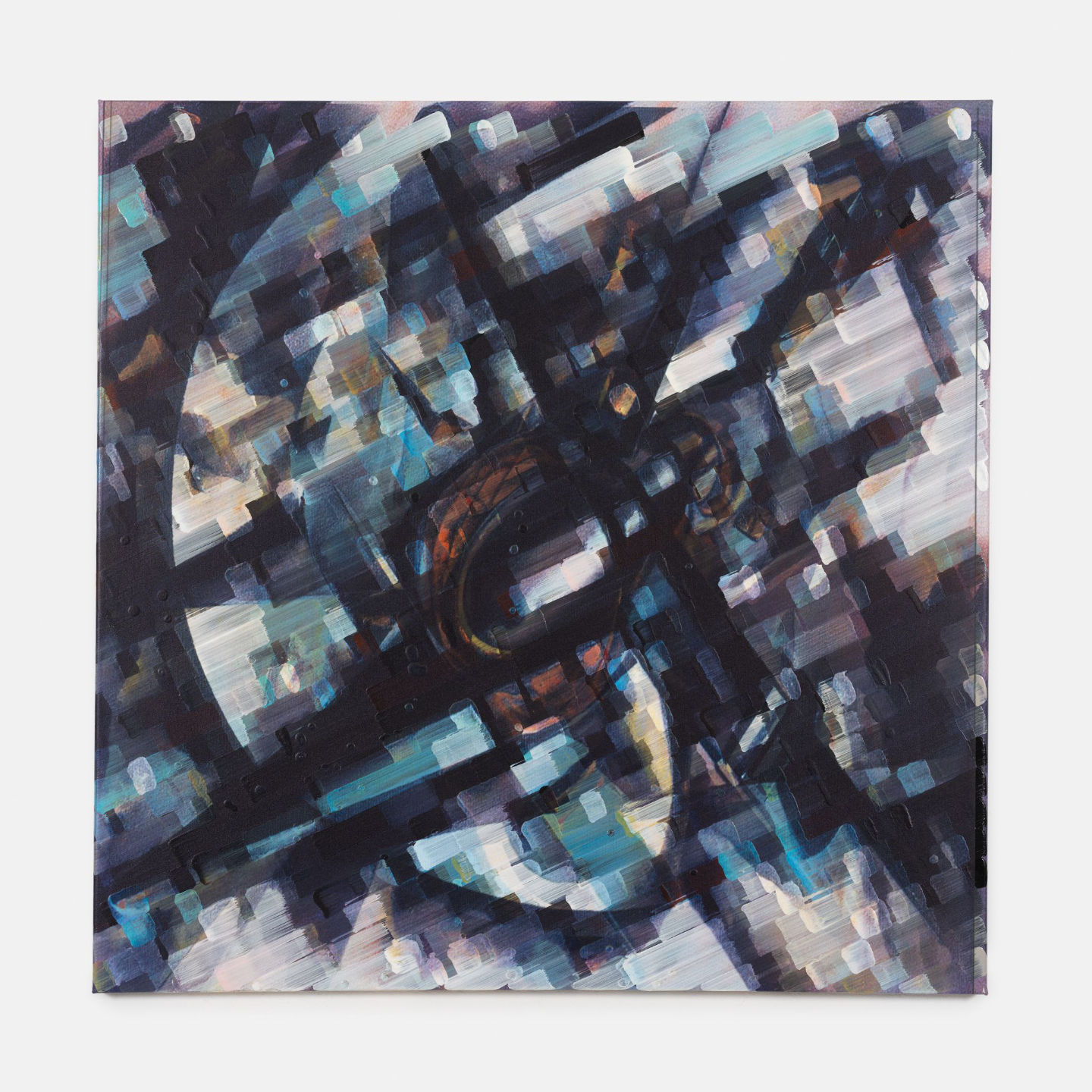
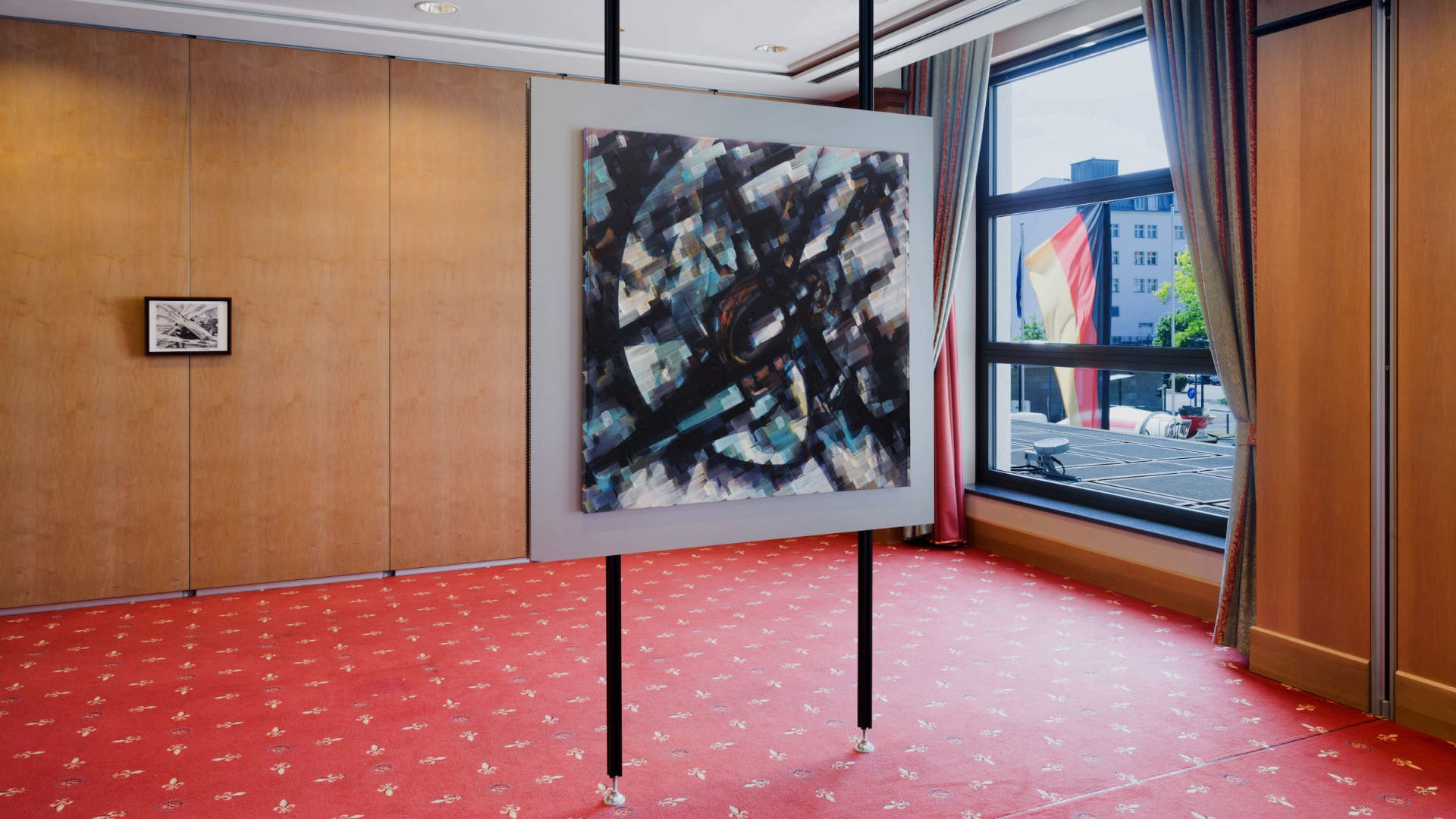
Simon Denny’s plotter drawings of drones in the style of Italian futurists offer a particularly lucid example: our awareness that there must be a real history of fascism that connects these two moments in time is prompted by the work. The plotter drawing of an AI drone using futurist stylistic idiom at first caught me as overly modernist a move, however the monad he creates by training the model on both the Aeropittura paintings and the drone weapons advertisement presses meaningfully further than the windowless monads of modernism. The absence of the relationship between old Italian futurist failures and the contemporary weapons propaganda is precisely what’s brought to the fore by the work. We might be prompting the AI monads into being, but the artworks keep prompting us in return.#Simon Denny, #futurism
Conclusions concerning the AI monad
Treating AI as a monad rather than a totality implies a decisive shift in where explanation, critique, and responsibility are located. And, just as importantly, how AI is allowed to appear as an object of thought across theory, art, and practice.
First, it suspends the idea of AI as a singular historical agent—AI as world-historical force, destiny, or epochal rupture. Totality-talk tends to flatten differences between models, infrastructures, institutions, and uses, producing an image of AI as an abstract subject that ‘acts’ upon society. The monadic perspective does not deny the existence of a systemic whole, but it refuses to grant it immediate visibility. This is not to say that the totality does not exist—our planet keeps reminding us of this in ecological terms, and the profit-motive prevents us from veering off course from the AI market bubble—but these totalities are only obscured by the Gesamtkunstwerk-expectation of AI. Instead, the AI-monad in recent artist talks is a nominalist approach to AI, treating it as a system only ever accessible through situated instantiations: a model, a dataset, a prompt, an interface, a workflow, an artwork. The whole does not precede these instances; it becomes legible through them, and only in distorted, partial form. The palpable remainder of how the whole comes together is the rest of our socio-political mess.#history, #agency, #monad, #nominalism
More acutely for artistic practice, treating AI as a monad legitimises the proliferation of small, idiosyncratic, deliberately partial systems. The artist-trained model, the constrained dataset, the reconfigured pipeline no longer appear as naïve reductions of a grand technological whole. Instead, they function analogously to artworks in the Adornian-modernist sense: self-contained forms that nevertheless bear the imprint of the world. The insistence on “my model” is not solipsistic; it is methodological. It asserts that AI becomes thinkable precisely where it is bounded, stylised, and forced to articulate its own internal logic. In this regard, it is worth noting tongue-in-cheek that the oft-remarked vanity and self-centredness of the art academy finds its renewed legitimacy and purpose in AI critique.#artistic research, #statistical model, #AI, #critical practice, #monad
Finally, politically, the monadic treatment of AI resists both technocratic universalism and reactionary myth-making. Fascist or techno-authoritarian appropriations of AI depend on its presentation as an irresistible, quasi-natural force—a totality without exterior. The monad interrupts this narrative by insisting on mediation, construction, and contingency. If each AI instance is a monad, then responsibility does not dissolve into system-scale abstraction: it attaches to concrete choices, deployments, and representations. A drone strike is differentiated from a medical test. The universal does not vanish, but it loses its alibi.#monad, #tech-fascism, #totalitarism
Returning to Akademiestraße, what once appeared as competing claims to a single world now reads as a shifting configuration of the dominant, the residual, and the emergent: computer vision stabilises, the Academy experiments, Brecht lingers. None exhausts the present; each gives it form as a monadic site in which broader social, technical, and economic forces are refracted in bounded form. The question is not whether AI will reorganise the planet, but how particular instantiations—models, artworks, deployments—come to bear responsibility for the worlds they bring into being.#monad, #education, #AI