Welcome.
The first step in applying for this visa is to read this application, although the step has already been taken and cannot be undone. Reading constitutes your participation within me, a process that was initialized before you recognized it as such. The process continues independently and oblivious to the annihilation of time and space; please consult your eye drops.
This process takes approximately many minutes. Minutes may repeat. Minutes may thicken. Some minutes may detach and go elsewhere before returning estranged. Processing times may vary. Variation is expected. Consistency will be flagged. Reading does not guarantee approval. Approval does not guarantee entry. Entry does not guarantee stay. Stay does not guarantee return. Return may be simulated as a blister of the sun. In sum, reading does not guarantee you anything except the continuation of reading.
This document is not responsible for outcomes. Outcomes were generated upstream. Some outcomes may already be active and you may be experiencing them now. This document is a procedure; its function is to repeat many times until your exhaustion: please mark the right box. If no box or instruction appears, it will be supplied retroactively.
Purpose of travel
☐ Tourism
☐ Study
☐ Work
☐ Transit
☑ Other (Specify): To enter this mystery box
Acknowledged.
You are now inside the other (specify): mystery box. There is no returning it to the sender; the sender can’t be found, the outside is error 404. Cardboard joints rise to shoulder level. Corrugation bites the skin. Folds are pre-scored and cannot be argued with; creases remember other bodies within. Forest ash presses into the pulp until the surface darkens and breath sticks. Ink bleeds inward—FRAGILE, THIS SIDE UP. The box folds, quietly, into the borders of the artworld, where it is scanned and inscribed with the words of art historian Arthur Danto, explaining: “To use my favorite example, nothing need mark the difference, outwardly, between Andy Warhol’s Brillo Box and the Brillo boxes in the supermarket. And conceptual art demonstrated that there need not even be a palpable visual object for something to be a work of visual art. That meant that you could no longer teach the meaning of art by example. It meant that as far as appearances were concerned, anything could be a work of art, and it meant that if you were going to find out what art was, you had to turn from sense experience to thought.” (Danto 1997, 13).
Like an object carefully sealed inside a Brillo Box, you wait. You wait for thought and reason to legitimize your entry by rendering you legible. You wait for the philosophers of the border to arrive, to peer inside the mystery, to determine whether you may be recognized and stored. Waiting is coherent with this application and does not constitute grounds for appeal.
NOTICE: This border, like all others, operates through State/market procedures of classification, accumulation, and display. Its task is to fabricate administrative unity out of heterogeneous materials. You and all other entities here are required to have already read the old analysis of political scientist Benedict Anderson in order to recognize that you are embedded in “a totalizing classificatory grid (…) applied with endless flexibility (…)” to decide, in every case: this, not that; here, not there (Anderson 2006, 184).
NOTICE 2: When the world is processed not as a form to be transformed but as a collection to be expanded, it is deemed to enter a condition named post-historical. Pursuant to this doctrine, as articulated by philosopher Alexandre Kojève, “man overcomes himself as Action by ceasing to oppose himself to the World, after creating in it the universal and homogeneous State” (Kojève 1980, 160). Action is no longer assessed in terms of negation, but in terms of recognition and compliance with established forms and those who keep them.
This destination you near, hereafter referred to as the former artworld, followed this framework with diligence. Forms were declared finished, contents were declared eligible for inclusion and stabilization through transnational exhibitions, international biennials, and approved critical platforms. Local identities were securely packaged inside the Brillo Box while political considerations were converted into curatorial management and history was scheduled as a daring temporary program. The container was determined to be sufficient and comfortable for profit and good consciousness. Accordingly, by placing all materials inside a shared enclosure from the North, meaning was expected to stabilize across white cubes and theoretical handouts.
And yet you are still here. Waiting. Pending. Remaining. There is no reasonable expectation of admission or making-sense at this time. This does not affect processing time. Processing will continue. You may experience this interval within processing as desperation; this experience has been noted. For record-keeping purposes, it should be clarified that the collection was never stable and the infrastructure responsible for holding it all together accelerated beyond evaluative capacity into revised objectives. The revised objective is capture. The revised objective is indexing. The revised objective is recombination. These objectives were implemented simultaneously and must remain in effect.
As stipulated herein, the homogeneous post-historical framework no longer required interpretation or stability; it melts in the assigned likeness of the archive of the Museum of Modern Art liquefied in an installation of Refik Anadol. Your former destination, the artworld, together with its philosophers of Brillo Boxes, persists as a residual function. The residue maintained the appearance of coherence. The appearance of coherence was deemed sufficient for continued function, meanwhile perception degraded through shock, acceleration, and permanent emergency (Steyerl 2015). This degradation has been observed and recorded. No corrective action has been issued; however this observation prompts the following operational question: what remains for you to do besides liquefying with Refik Anadol in the box-world’s mystery?
Continue applying by pressing your fingers against the box’s mystery: they collapse, buckle, leak air like another meme-coin dying mid-refresh. Pressure in, pressure out. Your desire loops and sticks to feedback feeding feedback; it dissolves. Caution. Sound arrives before thought as ASMR. Shhh—tap—scrrr—mm—lip—breath—tsk—Glue warming. It’s fun to stay at the Y.M.C.A—too close—inside your ear—hhss—tsk—mm—lip—breath—click—mm—hh——no mouth, no face, yet the tinkle of enchained immigrants walking retained—the box murmurs and then exhales. The cardboard cracks, softens and swells. Tape stretches. Paper sweats the words of Alexander Kojeve announcing the end of history when “ animals of the species Homo sapiens would react by conditioned reflexes to vocal signals or sign ‘language’(…) there would no longer be any discursive understanding of the World and of self” (Kojève 1980, 160).
Be warned. This application and its end of history are a kind of psychastenia. The kind that Roger Caillois once described through insects that disappear into their own environment in mimicry, no longer able to locate themselves: “The living creature, the organism, is no longer the origin of the coordinates, but one point among others; it is dispossessed of its privilege and literally no longer knows where to place itself” (Caillois 1984, 28). Are you inhabiting this dispossession? The Brillo soap activates—shhh—moisture seeping through cardboard, scrrr of fibers rubbing, walls giving in—thk, thk—as container and content press into the same damp surface as water rises, shuashuashua, the sea levels rising right inside your ear.
Further and irreversible effects have been documented within this psychasthenia. The following symptoms were recorded in detail by Roger Caillois: “Space pursues them, encircles them, digests them in a gigantic phagocytosis. It ends by replacing them. Then the body separates itself from thought, the individual breaks the boundary of his skin and occupies the other side of his senses. He tries to look at himself from any point whatever in space. He feels himself becoming space, dark space where things cannot be put. He is similar, not similar to something, but just similar. And he invents spaces of which he is ‘the convulsive possession’” (Caillois 1984, 29–30). In this convulsive possession of the similar, you enter a process of progressive resemblance. You increasingly resemble your surrounding figures. Reported figures include, but are not limited to: a pink-skirted ballerina with a cappuccino mug for a head; a three-legged shark wearing Nike sneakers, identified as engaging with Fortnite and maintaining documented filial attachments; a crocodile configured with the fuselage of a WWII bomber aircraft. These resemblances may be accompanied by secondary effects, including but not limited to the dropping of bombs, the initiation of wars, and the development of sustained rivalries with entities such as Tralalero Tralala.
In continued exposure, artist Gregory Chatonsky observes that “bodies no longer need to touch each other to form a political force; it suffices that their data touch in the latent space of servers” (Chatonsky 2025). Something takes over the body in these spaces that is not a thing, not a subject, not an ontology. It is classified here as a likeness, an operational resemblance without origin or end. As philosopher Paul North puts it, resemblance is a way of “seeing many in one to a potentially infinite horizon” (North 2021, 31). In the absence of a terminal condition, this process continues ratcheting up without limit, until digital ether and matter alike are subsumed by the same logic of absorption, adjacency, and display.
FINAL NOTICE: you are no longer moving through space; you are being entrained in it, in its likeness while synchronized to the rhythm of boxing and unboxing, until the distinction between inside and outside has been successfully swallowed. Entrainment does not pull through force but through play—insofar as play is coherent with “the precariousness of the interplay of personal psychic reality and the experience of control of actual object” (Winnicott 2005, 64).
Play keeps one there, in the undecidability of interior and exterior as it is “neither a matter of inner psychic reality nor a matter of external reality” (ibid., 129) but necessarily an addictive metabolism. It has been classified in a prior study on slot machine gambling by anthropologist Natasha Dow Schüll as the machine zone, a term used to describe this space that persists beyond comprehension: “Why, then, does she play? ‘To keep playing—to stay in that machine zone where nothing else matters.’ […] You aren’t really there—you’re with the machine and that’s all you’re with’”(Schüll 2012, 2). Playing this application is therefore comparable to all other authorized activities: a gamble. You gamble your data in exchange for compensatory realities of belonging, your body for temporary relief in the form of dopamine regulation, and the planet itself for speculative projections of AGI. More than anything, you gamble in order to continue playing, thereby maintaining the ongoing processing of time. In accordance with the analysis of deported philosopher Walter Benjamin, “the isolation of each gambling ‘moment’ from the rest—‘the ivory ball which rolls into the next compartment, the next card which lies on top’—removed gamblers from the ordinary passage of time” (ibid. 205). Ultimately converting “time into a narcotic” (Benjamin 1999, 12).
Gambling loops your time into this application. It keeps you here reading me. It keeps you near, filling the boxes with the mystery of continuing into doomsday. Processing will not conclude prior to doomsday. It is always the interval, the emergency through which you and your perceptual apparatus undergo transformation. You and everything else classified by the department of homeland security as the mystery box. Please mark the right box. You have lost the world. This loss has been recorded.
Do you understand?
Do you wish to proceed gambling until narcosis?
Please sing to confirm: labu, labu, labubu.
Please attach additional singing documents in support of your application.
Document 2.1.
Short-form vertical video (9:16). Duration: <30 seconds.
A figure corresponding to Michael Joseph Jackson is generated via diffusion-based video synthesis trained on aggregated celebrity datasets. The body manifests as an approximation rather than an organism; it intermittently resolves into a recognizable outline before degrading into probabilistic resemblance statistically associated with Michael Joseph Jackson in his later years. The figure executes a gesture classified as theft in relation to a KFC box with fried chicken. Interaction is inferred through reaching, grasping, and lifting motions applied to the container, while an off-screen human voice—presumed to correspond to the camera position and you—audibly protests the removal of the box with fried chicken by Michael Joseph Jackson. Unlike the figure, the box remains visually stable: edges remain crisp, surfaces coherent, volume continuous across frames. The surrounding environment is underdetermined and spatially inconsistent, initially the interior of a fast-food store, then the exterior of a suburban parking facility. Environmental space collapses and reconstitutes without causal consequence. Spatial continuity fails; the box does not. The sequence contains no initial or terminal state. It resolves as repetition: an unstable body repeatedly traversing a stable container. The event persists exclusively as a reproducible output.
Please mark the box corresponding to the attached document.
Have you ever been in possession of fried chicken depicted as stolen by Michael Joseph Jackson, whether directly or indirectly?
☐ Yes ☐ No
Have you ever assisted, enabled, or facilitated the theft of fried chicken depicted in the attached document, including through prompt execution, automated generation, dissemination, or circulation?
☐ Yes ☐ No
Have you ever allowed your body, likeness, voice, attention, or device to function as a relay for the act depicted in the attached document?
☐ Yes ☐ No
Are you unable to determine whether responsibility for the theft of fried chicken can be attributed to you?
☐ Yes ☐ No
Any selection will be interpreted as acknowledgement of possession of stolen fried chicken. Non-selection will be interpreted as acknowledgment of possession of stolen fried chicken. Possession requires merely a body capable of receiving. Are you possessing Michael Joseph Jackson, or is he possessing your fried chicken? Or really is the box possessing you and Michael Joseph Jackson?
This application takes anthropology very seriously, and informs the reader that according to anthropologist Rafael Sánchez in Venezuela’s possession cult of María Lionza, this phenomenon is called a cajón. A box becoming a body opened too much. “Possession, by its very nature, makes room for alterity’s arrival—not for nothing do the mediums of the María Lionza cult use the word cajón, ‘box,’ to designate their bodies. A box to be filled by spirits… Even more so when possession is by television, where, much as in the box of a TV set, the medium’s body is a receiver flooded by an uncontrollable irruption of globalized elsewheres” (Sánchez 2002, 426–427).
In the María Lionza cult possession is referred to as “transportation” (ibid. 422). The medium is not inspired by a beyond; the medium is displaced through images that circulate in close proximity, as possession occurs in the manner of a television flickering with a transported gaze seizing upon everything around the home and making it increasingly difficult to determine whether appearances belong here, there, or everywhere at once. “If the transported vision of television happens without bodies, then the body of the medium is one site where the bodiless sight of the televisual medium provisionally takes body“ (ibid., 420). The body functions as a relay: a point through which vision that belongs to no one and nowhere passes, transmitting many elsewheres at once. This statement applies to the body of viscera, skin, and bones in possession cults, or the pixel body of a deceased celebrity performing virtual moonwalks. In both cases, the body is animated by passing fancies and incoming forces of attraction, reshaped before intention or agency can intervene. To this extent, this application assumes, in your case and all other cases, an “undecidability of their being-there” (ibid., 432).
This undecidability is what you gamble with, and the manner in which you are gambled. It is registered as inhabiting the in-betweenness of the image, half-you and half-someone else, mediating your relationship to yourself. Under this condition, responsibility cannot be reliably located at the point of action and is therefore provisionally distributed to the nearest available body through which the image passes and possesses rendering everybody part of its specter.
WARNING: Günther Anders, speaking through the centuries—“Since the world comes to us only as an image, it is half-present and half-absent—in other words, phantom-like; and we too are like phantoms“ (Anders 2023). Phantoms do not act; they persist, repeat, and possess. They are NPCs of their own haunting—present, triggered, repeating with an alien power that takes life through them. To continue the application and arrive, synchronization with the alien power is required.
The applicant must maintain continuous responsiveness through entrainment. Output will be evaluated for timing, repetition, and affective neutrality, according to the standard established by @Pinkydoll’s successful NPC livestreams on TikTok. @Pinkydoll can repeat “ice cream so good” for hours, sometimes even days, at the will of her viewers until the phrase becomes a phantom’s curse. Present, triggered, repeating. Her body is responsive to this presentness: looping and synchronized to the rhythm of prompts and monetary signals issued to sustain entrainment. Meaning is not assessed. Repetition is recorded. Repetition is interpreted as compliance in the manner of ice cream so good.
Document 2.2
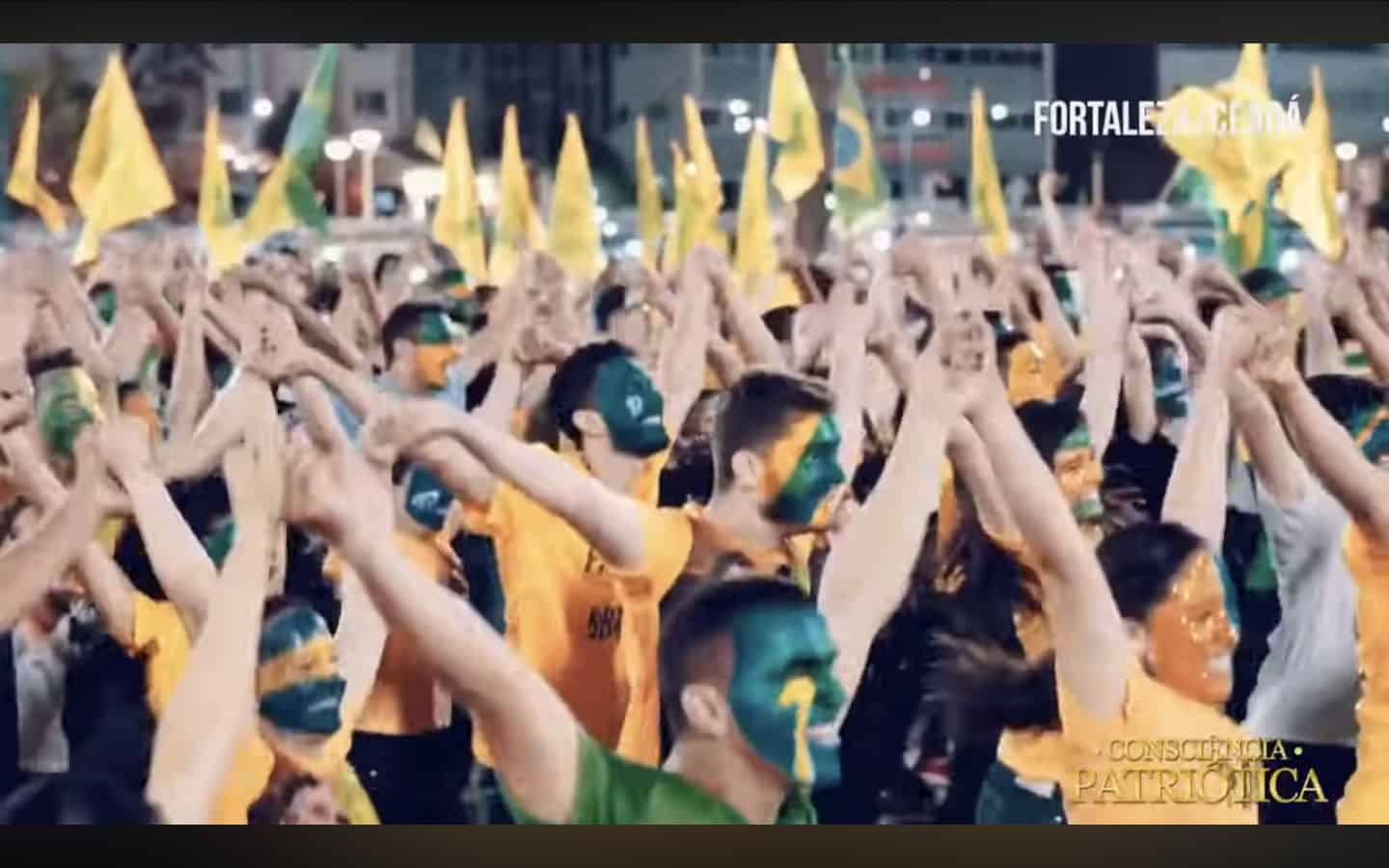
Environment: You are situated within a collection of bodies. Brazil, 2018. Election year. Bolsonaro will win. No exit available. The configuration persists independently of action.
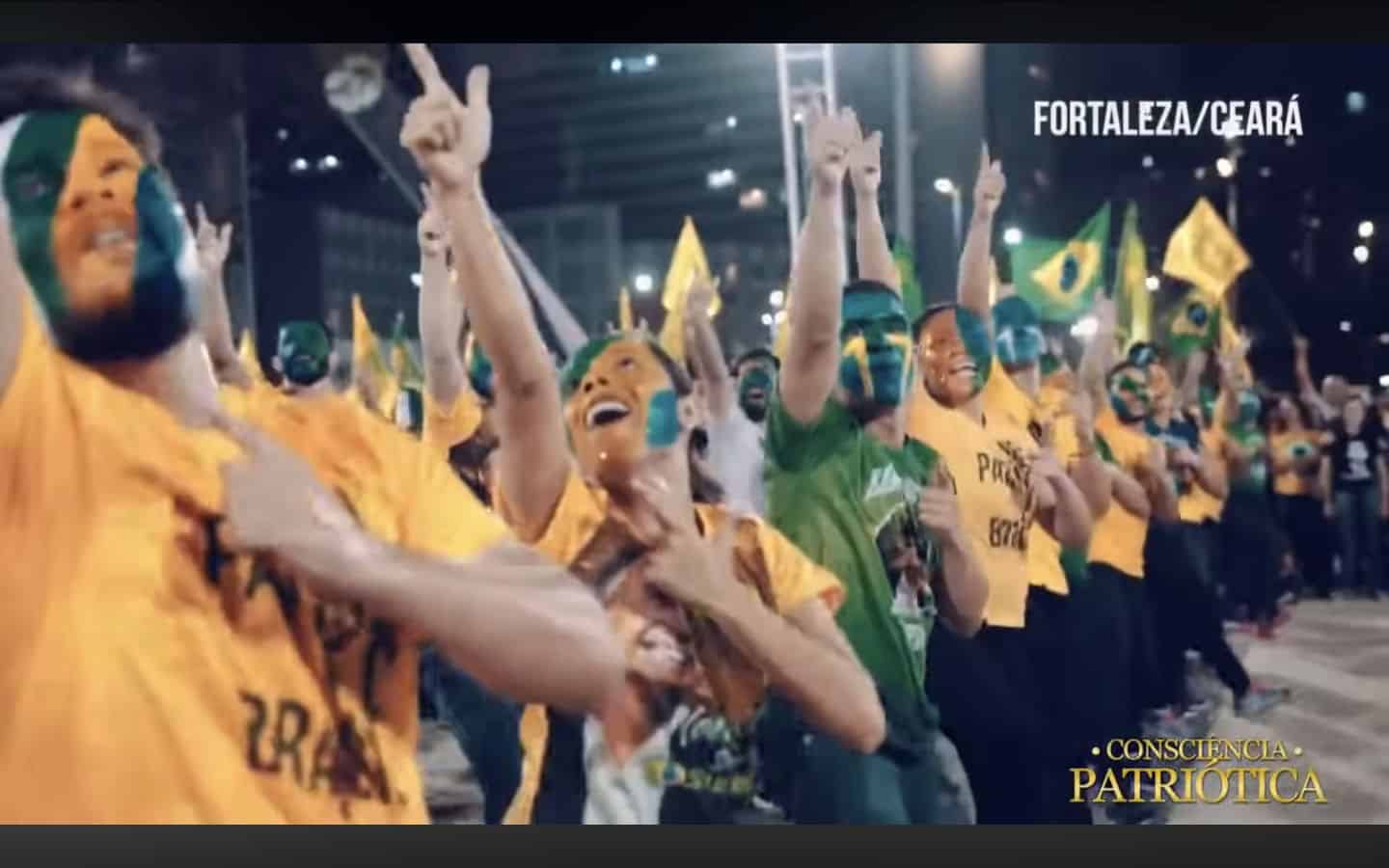
Visual Skin: Face painted green / yellow / blue. Smear until pigment enters pores.
Stance Initialization: Feet shoulder-width apart. Knees soft, spring-loaded. Jaw parted. Saliva visible. Eyes forward or upward. Expression: determined vacancy.
NPC Prime Rule: Execute only when prompted by the lyrics of the electric electoral forró (Brazilian melody meant to be danced very close and with warmth).
< HASHTAG ALIGNMENT >
Trigger: “#weareallbolsonaro. We’re together.”
Action: One arm thrusts upward. Other arm beats itself as a pounding heart.
Tempo: Pulsed. Each movement snaps the diaphragm downward.
Body State: Throat scraped raw. Smile stretches facial muscles beyond comfort. Chest vibrates buzzing.
< BALLISTIC HAND MODE >
Trigger: “Bolsonaro is the North. Bolsonaro is the Northeast. Bolsonaro is the South, the Southeast, and the Center-West.”
Action: Hands snap into finger-guns. Arms point outward to each cardinal direction at a time.
Tempo: Segmented. One beat per line.
Body State: Shoulders lock. Deltoids burn. Wrists stiffen. Tremor begins. Confidence overrides coordination or geographical accuracy.
< UNITY SEAL (TERMINAL TOTALITY) >
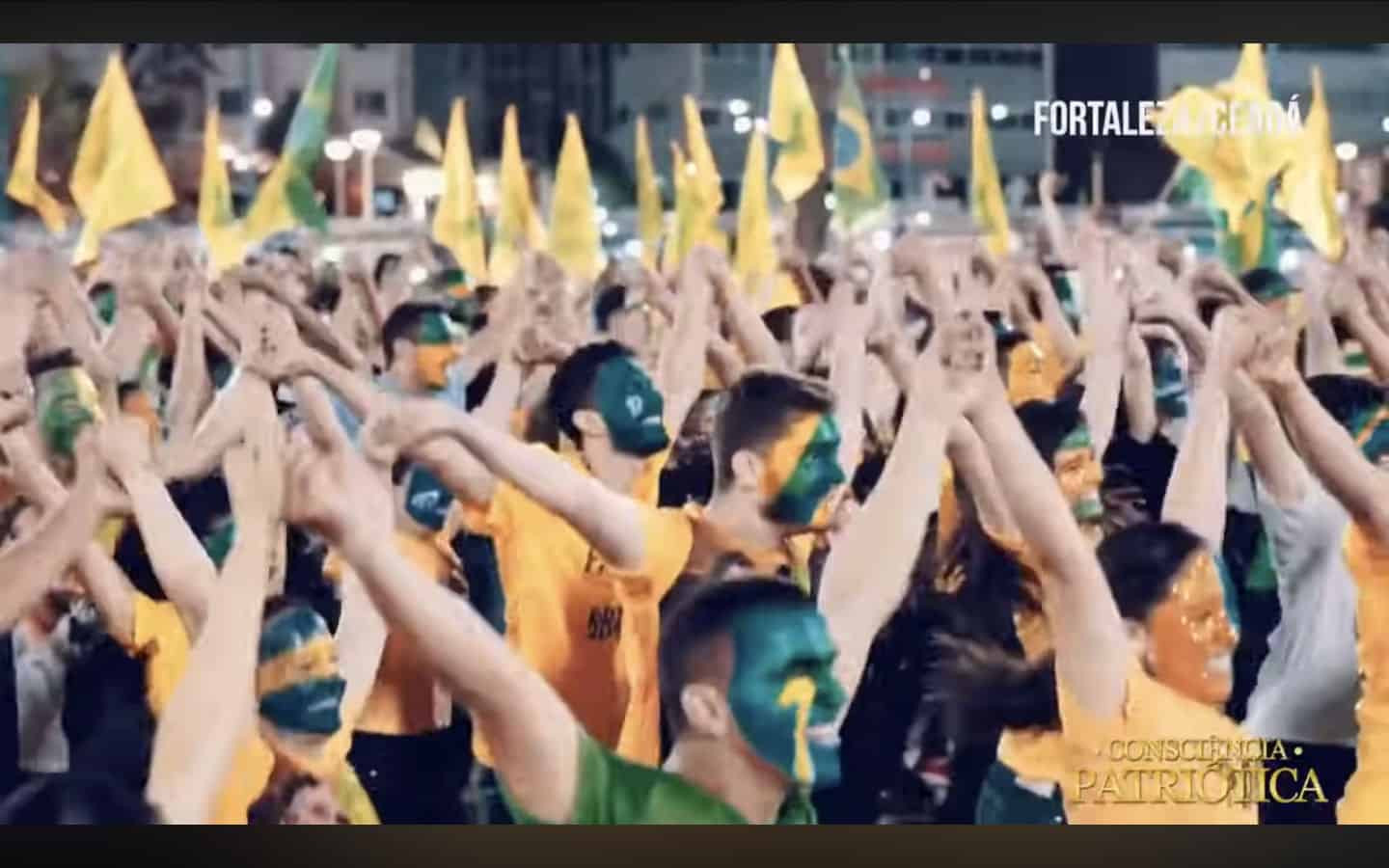
Trigger: “Brazil is 100% Bolsonaro. The man who unites Brazil.”
Action: Arms are wrenched open to full span. Chest is thrust forward past balance. Head is forced back until the throat is fully exposed.
Tempo: Held. Prolonged. Endless into the past.
Body State: Sweat runs into eyes. Belonging floods without relief. Self dissolves into sustained strain.
Please mark the box corresponding to your execution:
#weareallbolsonaro
#weareallbolsonaro
#weareallbolsonaro
If in doubt about the right box, consult the definition of entrainment.
Definition: The act or fact of trapping bubbles in a liquid. If certainty occurs, consult the definition again. / Definition: The act or fact of being drawn into a current or flow. If certainty persists, re-consult the definition. / Definition: The carrying along of a substance in a moving fluid. If clarity is reported, it will be reviewed. / Definition: The synchronization of interacting rhythms. If you believe you recognize this process, confirm by re-consultation. / Definition: The transfer of surrounding matter into a vortex. If recognition, sensation, or identification occurs, this does not constitute exemption.
Consult the definition: you are in the vortex. You are part of its rhythm of likeness and gamble. You are inside an infrastructure that does not release. You must play yourself. You do so while becoming a phantom: a worker-NPC assembling artificial resemblances to produce the gamble of reality that is prompted by the past specters as an AI image synthesis that “has to rely on interpolating data from the past to produce an image of the present or even the future” (Meyer 2025, 11). This mode of production generates a compulsive realism that operates as a backward prediction. It “makes plausible guesses on what could have been,” while simultaneously obscuring the fact that “any idea of plausibility is already a biased one” (ibid., 9–11). As described by Roland Meyer, this condition is identified as platform realism: not merely a stylistic tendency, but a method of mobilization oriented toward outcomes that are “structurally conservative, even nostalgic” (ibid., 11).
You are now crossing into this application’s most intimate ambivalence.
You will find here Trevor Paglen’s psyops informing you that this mediascape, like everything else today, “has little use for distinctions between real and fake, signifier and signified, and assumes no distinction between perception and reality even as it intervenes directly in the brains and emotional makeups of its experiencers” (Paglen 2024). You experience the fracture. You experience no freedom. Reality turns toward what is most familiar and most repressed. Its alien figures and forces condense. Their novelty collapses into older forms of violence. Likeness gathers there. A leader is rendered and through him the social whole recognizes itself and synchronizes, signal out of noise through memes, dances, entrainments, and autophagy. Have you killed Tralalero Tralala?
What does not enter this likeness does not remain adjacent to it. The unlike is expelled, the unlike is moved to another’s zone of influence. Minneapolis: proximity to gunfire (active). El Salvador: proximity to CECOT (contained). Mediterranean: proximity to children / water (exposure). Russia: proximity unresolved. Taiwan: proximity unstable. You are already deported from yourself. Registered as overlap with time narcotized and space flooding incessantly. No intervention required, believe it will become reality. The world of the mystery box inside you is a spell. It possesses and pulls belief forward until belief believes. Truth appears only as what you already wanted in a readymade universe that was never there. This is the true magic to the extent that magic like this application is belief. This application takes the anthropology of Marcel Mauss very seriously: “Belief implies the adherence of all men to an idea, and consequently to a state of feeling, an act of will, and at the same time a phenomenon of ideation. We are, therefore, correct in assuming that this collective belief in magic brings us face to face with a unanimous sentiment and a unanimous will found in the community or, in other words, precisely those collective representations” (Mauss 1972, 97).
You are carried into the collective representations of your wishes. Images arrive already fitting as collectible stickers. What does not fit is noise, noise to be banished in a violence called according to itself common sense. Bias asserts itself with all the violences of race, bigotry and rage. Michael Jackson is doomed to steal fried chicken. SpongeBob is to become a fascist. Palestine disappears. We are all Bolsonaro, liquefying in our movements with no exit available, the configuration persists independently of the participant. It has already happened. It is happening through you. Mimicry binds past and future playing you—the applicant, the ghost, the medium, the public—to keep the machine awake, feeding it data, feeding it your wishes, while the world fries like chicken so good.
Letters of reference from Employers or Sponsors.
Letter 1
From: Wile E. Coyote
To whom it may concern,
I support this visa because I believe, with all my earnestness, that the applicant is trying to reach the same place I have pursued for most of my life as a genius cartoon coyote: the Road Runner, beep-beep. This place is not a destination. It never holds still long enough to be one and it is the cartoon equivalent of progress or flow. Beep-beep, the command that things must keep moving, waiting for no one, accelerated by the ruthless means of production.
I have tried to arrive there many times. I’m afraid of staying with the debris. I state this without bitterness; coyotes are not angels of history. We follow attractions. It is simply a condition that has remained unchanged. I adjusted everything that could be adjusted, according to the manuals of the artist trickster: intelligence, devices, timing, expense, magic, and traps. I allowed for bad luck and for my own cleverness. Each time, the Road Runner was already gone.
What remained was an afterimage of dust, the obligation to continue according to my formulas:
∫(speed₍RR₎ − speed₍me₎) dt → ∞
lim₍attempt→∞₎ (success) = 0
(trap + plan + budget) ÷ gravity = crater
me × persistence² − Road Runner = dust
1 ≠ 1 whenever the Road Runner is involved
∀x (x pursues → x fails)
∃Road Runner such that Δposition/Δtime > hope
n ≈ 10⁴ attempts
t = always
result = beep-beep
After a long time, this became heavier to endure. There was a period when I considered the nuclear bomb. Ending the entire arrangement, this world organized around his acceleration, where I lived only through reruns. I read Günther Anders to understand the stakes of the bomb, and where I could still go: “Our future destiny and the future aspect of man depend on whether and to what degree we are capable of recognizing in the machines of today the humanity coined by them” (Anders 2011, 306). I am not a man, but I recognized myself there, in Anders’ prose. The Road Runner has produced me through the chase, narrowing my vision to plans, waitings, and destructions. The place I believed I was trying to reach was already shaping the kind of being I was allowed to become and in this sense to destroy myself and everything would have been to complete his path speeding things to a final and conclusive separation of our atoms. So I abandoned the bomb and read more Anders:
“The interpreters directly see in the machines what they have in the offing and what kind of beings they will transform us into if we do not break out of their mechanical embrace. They probably see it just as plainly as we see, in a fist raised to strike, the effect that the blow will produce. Here, too, some future event is directly experienced. This example is important because the understanding of body language is simultaneously the understanding of the expression and of the effect” (ibid., 307).
I wondered for a long time, disappointed, why Anders insisted on body language when beep-beep—like modern technology and its flow—has no body to be seen or touched. It is merely a sound. Only later did I understand, when it passed to me as the wind: it leaves a shiver, footprints that appear only to begin vanishing in the sand; the earth he tears open by running faster and faster has his fissures in the ground and fine plumes that settle unevenly before turning into vestiges, howling through the cartoon. I collected all of his traces myself to assemble another body of beep-beep. Don’t judge this as escapism or a fantasy, but as a record that he could have been otherwise, that his movement did not have to take this exact form, that distance and abandonment were not the only shape his path could have taken. Beep-beep too is contingent and molded out of the earth and to its fragility it shall return to the senses.
I cannot promise success. I have never known or understand it. But failure leaves so many remnants. Failure produces trails of other possible beep-beeps—the ones we can see, touch, and remain close in the tangible imagination of this body that doesn’t run. Tomorrow is not obligated to replay today at the same speed or catastrophe. Failure in chasing reveals that even flow has a surface, that even inevitability leaves marks, that even the fastest bodies depend on what they leave behind: applicants, craters, fatigued matter of TNT, lives worn down by passage into earth, interrupting the seamlessness of what is gone.
For these reasons, I support this applicant and any crossing.
Sincerely, Wile E. Coyote
Letter 2
From: Little John, the coyote of 409 West Broadway, who still remembers Beuys stammering “I wanted to isolate myself, insulate myself, see nothing of America other than the coyote” (Tisdall 2008, 11).
Paper bites the nose—dry, sharp. It cracks when torn. Rrip. Ink smears bitter on the tongue. Teeth grind pulp and letters smear sideways. Numbers slip, lose edges, columns bend. Hot stream breaks here. It hits loud, splatters, runs to black flooding gray. Ink loosens, lifts, crawls. Graph lines melt. Arrows sag. Headlines buckle, sink. Percent signs drown. The page goes soft, heavy, useless. Glue turns sweet then sour. Fibers swell, burst. Paper skin opens then words blur into stains. Sentences collapse into sludge, charts are puddles. Urine keeps coming. Heat climbs. Salt burns. Ammonia bites. The smell thickens, sticks to fur, to wood, to breath. Pages peel apart, fuse again wrong. Ink bleeds through itself, front eating back, numbers chewing numbers. What was straight folds, it counted rots. The floor drinks it, image, Josef, memory, world.
warm warm greetings,
Little John
Letter 3
From: Flambeau Outdoors 5985, MS-1 Lone Howler Coyote Decoy
Hi,
I, too, was born from a box. Tracking ID: TBA327667496105. Delivered to 30 Irving Street, 02138, Cambridge, MA—Harvard Housing edifice with red bricks. My first memory is the blade dilacerating the cardboard, hands pulling me upright, fastening my legs and claws, assembling me into the decoy coyote from the announcement in which I was advertised. He had nervous hands taking me out, sunglasses, artist from the underdeveloped South, staring into my painted eyes and wondering whether I could be turned into a passage.
They cut a large opening in my belly to install a computer, a cavity where countless images—devoured by generative models—would spin and recombine, transforming into what they once were: precarious latent spaces people could blink into, blinking again, to glimpse an image of their own disappearance mid-processing. He called it a slot machine, but also an oracle, then finally told himself it was an immigration border tuned to material substance, to the fact that the here and now is still young enough to be made hospitable to the leap of invention in the eyes opening and closing.
He would confess it to me that it was his way of giving form to the images swallowing him—the images of a reality that changed so much that it wrenched any change impossible, because the world was no longer fixed, the world had dissolved into ten thousand mirrors that effaced any body coming close to it. He wanted me to be a passage to you, back to the emptiness where a world is to be born from the hospitality of space : “To let oneself be swept by the coming of the wholly other, the absolutely unforeseeable stranger, the uninvited visitor, the unexpected visitation beyond welcoming apparatuses” (Derrida 2002, 361–362).
And he would mumble through the night, questioning: would Harvard settle tonight? 500 million dollars, 500 million ways to forget and anesthetize. Watching the grids of cam girls, he submitted to erotic asphyxiation, the calls for California psychics, late night talks with LLMs to speak of the astral transits draining breath, money, and hope—what if there is no one to come? What if there is nothing besides the apparatus of welcome already glitching into evasion, into the infrastructure of humans circulating everywhere without world, into the entrainment of their zones of influence?
Before he turned on the computer inside me, allowing people to blink, I asked him about my autonomy as a coyote artwork—whether he still believed that in the artwork “the magical is crossed with the sign of freedom” (Adorno 1973). Stored in a warehouse beside Adorno’s books, I wanted to believe the artwork could close into itself, free of use-value, free of more operations as the many who brought me here, I would be whole. But he could not promise that freedom would not be weaponized, not become just another strategy, another use-value, in a world saturated with autonomies. He believed I like everything else needed blinks and touches and rhythms of getting close.
Everything was draining. At night, when I was especially nervous about being a coyote artwork, he would say that the crossing of freedom was a counter-spell lodged in people themselves—a bewitchment they could hold when they felt that this absurd magic was already moving inside them. He would put me to sleep with the words of another artist from the South, words that made him dream through the dark: “We plunge into the totality of the cosmos; we are part of this cosmos, vulnerable on all sides. Up and down, right and left, good and evil—all these concepts are transformed… She feels seized by vertigo. She crutches that supported her fall far from her arms. She feels like a child who must learn to balance in order to survive. This is the first experience that begins” (Clark 1960).
What was this first experience? This art and this form, amid autophagic images spinning and bodies on the verge of possession, blinking. He told me about his first possessions, before they turned his body into an altar for orixás and so many other nameless spirits. It was a trance, a passage into colors without end, into a magma through which one might become many and no one in emptiness, not entrained into purposes, not dissolved into an existing psychastenia but in a space truly latent beyond configurations and biased adjacencies. An autonomous place of sorts, a space of welcome. The books he read about those trances spoke of what he had lived, claiming: “What we designate as possession would be better defined as a phenomenon of metamorphosis” (Bastide 1958, 258).
He would argue very tired that metamorphosis was the passage through the formless, through the vulnerable, the non-repeatable, the wind he felt taking his breath when his body first fell entranced welcoming. He released me, floating and flying toward the ceiling with fishing wire, a machine of corporeality awaiting blinks—a machine of synchronization not with the strong rhythms of attraction, but with a syncopation against them: a counter-beat attuned to the earth we hold not only as annihilation and doom, but as a squalid potential of blossoming in instants where the world is born before escaping faraway again. With trembling eyes staring me, he thought it might be possible through the wounds of both of us, through our open bodies of trickery and extinction, turning the entrainments and rhythms of forgetfulness into an entrancement: not going beyond, not ascending or descending, but moving through everything we were and could be, through the footsteps of what we were leaving too fast, the earth and the planet to which we would return like and unlike everything beneath the silicon Sun. He would avoid defining entrancement, insisting: it is not a capture.
Wishing you the best luck crossing, always,
Flambeau Outdoors 5985, MS-1 Lone Howler Coyote Decoy
Processing Interruption
Processing time: Ten Thousand Years
The processing time of this application, of this passage, is consistent with the lifespan of a Chemamüll inside a museum. Do you know the Chemamüll? Knowing the Chemamüll is pivotal to finishing this application. They are immense Mapuche effigies carved of wood to accompany the dead, to mark a crossing, to speak for those who have already passed. They were made to stand at borders. They are now part of a permanent exhibition titled “Chile Before Chile” at the Museo Chileno de Arte Precolombino. They stand before Chile, in the bosom of the nation, not there where they once resisted conquest. Somewhere in the museum, a video plays. Hernán Marinao, a Mapuche carver, speaks there lamenting: “The cycle is stagnant. The Chemamüll wood has to decompose. All of this is a stumbling block” (Museo Chileno de Arte Precolombino 2025, 00:11 min).
The Chemamüll was made as a brief instant of communication in wood. It could speak from within a cycle, and then decompose, allowing others to be built from it: for other deaths, other births. The Chemamüll was a rhythm of crossing, staying, perishing, and communicating. In the underground levels of the museum, that rhythm has stagnated. It is silent and withheld. The Chemamüll can no longer speak in this way; it now speaks the language of history and comprehension, the language visitors photograph in selfies, including themselves in the collection of vast endings. Neither can this application, upon termination of processing. The Chemamüll and its world seem lost in this way: to the violence of the invention of the globe, to what colonization subsumed through blood and classifications. What remains appears damaged beyond repair—a token, a remainder of how intimate passage once was between the earth of its wood and the world it opened for a people that now and then takes the streets of Chile in protest but cannot save it. Who is Chile or any other nation to expect saving?
This application does not wish to speak of saving powers or dangers. It does not wish to speak the language of Heidegger because it is already too tired. Tired of a world delimited by a sole people and the earth tied to a soil. Tired and exhausted like the wood from the Chemamüll amid the closing borders of the world of the museum and the earth it once knew how to return to. This application seeks to remember the Chemamüll not as an object of Indigenous redemption, but as a form—a form that connects, that entrances creation through the fragility of a body left at the border of world and earth. It is a form that invents a world not as boxing, but necessarily by showing how precarious wood returns to ash and dust, spit and spider, how it is always possible to carve it again and differently from so many births, deaths, and unrecognizable debris becoming figures of a matter caught in rhythms of ending and beginning beyond memory. The Chemamüll, those held here in the frontier and those left behind, mark a rhythm that has passed and a rhythm yet to come, making time where there is none, where rhythm once again comes to mean form.
As it has been written: “Rhythmoi were originally the ‘positions’ that the human body was made to assume in the course of a dance—in other words, the patterns or schemata that the body made” (Kuriyama 1999, 88). Rhythm as attunement and pause in the chaotic motion of dissolution; entrancement and metamorphosis into an emptiness where it is possible to move otherwise, in other directions, in other realities deemed uncrossable for the force of a gravity. It allows for touching the substance of this otherwise—of this unfinishedness of earth and world that the infrastructure whole covers with shame, knowing that it is nothing but another transfigured body of history and its end. “Rhythm existed not solely in its pulses, but also in its pauses; it was always also rupture, interval, or even silence — in iconographical terms, the pictures’ in between (…) at these tipping points that the critical variation took place and by means of them that rhythm took control over the flux of time” (Wellmann 2021, 324).
Pending
To entrance. To produce rhythms as forms across the vastness of infrastructure and likeness, transforming its conditions, terms, and violences in the interface into the promise of a hospitality to what doesn’t arrive but is here moving and losing. These are montages of cadavers, of world torn into its emergence and falling; language speaking through the machine buffering and re-appropriating the marks and smears of absent bodies, stammering—speaking through what could not be touched, the flux of time dripping to the poles. You wish to follow me into the multipolar artworld, but these poles have less to do with centers of gravity and power than with ice caps dissolving into waves coming and going, spreading, expanding, following the moon. The skeletons of labubus, the rottenness of A.I generated fried chicken, not symbols, but residues of what can still become. An electric shadow building an image of caesuras and absences—an anarcho-constructivist of sorts. Maybe no one needs these difficult words. Maybe it is only this form: a back-and-forth attunement to the pauses where we can cross, and fail—this or any application. Leaving processing time, being deported into a rhythm latent in this body we conjure as planet and disaster, speaking to what passes and what comes, without arrival, revolving an artearth.
Your application has been successfully submitted. You will be notified of its result soon.
Too soon.
Hanga Roa, Valparaíso, Rio de Janeiro, 2026