The system of late capitalism, in its current form, has become prospectively unworkable. On the one hand, we have reached the natural limits of growth, and now we mostly produce waste and environmental damage. On the other hand, we have developed technical possibilities for transparency and manipulation that, having built up into a solid, cohesive, and complex system, are now capable of driving economic, financial, and social relations in unimaginably, unrealistic directions. This new reality is commonly called ‚surveillance capitalism‘ (Zuboff 2019), and more recently the term ‚techno-fascism‘ (Catherine D’Ignazio 2026) is also used, not without reason, as there is a long tradition of magnates being attracted to dictators. And let us not forget Horkheimer’s 1939 thesis: “Whoever is not prepared to talk about capitalism should also remain silent about fascism” (Horkheimer 1989, 78).#capitalism
Black swans are lining up, everything is being said, and claims such as the ‘last century of civilization’ (Rees 2003), or in a milder but equally realistic tone, that we are living at the ‘end of the century of democracy’ (Mounk and Foa 2018) and something else will come, can seriously be raised.#black swan, #end-of-history
We are at the end of a multitude of exponential processes, and such curves usually end with dramatic changes, a collapse during which – among other things, of course – a huge loss of knowledge occurs, which, at least according to history so far, is usually followed by several hundred years of a so-called ‚dark age,’ until a new body of knowledge was built from the deconstructed fragments. It is worth reminding ourselves how fragile our advanced communication technologies are, and how vulnerable our digital archives are, in terms of raw materials, infrastructure, energy requirements, and environmental impact. What could be useful in a post-collapse state? What can the Fortinbras generation (perhaps ourselves) cast from the future onto the shore of the past, gather in its carrier-bag, in order to craft a livable present from the remnants of the past?#fragile, #infrastructure, #archive
Even if we manage to stop the ‚great acceleration‘ of our own endeavor – that could be the optimistic scenario – it would also mean the end of growth; but this is also the engine of what produced everything we naively want to remain the same. Growth that sustains welfare is driven by consumption, because it has become the democratic and emancipatory force that has removed all cultural and moral obstacles in the way of growth. And unnoticed, consumer thinking has become the new grand narrative that connects and defines; and whose perspective – I am thinking of the importance of choice, novelty, popularity, maximizing results – we also follow in other, more symbolic areas of life, and even apply it in our private lives.#growth, #de-growth
The situation is also known as the ‚Paradox of Theseus‘ and in his parallel biographies of Theseus and Romulus, Plutarch writes: „The ship wherein Theseus and the youth of Athens returned had thirty oars, and was preserved by the Athenians down even to the time of Demetrius Phalereus, for they took away the old planks as they decayed, putting in new and stronger timber in their place, insomuch that this ship became a standing example among the philosophers, for the logical question of things that grow; one side holding that the ship remained the same, and the other contending that it was not the same.“ Now we may ask: does a thing remain the same if, over time, its constituent parts are replaced one after another with new ones? The essential point is that all of this happens underway. So, how can something be rebuilt while we simultaneously want to keep using that particular thing? And in our case, ‘keep using’, in the sense of what was said earlier, would mean survival.#reconstruction
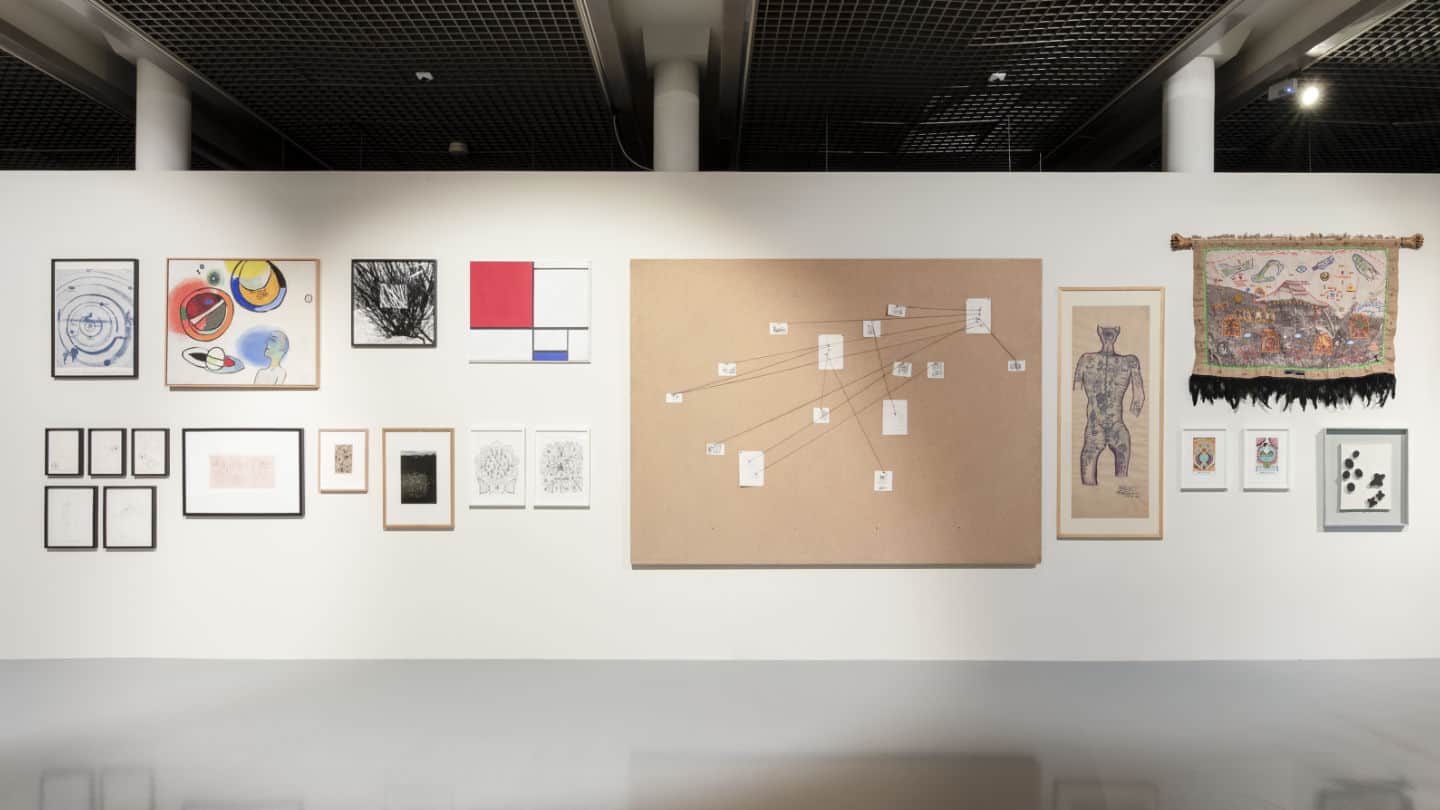
Within the extremely sophisticated, vast and complex system of the division of labor, art represents that small, yet vital ‘counter-system’ which, as the last refuge of freedom of speech, keeps the responsiveness of the big system fresh. Art uses the peaceful tools of lateral thinking and continuously shapes public opinion with visual, aesthetic, and moral alternatives. One could say that it demonstrates continuous rebuilding while in operation. Indeed, art provides an opportunity to encounter the other, the incomprehensible, something that cannot be processed based on conventional thinking, in simpler, more peaceful circumstances than in the harsh reality. In the social division of labor, artists task is practically to think differently from the majority, thereby serving the well-understood long-term interests of the majority.#art, #reconstruction
In 1917 Viktor Shklovsky called the artist’s activity ‘ostranenie’, which translates to ‘estrangement’ or ‘defamiliarization’ (Shkovsky 2017). And during reception – in proportion to the degree of estrangement – we can experience the instructive process that leads from non-understanding, through misunderstandings, to understanding; and then, later, in a critical situation – when the ship has to be rebuilt on the open sea – we can apply this experience.#ostranenie
Following the development of the socio-political field that shaped the secular concept of art, an environment emerged that, through its activity, legitimized even those works whose understandability, receptibility, or let’s say, usefulness, was not clear to the present, and therefore required mediators, supporters, explainers; that is, a loyal environment of interpretive attention. Through this context art prepares us for confronting the other, the incomprehensible; and with all this, for solving future problems. The institutional framework supports the self-reflexive basic research of art in various ways, clearly tending from the modernist concept of freedom all the way to the contemporary concept of ‘total competence’. This background makes it possible for the artist – in line with their task as an in-process reconstructor – to go as far as possible from mainstream thinking.#ostranenie, #art, #incomprehensable
This institutional system is currently being transformed everywhere in the world in the populist-demagogic spirit of the creative industry. The concept conceived in the of end of history atmosphere of the late last century, primarily born to improve economic statistics and regards creativity as a kind of ideology-independent commodity. The creative industry brings back the pre-modern client who has concrete expectations for their money (Lovink and Rossiter 2008). In Hungary, we encounter an illiberal state version of this, according to which creativity is a national strategic resource that should not be left to experts. This situation forces all actors in the institutional framework of contemporary culture to rethink their self-definition; for example, traditional roles are changing, and commercial galleries and collectors are taking over functions from other institutions that have lost their autonomy. Every element of the classic model, composed of interdependent private and public, small and large institutions, must rethink its traditional role in order to survive in a practically hostile economic environment. The much-discussed institutional critique of the past has now become the daily practice of institutional existence.#end-of-history
With the weakening of the critical counter-system built on modernist autonomy, the problem-solving capacity of the entire system weakens. #Modernity, #autonomy
1850 years after Plutarch, another author, Giuseppe Tomasi di Lampedusa, has his character Tancredi Falconeri in the novel ‘The Leopard’ state this at a certain point in the story: “For everything to remain the same, everything must change”.
Since then, this has become the most quoted sentence from the novel.