Is quantum the new hopium of the art world? In 2025, several major tech companies and start-ups – from IBM to Microsoft and Google – rolled out the releases of their newest quantum computers to the public. Over the course of the International Year of Quantum, celebrating a hundred years since the first quantum revolution, hype-driven media headlines began pumping out sci-fi scenarios about the multiverse to teleportation to the fast-approaching quantum apocalypse – bold claims which were as unverifiable as a TikTok grifter peddling quantum oil. The hype was warranted to some degree – there have been major milestones to achieving full-scale quantum computation, despite there being no major real-world applications yet. But, as the geopolitical arms race to build the world’s first full-scale, fault-tolerant quantum computer intensified, so had quantum’s exponential presence on a popular and political stage, which led to a massive surge in funding for all the companies involved.
Still in its nascent phase, quantum computing has been positioned as the next tech frontier, both by corporations and cultural institutions alike; its hype mirrors the early hype around AI, both in terms of its cultural adoption and economic impact. The rush to achieve so-called quantum advantage – when a quantum computer outperforms a classical computer – has become a matter of national security through encryption algorithms and the prospect of enhanced warfare.
The corporate rush among companies and nation states, in particular the US and China, coincides with the decline of global western liberalism, with its focus on Enlightenment values, and the beginning of a new multi-authoritarian paradigm, characterised by AI-thoritarianism, rising censorship, geopolitical tensions, and post-woke (dis)order. In this post-AI landscape, the metaphysical binding of tech acceleration to the Hobbesian market is a reality that very few people asked for, yet one we can’t escape. Tech narratives are optimised and operationalised for profit and power; regular bots, recommendation systems, and automated agents are rerouted into defence and military paradigms; even using a robot vacuum or a period tracking app is enough to implicate us all in the techno-imperial boomerang – so, what’s next?
At this point, quantum computing remains mostly speculative – most of its mainstream applications have yet to be seen – and its narrative arc is still pending. We cannot predict quantum having a ‘Chat GPT’ moment anytime soon, for example. While AI was made available to the home user through cloud computing, a similar move for quantum is difficult to imagine at this stage. For now, it’s primarily a tool for scientific discovery, such as electron microscopes and deep-field telescopes. In a post-AI landscape, how we think and make sense of quantum is particularly important to develop the right conditions for new tech imaginaries to surface, to disrupt the status quo, rather than sustain it. But when this combines with urgent global issues, geopolitical competition, and the technical complexity of quantum tech, it becomes easier to de-prioritise critical reflection.
From the earliest days of quantum physics, military infrastructures have driven what gets funded and when. Philosophical engagement with quantum mechanics, once inseparable from science, was deprioritised in the Second World War in favour of applied nuclear physics – most notably with the Manhattan Project to build an atomic bomb (Kaiser 2011). Deeper questions about the nature of reality drifted downstream from academic focus into pop culture, with terms like ‘entanglement’ and ‘quantum jumping’ becoming synonymous with New Age spiritualism, furthering the rift between theory and praxis. It’s nevertheless the latter that informs most of the mainstream narratives about quantum, using quantum terminology as a narrative lube to shift specific, complex concepts into expansive claims about anything high-speed or multidimensional.
Through scientific positivism’s focus on the empirical world, which is orientated toward capitalist extraction and exploitation, the rapid acceleration of quantum tech will depend on the incentives of those funding its development. Given AI’s track record, quantum’s absorption into the war economy is perhaps inevitable under these conditions – unless guardrails are put in place to prevent further mass destruction. Prototypes for military use are already being tested in the US, China is using seabed sensors to track submarines, and Russia is building quantum navigation to counter electronic warfare. Defense ministries are funding scaled programs, and alliances are ranking quantum development a priority (Center for Strategic and International Studies 2026).
Right now, it’s hard to imagine a version of events where quantum’s main application isn’t the battlefield. But this is just one possible trajectory. It’s not inconceivable to cast a future where the founding principles of quantum theory can be used to break free of a data-centric and authoritarian society, instead of supporting it. As early adopters of emerging technologies, artists are particularly well versed to explore these possibilities – even if they lack the funds to realise it. In contrast, we’ve witnessed how corporations instrumentalise and operationalise fiction to support slop fascist ideologies. Framing tech acceleration as a spiritual transformation, tech libertarians LARP network states into the IRL, using cloud feudal models to profit off consensus (un)reality. It’s no quantum leap to consider how these narratives might be wielded to support the unregulated development of quantum tech – to move fast and break things.
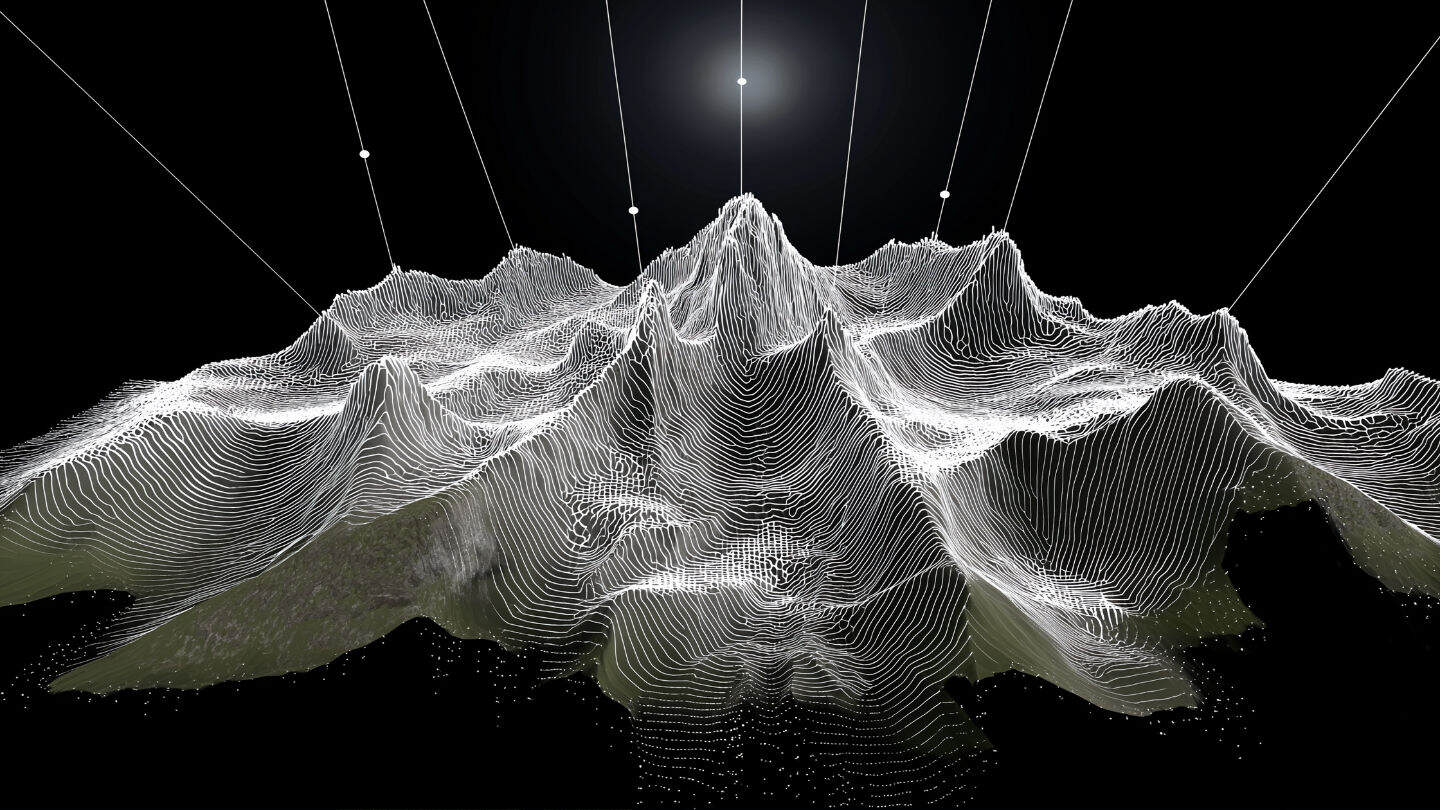
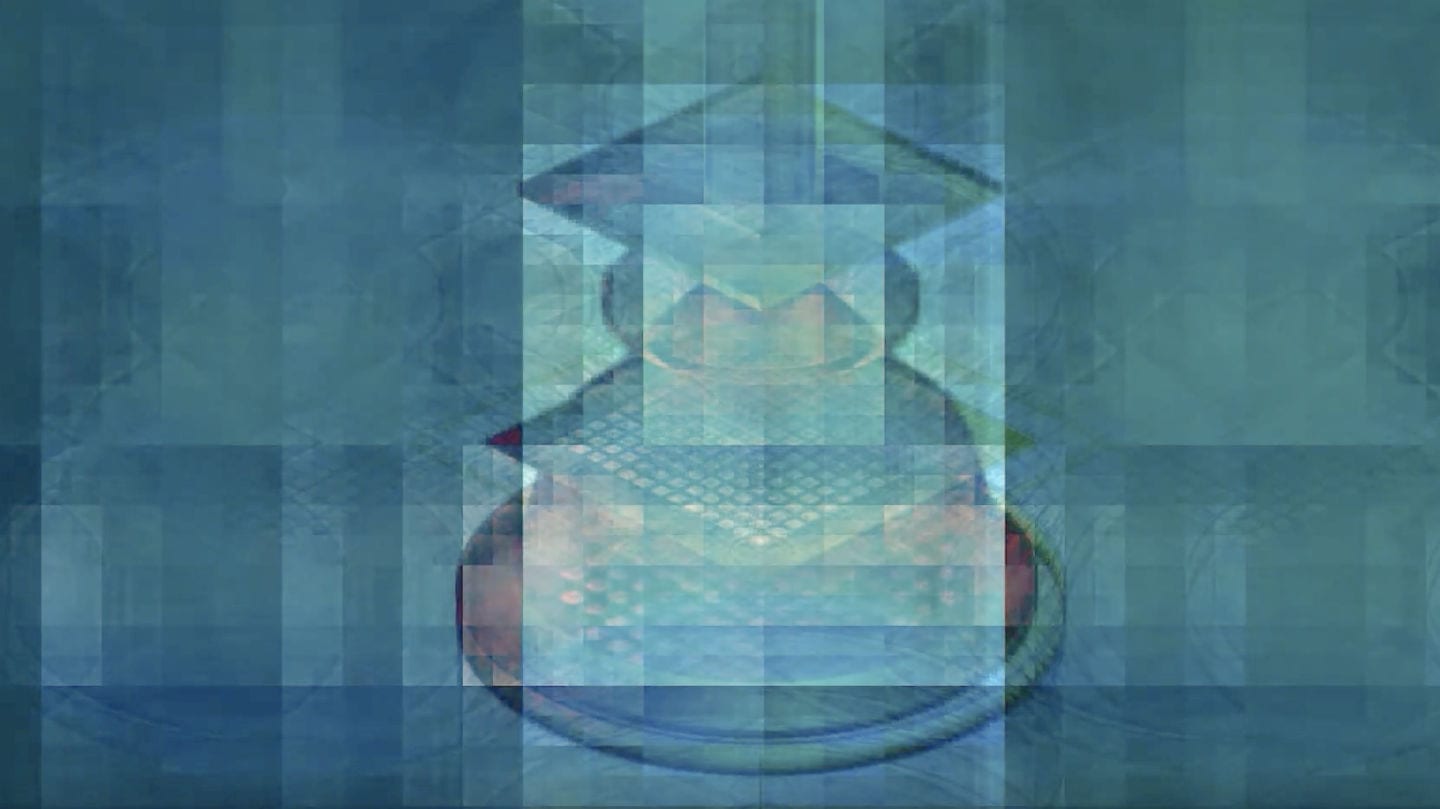
So far, the development of quantum art has yet to be associated with a coherent aesthetic. This is probably because quantum tech has yet to generate a distinct style that can be distinguished from other available tools. For example, IBM’s Quantum Blur method takes several hours to process seconds of video footage, its result is lo-fi and pixelated. Most of the ‘quantum’ tech that we see utilised across contemporary art are in fact simulations of quantum computers. Still, those early interactions with technology are what have historically created the most exciting results – think of the early experiments in DALL-E versus generative AI’s enshittified present.
What I suggest is to draw a line between art made using quantum tools and art about quantum – though not mutually exclusive, the latter is more common, drawing on the deeper insights of quantum theory to ask philosophical questions about the nature of reality and space-time. In the context of a multi-polar world, the idea that there exists multiple coexisting and contradictory states, timelines and realities is a useful tool – to reimagine what is possible and impossible within culture, politics and economics. Though we must be careful not to drift too deep into sci-fi tropes that depict quantum as a mystical force. This would reproduce the same logic that flattens politics into slop gestures that play into the financial objectives of the tech elite.
Imagining an alternative system modelled on quantum principles requires us to consider the existence of another layer of reality. One that we cannot perceive, because it sits outside our own structure, which as humans, is a classical one. Breaking away from the Newtonian model of reality, with its focus on stable, separate units, quantum theory sees reality as relational and interconnected. This lends itself to a deeper engagement with the world that sits outside of the western reductionist worldview – quantum phenomena such as non-locality are leading us towards a more holistic understanding of the world. But the metaphysical framework that underpins modern science is fundamentally at odds with quantum reality, which would require us to throw away the entire modern western paradigm, towards a reality in constant flux. Imagine a Western world run on Heraclitus rather than, say, the dialectic between Aristotle and Plato. Clearly, this isn’t in capitalism’s best interests.
Today’s slop society is nevertheless as fractured and contested as quantum theory itself – which has several interpretations, many of which cannot be proven true or false empirically. With quantum’s sudden jumps in states – and the idea that several states can coexist at the same time – there’s an intuitive connection to be drawn between the online experience and quantum reality, where our digital presence is distributed across networks in ways that cannot be reduced to cause and effect. Think of LLMs rewriting history in real time through the creation of a limitless number of competing realities, all playing out at once. This produces a superposition of simulations where the result advances the plot, according to the LLMs training corpus. Both AI and quantum run on probabilistic logic, the main difference is that the former relies on classical computing (for now), whereas the latter is quantum. This also affects how we perceive time and space – as K Allado Mcdowell writes, AI “signifies a shift in our thinking, from thinking in terms of a reality divided by time to thinking in terms of a reality with no time, a reality which connects all things” (Allado-McDowell 2021).
In this hyperdimensional online experience, with its shifting constellations of data, memes, markets and collective belief, discordant alliances of thought drawn out of anti-Enlightenment ideas vibe for attention in the social media arena. The concept of time – once thought to be linear – is open in all directions, with multiple, non-universal states existing simultaneously. In this present, where the junk future sits besides the archaic past, we find ourselves at another crossroads.