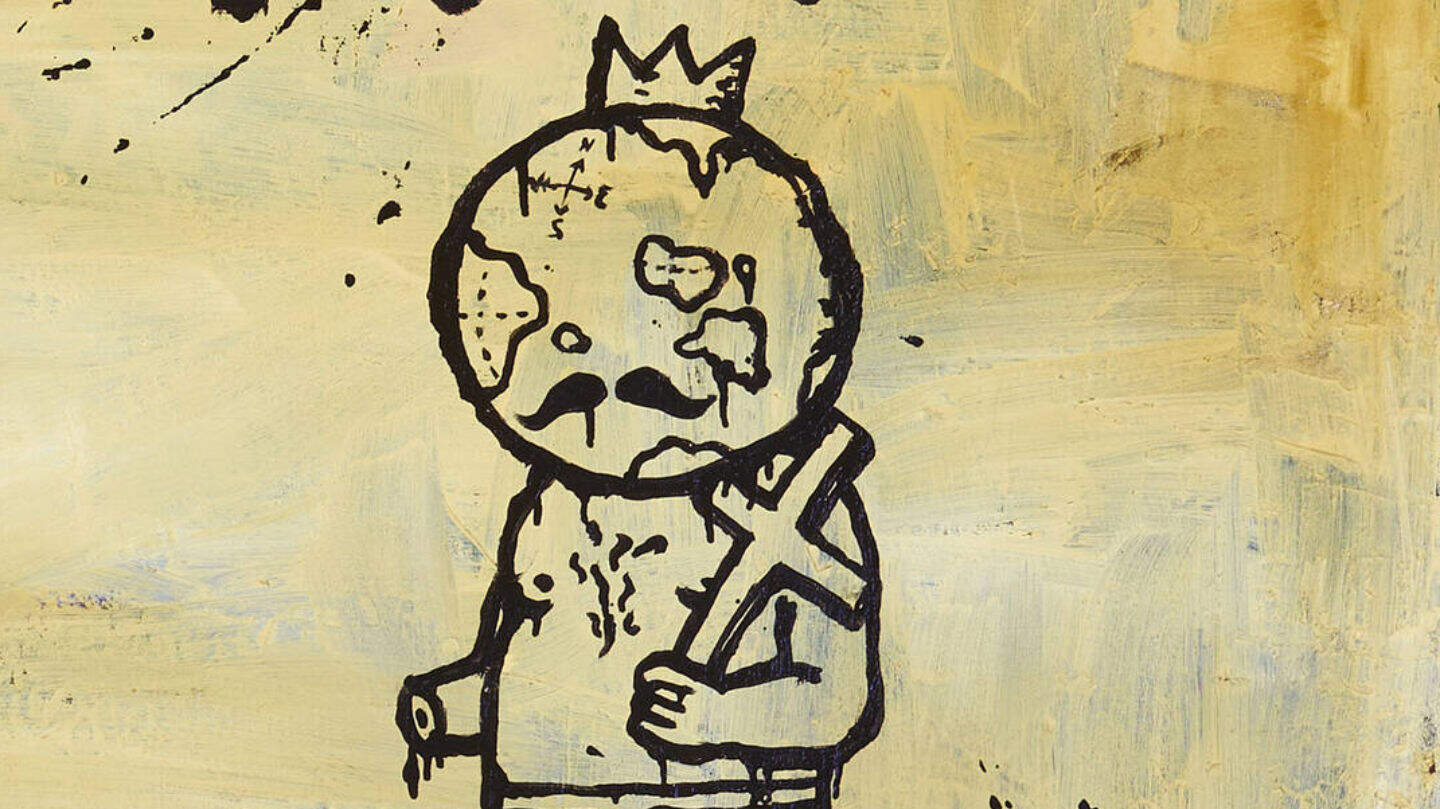
There were no art museums in the town where I grew up in the 1990s. Our aesthetic was scratched together from skate videos, album art, and the zines sold at punk shows. Mannerisms were lifted from rented VHS tapes. The outfits of out-of-town bands were observed with the precision of jewelers. Lucky for me, my grandmother was a live-in caregiver for a sculptor who made bronze monoliths as public art. The styrofoam molds emitted fumes that had corroded her brain and when her books headed to Goodwill, I got early access. I took one by Ben Shahn with the line drawing of a lion on the cover, a hardcover of Michelangelo plates, and a retrospective of Kurt Schwitters. For my next zine, I wrote cursive over photocopies of the faces of the sibylls from the corners of the Sistine Chapel and glued typewritten text over ticket stubs and assorted Merz. A letter arrived in the mail from the proprietor of the local skateboard store, who was also a half-assed poet who wore suits and rode old bikes. He drew a cartoon blue ribbon that read: “most improved.”#Zine, #art
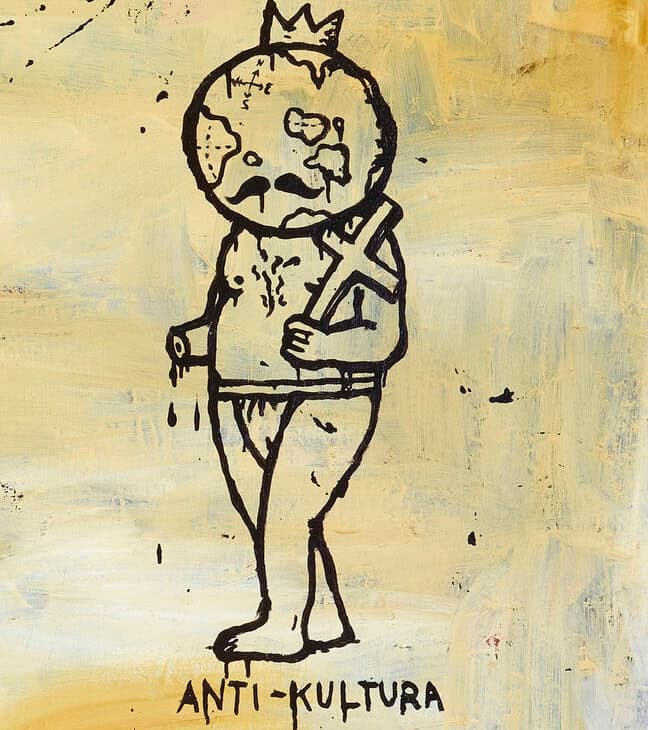
At college, I stalked the library stacks for content. It was there I found the first contemporary art that meant something to me: an exhibition catalog of the Filipino-American artist Manuel Ocampo, then in his 20s, all in the naive colorful style between the barber shop, the altarpiece, and the binder doodle. I remember a hieratic cockroach in a crown holding a goblet and scepter. A decapitated head floating backwards like a summer swimmer. An exhausted plucked chicken in a crown of thorns. Images jostled with icons and languages I did not understand then but would later. In Fraktur: “Scheiss Leben” (Shit Life.) Over an image of a man in a KKK hood wrestling a German eagle with ethnographic images of natives at the corners (like the sibylls in the chapel!): “Wieder Einmal in der Welt voran” (Once again on top of the world.) One of Ocampo’s recurring characters was the “world baby,” a chubby body, often with a severed hand, often in a loincloth carrying a bible or a cross, with an enormous globe for a head (Fig. 1). I could figure out the word under one: Antikultur. I read someone later say that the world baby “marches resolutely ahead as if to spite history” (Borum 1996).#Manuel Ocampo
I had been raised with kitsch images of racial unity and universal harmony, Unicef Realism. Ocampo’s world looked more real to me. It looked like history.#history
The Place of Art in the Empire of Difference
The early 1990s inaugurated an era that some claim we are now departing. Joshua Citarella describes the end of a period when “contemporary art sought to unify a world society whose aesthetics, markets, and institutions would slowly converge upon a shared set of values” (Citarella October 9, 2025). In another text about the emerging “multipolar world,” Mi You writes about how, “over the past three decades, the global art world has thrived thanks to the infrastructures of peak globalization; it has consequently internalized value systems that are embedded in the alignment between liberal democracy, the progressive state, and neoliberal metrics of economic stability” (You Dec 2024).#multipolar, #art
This seems plausible but are they describing the kingdom of Ocampo’s phantasmagoria? Is the world baby at home in the world society of which Citarella speaks? Andrea Fraser observed in her 2024 text The Field of Contemporary Art: A Diagram that the art world only staged its triumphal march because it was able to “capture an extraordinary range of investments: not only financial investments from private, public, and nonprofit sectors, but also the aspirations and energy of growing numbers of people drawn to the field and the possibilities it promises.” The dynamo of the contemporary art machine was transgression: “political negations of aesthetic, disciplinary, and institutional boundaries, which created the conditions for art’s extraordinary expansive capacity and incorporative power” (Fraser Oct 2024). #art, #transgression
There was a curious echo here of the way that New York finance was overturned in the 1980s by the use of high-yield “junk bonds” to fund corporate takeovers. Intrepid young investors sniffed out assets coded as garbage and refuse, bundling them into leverage against the dominant players. Without forcing the analogy, we can see how contemporary art and finance both universalized, paradoxically, through a mandate of turning existing hierarchies on their head: finding value in what had previously been marginalized and scorned. In other words, it makes sense to see contemporary art, as Citarella suggests, as the superstructural complement to the expansionary dynamics of neoliberal globalization as long as we note that the intellectual and cultural draw of the project was its claim to be doing the exact opposite of domination, to be conducting a transvaluation of values in which the last would be first. Like many empires before it, this was not an empire of smoothness but an empire of difference. Assessing the arrival of a “multipolar art world” is impossible without first assessing the status of the “multi” in the world that preceded it. Looking back we find at ist heart a three part protocol: invert, delegate, and tolerate.#finance, #neoliberal, #multipolar
Protocol One: Invert
Multiculturalism was both one of the most ubiquitous but also the most maligned categories of the period that stretched from the end of the Cold War to the 2010s. The very strenuous quality of its disavowal suggests it might contain a hidden truth. Indeed, like its successor category of “woke,” multiculturalism had its early champions. In the catalog to the TransCulture exhibition curated by the Japan Foundation at the 1995 Venice Biennale, the Brazilian curator Ivo Mesquita wrote that “the concept of multiculturalism brought to an end the previously dominating European and Eurocentric efficiency of the world. It opened new fronts and provided visibility to different cultural and ethnic groups that until then had been on the margin of history: immigrants, political refugees, and expatriates that make up significant manpower in the main centers of the Western part of the Northern Hemisphere” (Mesquita 1995). Middling critiques later taken as fatal were batted away. Of course, globalization had contradictory effects. Of course, it simultaneously homogenized culture while seeding a longing for essences. Of course, multiculturalism was forced to reaffirm outward signs of particularity even as it claimed to undermine hierarchy. The challenge, as the Cuban-American artist Coco Fusco wrote in the catalog for the 1993 Whitney Biennial, was to surf the contradiction, make use of the elite and even mass interest in difference without falling into a shallow exoticization. Multiculturalism was a “double-edged sword,” she wrote. It could cash out as “the presentation of static models of ‘diversity’” but also represented an “opportunity to transform the stereotypes that emerge with the imposition of control.” The fact that artists from minority groups were active participants was not insignificant. “That mainstream culture has periodically expressed desire for subaltern art has never obligated anyone to deal with subaltern peoples as human beings, compatriots, or artists,” Fusco wrote, “That is, perhaps, until now” (Fusco 1993). #multiculturalism, #globalization
This was a time when indigenous art, for example, was being shown in a new context — not as artifacts of a dying or dead civilization but individual, named artists actively engaged with the contemporary world. One could see this in the touring Te Maori show of the mid-1980s, Dreamings: The Art of Aboriginal Australia at the Asia Society in 1988, and the National Gallery of Canada’s Land, Spirit, Power show in 1992. The historian Miranda Johnson writes in The Land is Our History, the extension of the extractive frontier — especially of mining and forestry — deeper into traditional lands of indigenous groups in the 1980s produced an activist response that was expressed in cultural and artistic exhibitions, and later folded into the national narratives of New Zealand, Australia, and Canada (Johnson 2016). Walking through a recent massive show of the Cree artist Kent Monkman at Montreal’s Museum of Fine Arts, even a cynic cannot help but marvel at the wall-sized history paintings in the style of Delacroix and Géricault showing queer sex parties at the base of the Canadian Rockies and the detailed, individualized and life-sized faces of indigenous children witnessing the hanging of their fathers and uncles by the Canadian state in 1885 (Fig. 2). (Admittedly, the fact that my own great-grandfather’s race was marked down as “Cree” by the authorities may have make this record of Canadiana hit extra hard.)#colonialism, #indigenous erasure, #violence
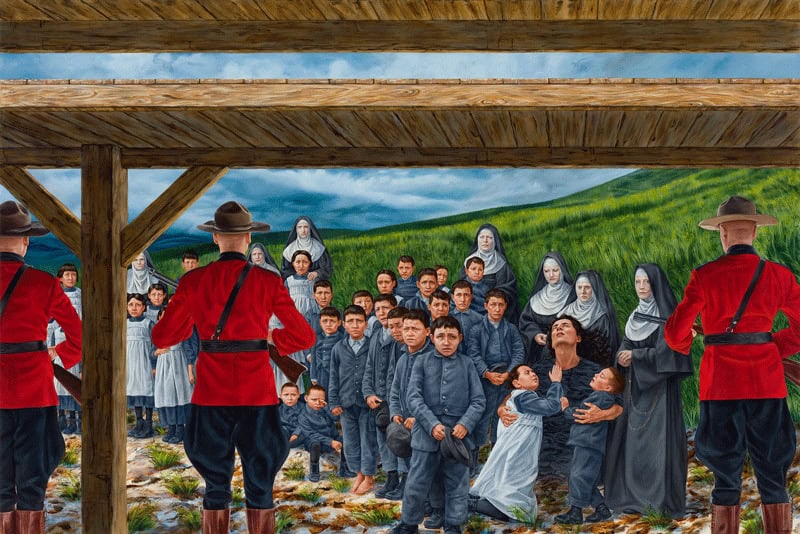
The title of Monkman’s show, “History is Painted by the Victors” is a characteristically sly commentary on the apparent arrival and even domination now in official exhibition spaces of formerly doubly and triply excluded populations now being shown at grand scale and in riotous symbolic excess. Furthermore it is being done with what Hal Foster identified in the playful-serious works of James Luna already in 1989: it is “hybrid art” that is “wryly anticategorical in a way that resists any further ‘settlement’ into separate ‘zones’” (Foster 2004, 619). Looked at one way, Monkman’s retrospective represents the culmination of the “multiculturalism” project launched in the early 1990s. In his essay for the 1993 Whitney Biennial, Homi Bhabha designated “political victims” as the “best historical witnesses,” mostly likely to deliver “an encounter with ‘newness’ that is not part of the continuum of past and present” (Bhabha 1993, 68, 71). #multiculturalism, #history, #witnessing
The message was one that reverberated through contemporary art discourse in the early 1990s: old horizons of popular liberation represented by the 1960s anti-colonial nationalism had proven not only a failure in the sense of being crushed from outside, but also a failure on their own terms. They had always been accompanied by aporia of oppressions that outlasted electoral emancipation. Bhabha’s catalog commentary was repurposed as a preface to a new edition of Frantz Fanon’s Wretched of the Earth (Fanon 2004). Fanon would have said the new national bourgeoisie had forgotten the peasants. Bhabha drew attention to migrants and refugees. “Increasingly ‘national’ cultures,” he wrote, “are being produced from the perspective of disenfranchised minorities” (Bhabha 1993, 67). Fusco pointed out indigenous erasure that preceded national liberation. History was recast as a cascading, infinite, and likely unresolvable sequence of grievances and crimes.#colonialism, #nationalism, #indigenous erasure
This framing produced a challenge captured by the critic and curator Giorgio Verzotti in 1993. “If multiculturalism is to be interpreted without mystification,” he wrote, “it must be examined as a dialectic of dominant and dominated cultures in which each necessarily affects the other. At the same time, an analysis of this dramatic interpenetration should avoid postulating any reassuring harmony between cultures of the center and of the margin. Instead, it must inevitably recognize conflicts and reveal contradictions, analysis of these conflicts being the only way out of the frightening regressive symptoms our world is displaying” (Verzotti October 1993). Good multicultural art, in other words, needed to be ugly. It needed to look like Ocampo. But if the last victim was always receding into an asymptotic event horizon of suffering, then who would be around to do the representing? By definition, those most entitled to speak were those least equipped and available to do so. This brings us to the second protocol of art in the empire of difference. If the first was to invert, the second was to delegate. #multiculturalism, #violence
Protocol Two: Delegate
The 1990s were a time when theory and cultural producers experienced what might have been the high point of their influence in the United States, and certainly the high point of their institutional comfort. We can see this in the statistics of university enrollments across the decade, as well as the creation of new tenure-track professorships. Departments of English, history, and art history were turning out PhDs into a glorious job market, buoyed by (the last of the) demographic tailwinds and booming financial markets, which encouraged the wealthy to recycle donations back into university endowments for tax relief, and parents to plunge into intergenerational debt to gamble on what seemed like the sure shot of later returns on investment in human capital. In a way difficult to imagine now, the humanities and the social sciences were the aristocracy of academia in this period. The ecologist E. O. Wilson wrote a book called Consilience in the 1990s imploring readers to recognize the importance of the hard sciences (Wilson 1998). His book is a testament to the fact that there was a time when the fields of genetics, engineering, and computer science felt genuinely threatened by … Jacques Derrida.
How to think about the role of the producer of art and ideas in this special moment? The person most often turned to was Pierre Bourdieu. This was a significant choice. In a helpful essay, Michael Burawoy compares the intellectual in the theories of Antonio Gramsci and Bourdieu (Burawoy 2019). Gramsci believed in the possibility of an organic intellectual emerging from the working class, whose wisdom and insight was gained through proximity to the process of daily labor and the struggles of everyday social reproduction. His understanding of common sense was a version of domination that someone from the dominated class could be theoretically capable of seeing through, to build what those following him famously called counter-hegemonic power. Bourdieu, by contrast, had no such faith in the possibility of an organic intellectual emerging from the working class itself. The equivalent of Gramsci’s hegemony, for Bourdieu, was a term that is often used but also often misused: symbolic violence. The idea is that people operate under conditions of domination that they have no capacity, or even potential, of being able to recognize the contours of themselves. As he put it, “all forms of symbolic domination operate on the basis of misrecognition, that is, with the complicity of those who are subjected to them” (Bourdieu and Haacke 1995, 54). Because the working class was trapped in a cycle of symbolic violence, they could not be relied upon to arrive at the spark of insight that could lead to revolution. Rather — and this is where Bourdieu becomes important for contemporary art — the cultural producer or intellectual, detached from working class life, enjoyed a remove and a perspective that gave them both the time and space to stage a critique of bourgeois power over the workers. Through deft use of the media, their effect could even be much greater. In a remarkable statement, Bourdieu said in conversation with Hans Haacke in 1991: “Exaggerating somewhat, we could say that fifty shrewd people, capable of staging a successful happening that gets five minutes of television airtime, can have as great a political effect as 500,000 protesters“ (Bourdieu and Haacke 1995, 23). Sufficiently mediagenic artists could replace social movements (Fig. 3).#Pierre Bourdieu, #violence, #intellectual
Two things followed from Bourdieu’s insight. First, cultural producers should not be ashamed of fighting for the privileges of their own class — that is, fighting for the university, museum, or cultural institutions themselves, rather than simply seeing them as part of a larger complex of ideological production. Agitating for the relative autonomy of the field of artistic production was itself a defensible political goal. This was a quintessentially modern framing stretching back a century to the Belle Époque. “According to the model invented by Zola,” Bourdieu wrote, “we can and must intervene in the world of politics, but with our own means and ends” (Bourdieu and Haacke 1995, 29). Second, because the artist or cultural producer was not a member of any given class, it would not make sense for them to speak on behalf of a particular sub-class of the population. Rather, Bourdieu argued, the task of the cultural producer was to speak on behalf of the universal. It was “universalism,” he said “toward which all intellectuals should struggle” (Bourdieu and Haacke 1995, 68).#ideology, #intellectual, #Pierre Bourdieu, #subaltern
Here, then, we find ourselves with a theory of the role of the artist that supports Citarella’s point — but the mechanism through which they were doing it is important not to overlook. That is, the intellectual work of speaking on behalf of the universal that Bourdieu describes was not cashing out as a description of the human as such — a disembodied understanding of human rights — but was specifically focused on the oppressed and the suffering, on those who had accumulated as many markers of exclusion as possible. Every marker of exclusion amounted to a potential switch of enlightenment that could be turned on through activation by a well-composed gallery space, sculpture, photograph, or the combination of text and image. Bourdieu’s ideal version of the artist was Hans Haacke who he praised fulsomely in a published dialogue with him in 1989 quoted throughout this text. Haacke’s work used techniques of disclosure to draw discomfiting attention to entanglements across institutional boundaries: the German firms profiting from the U.S. operation in the Gulf, the Nazi past in the Austrian town of Graz, the overseas assassination of a South African resistance leader. #Hans Haake
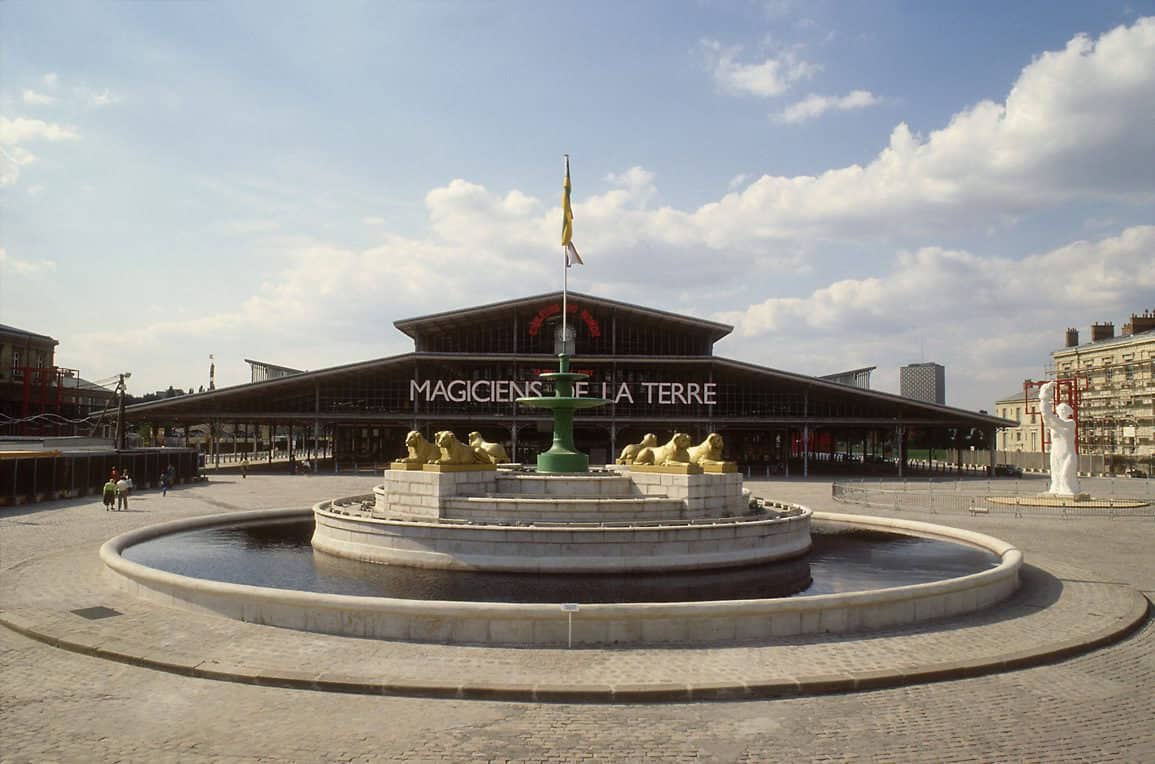
In short, Citarella is right that we may be moving on from an era of a push toward a world society under the sign of “western-style liberalism.” But to understand why that project was able to attract so much talent and creativity for the thirty-five years that it was underway, we need to see that this world society was not being pursued through a merging or melding of experience, but specifically through exploration at the edges of darkness — the belief that the hidden abodes of daily life, and not just production, held clues toward a larger truth that could be composed by the skillful enough — and, it must be said, empathetic enough — art worker. Thus it would be unfair and incorrect to see the world shows of the early 1990s: whether Magiciens de la Terre, the 1993 Whitney Biennial, or TransCulture at the 1995 Venice Biennale let alone the explosion of what Hans-Ulrich Obrist called “peripheral biennials” from Cairo to Johannesburg to Kwangju that would follow — as simply rehashes of colonial exhibitions of a century earlier — ”new Crystal Palace expositions,” as Martha Rosler disparaged them in 2003 (Griffin Nov 2003). Even if they did seem formally similar, it is essential to see that the intentions of the creators and the artists were to invert that power relation. The affective force of the project relied on that impression of inversion. This was a world society that, by its own understanding, was being created from the outside in. The fact that it was a select class of cultural producers doing the production — this was merely a concession of the point to Bourdieu over Gramsci.#art, #intellectual, #Martha Rosler
The technique of axial inversion, which was an attempt to reverse the hierarchy of the art world by placing the most subordinated perspectives at the top, threw up all kinds of problems familiar to cultural critics to the present. Was this merely what Apinan Poshyananda called in 1995 “transactional transculturization” (Poshyananda 1995, 76)? Was “postmodern globalism” a new currency of exchange with each group figuring out how to make their identity “useful to others” as Thomas McEvilley wrote the same year (Nanjo 1995, 15)? Already by then, Thelma Golden spoke of multiculturalism as an “unfortunate catchall term” that “at its best should surely have provided options that would encompass difference — difference of issue, ideas, race, and practice. It has been most visible at its worst, however, and has come to represent something extraneous to art proper” (Golden Nov 1995). In 1996, Andrew Ross spoke derisively of the “the boil-in-the-bag models of multiculturalism that have succeeded the rusty old melting pot” (Ross Oct 1996). Ocampo rejected the term for his own art with a critic calling it a “belated marketing catchall” (Noriega 1997, 8). This was obviously an omnipresent danger. The Venice Biennale in 1995 captured some of the range. There was the glib, the project by Cai Guo-Qiang titled Bringing to Venice What Marco Polo Forgot, which put Chinese traditional medicines inside a soda vending machine. There was also the blandly boosterish, as in the World Tea Party installation by Canadian artists, which brought together the paraphernalia of tea drinking from a range of different cultures to embody a unity in diversity. Rather than following Walter Benjamin’s much-repeated edict that “every document of civilization is also a document of barbarism,” some art of this period suggested an equilibrium: a palatable pluralism. This brings us to the contested third term in the protocol of world art at the end of history: after invert and delegate, tolerate.#multiculturalism, #Manuel Ocampo, #globalization
Protocol Three: Tolerate
In her essay for the 1993 Whitney Biennial, the critic B. Ruby Rich recalled that the year prior had been the controversial quincentennial of Christopher Columbus’s arrival in the Caribbean: “twelve months doomed to be spent remystifying or demystifying Columbus as the explorer/exploiter he never/really was.” She drew attention instead to 1491, the period just before the expulsion of the Jews and Moors from Spain, known as the convivencia. She saw the creation of “a rich cultural renaissance, strengthened by its diverse parts” as a collective goal for the present (Rich 1993, 88). Although Rich protested that “coexistence” was too “pedestrian a translation” of the concept, it does sound indeed like what she is describing. Talk of “hybridity” and “encounter” was everywhere in the early 1990s but it often adhered to the politesse or the orderly exchange of the World Tea Party. It’s difficult not to recall Slavoj Zizek’s recurrent criticism of multiculturalism as the acceptance of difference at a safe distance. In 1997, Zizek wrote a piece in the New Left Review – reprised by many others in slightly different forms over the coming decades – denouncing multiculturalism as the “cultural logic of multinational capital” (Zizek Sep-Oct 1997).#multiculturalism, #capitalism
By the end of the 1990s, multiculturalism was almost exclusively invoked in the negative. Yet while some critics and artists mourned the transgressive quality of the avant-garde and resented the impression that art was being crudely instrumentalized, others welcomed it. “The notion that a culture is built like a mosaic,” Mesquita wrote in 1995, “presupposes the need for an element, such as mortar, to fasten all parts side by side. It seems to me that currently artists are works who produce and apply this mortar” (Mesquita 1995, 64). Much more recently, You has echoed this in a different way, writing that “exactly in this multipolar and deeply pluralist world … art can take on the role of mediation (rather than reproduction or representation), if not the role of an ambassador. In a fractured but not yet fully segregated world, art can fill the communication gap“ (You Dec 2024). How different are the challenges faced across the three decade divide? And how different are the strategies offered in response? Squinting slightly, the “multis” of polarity and culturalism can appear as near analogues. Both are paths to convivencia in an era where difference is taken not as exception but as rule.#multipolar, #mediation
In my book, Globalists, I wrote about how Austrian neoliberals saw the Habsburg Empire that shattered after the Great War as a potential scale model for a future world society, one in which particular acts of cultural and national self-determination could be accommodated in a larger universal space of monetized exchange and the international division of labor (Slobodian 2018). This vision of empire did not require monoculture; it bought stability and consent through multiculture. The Habsburg empire of difference worked through local education in diverse languages, the canonization of “national poets” and dramas, and the creation of a vernacular printed press. What media defined the 1990s? Some of them were the same. In her essay introducing the iconic 1993 Whitney Biennial, the head curator Elisabeth Sussman focused on a work by the artist Robert Gober she called the “signature piece of the early nineties” (Sussman 1993, 13). It was a stack of newspapers, bound with twine, with fabricated headlines including one of the artist himself in drag (Fig. 4). #globalization, #neoliberalism
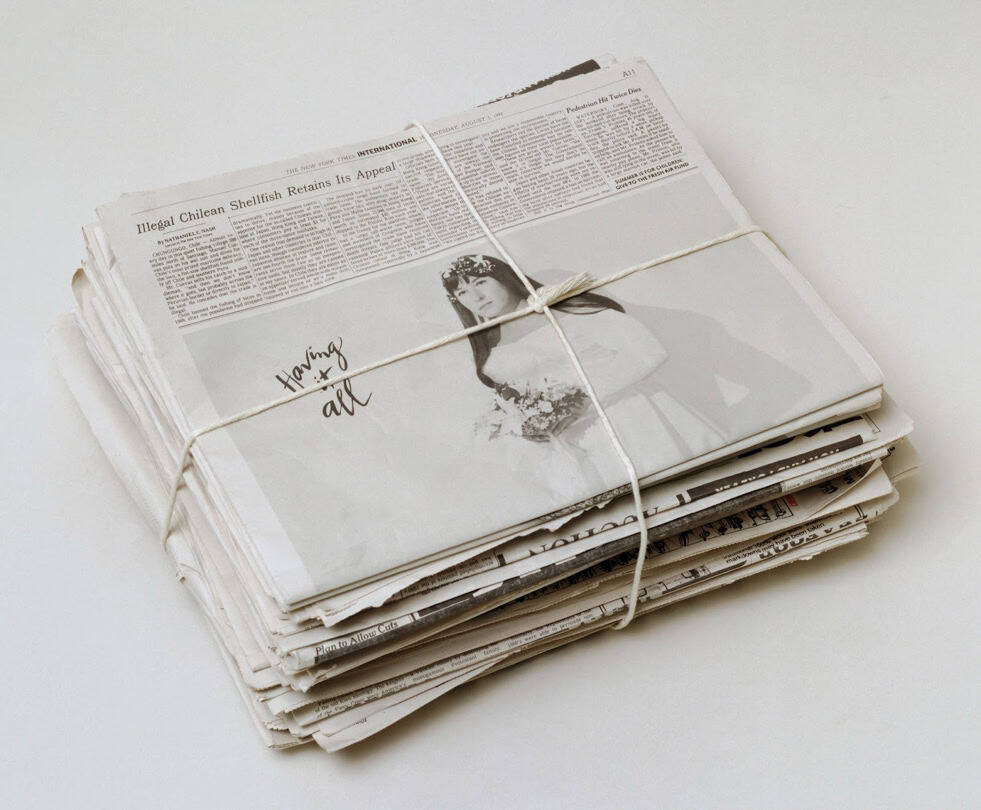
Sussman wrote that this piece captured the persistence of a single narrative storyline inside American culture, even under the much-discussed pressures of identity politics and minority mobilization. One could still rely on the daily newspaper that would capture those stories and land on the doorstep of much of the middle and upper classes. Haacke implied something similar in his conversation with Bourdieu in 1991 when he said that “the press is the immediate audience” (Bourdieu and Haacke 1995, 28). They were probably correct then. They are certainly not correct now.
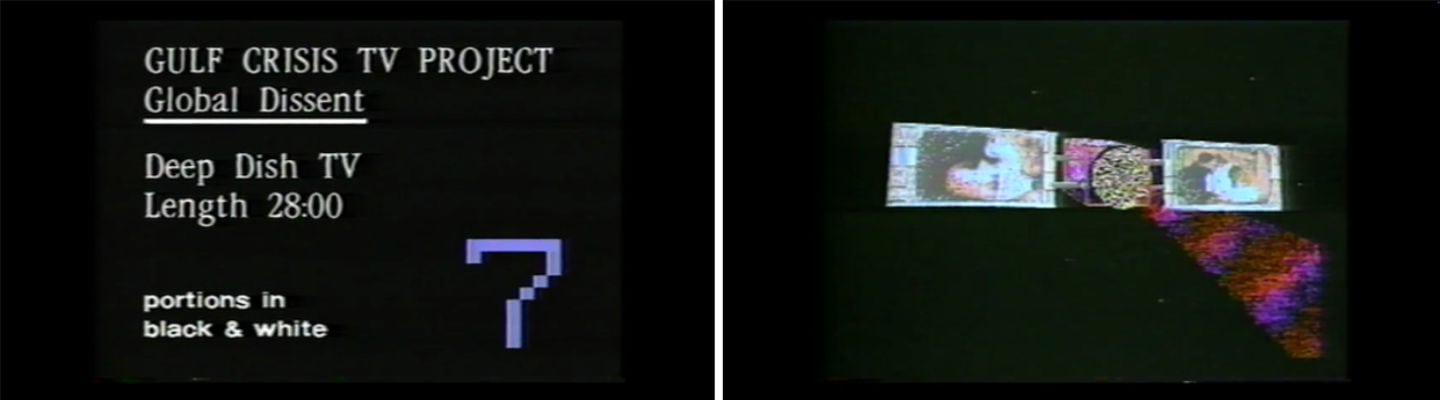
Closer to the present is the Gulf Crisis TV Project, which adapted the technique of what was then called narrowcasting — broadcasting to a small target viewership, often an immigrant diaspora — and rethinking it for more overtly political purposes. During the First Gulf War, with the usual outbreak of jingoism and non-critical reflection on the actions of the American military, organizers and activists as well as artists responded by creating alternative news sources and then, through satellite uplink, making these available to one another, where they were then broadcast on public access (Fig. 5). These tapes held discussions of the long history of American foreign policy in Puerto Rico, discussions led by women in the Bronx, and footage of demonstrations happening across the country. It was a foreshadowing of the role that Indymedia would play ten years later and social media ten years after that.#Cold War, #satellite, #subaltern, #immigrant, #art
From a different direction, there was the piece by the Japanese computer artist Masao Kohmura with the title Whole Character Catalogue, a riff on Stewart Brand’s highly influential Whole Earth Catalog of the late 1960s and 1970s. Set up in the center of the gallery space was a computer with a simple program that, at low resolution, was printing out all of the characters in human languages to be bound and placed into libraries (Fig. 6 and 7). #Masao Kohmura, #art
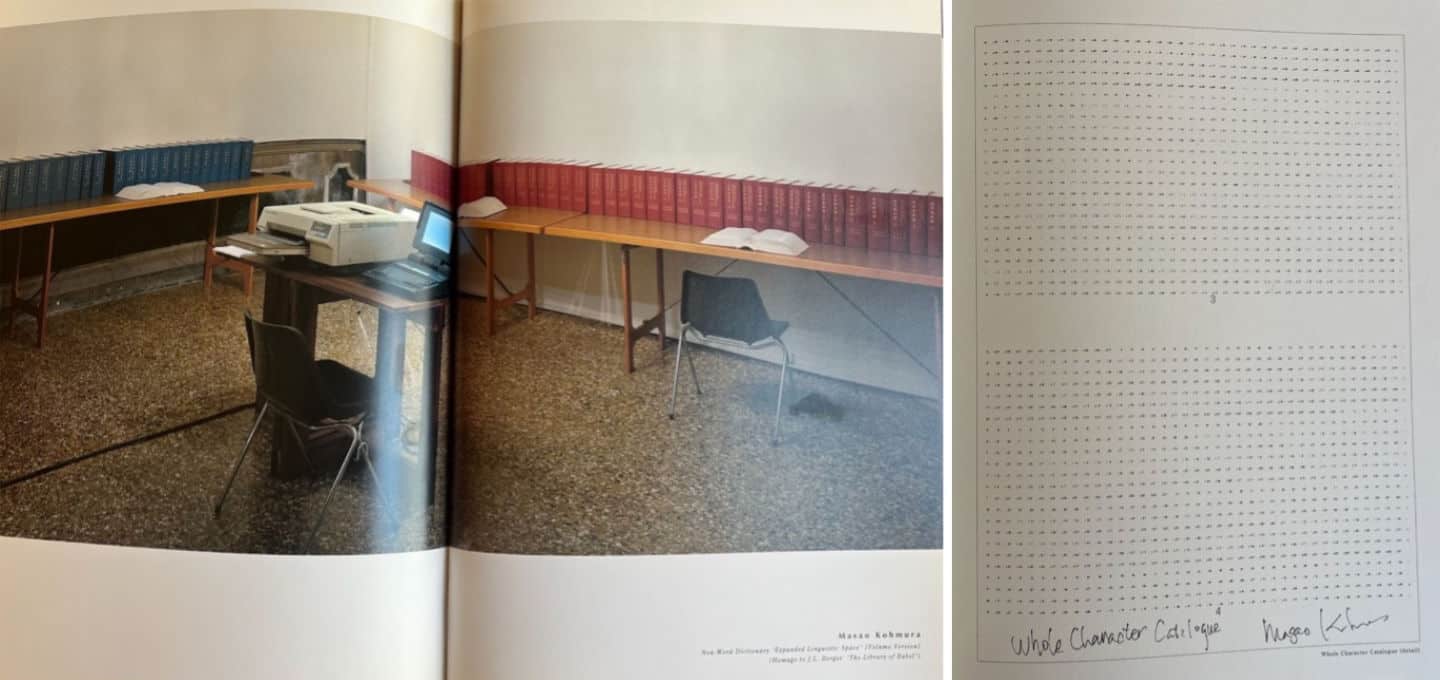
The catalog copy used this as a launch for what would have seemed like science fiction still in 1995. “Soon the computer might be replacing the book as a place to secure information,” it speculated imagining an era when libraries where “issued as a set of CD-ROMs or available for international browsing on the Internet” (TransCulture 1995, 126). How strange that the futurists of that moment found it so easy to imagine a world of fully embodied virtual reality (one essay was included predicting this in the same catalog) that has still not come close to arriving, and yet the digitization of knowledge in the simple text form felt like an unlikely goal. Meanwhile it was recently reported that over 50% of articles on the Internet are now written by large language models using distant relatives of Kohmura’s piece, producing statistical models of word prediction and sentence completion that now threaten to make both reading and writing obsolete (“More Articles Are Now Created by AI Than Humans” 2025). #LLM, #Masao Kohmura, #art
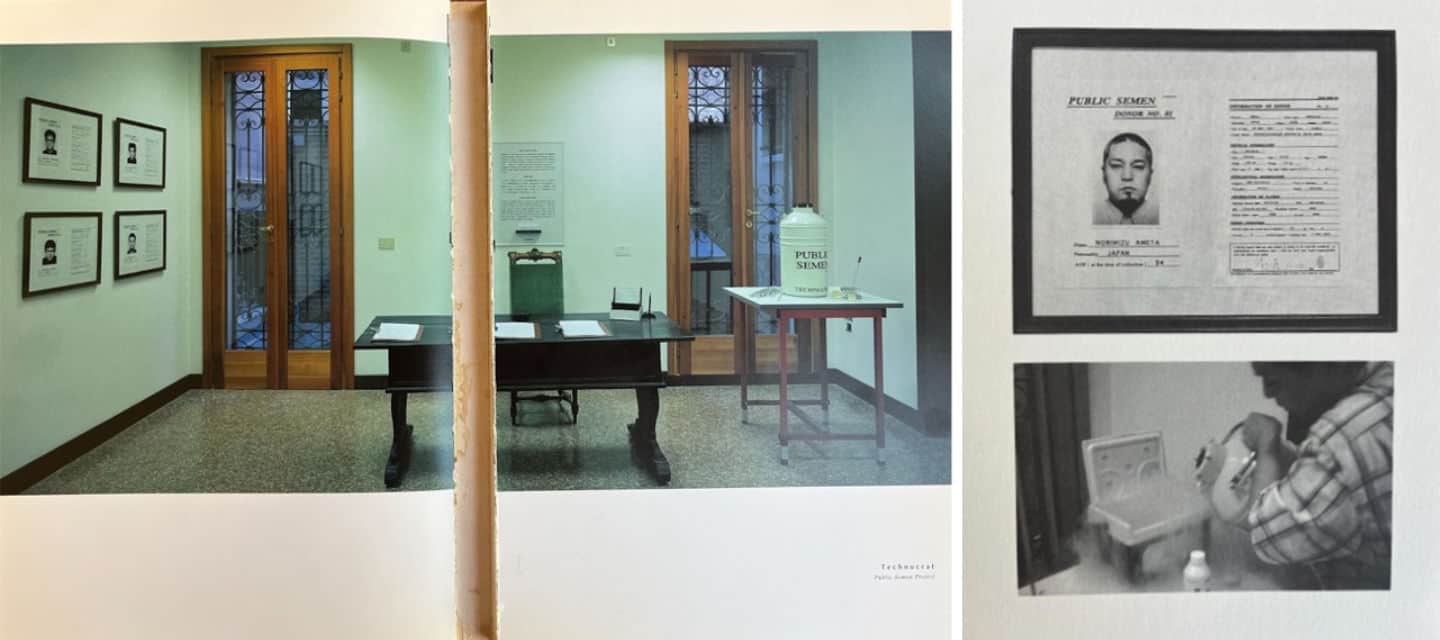
While the Whole Character Catalogue broke the rules of the empire of difference by rendering particularity down to monochromatic code, another set of works overstepped the bounds in a different way — by pushing the protocol into the human body. The works were by the Japanese art collective, Technocrat, which staged three projects. One was called Swapping Project, which offered the chance to voluntarily exchange sexual partners according to an analysis by a set of experts inside the art collective. The second was called Blood Exchange Program, which allowed people to swap blood with someone of their same blood type — not for any health purpose, but just as they put it, “to live with someone else’s body fluid and have someone live with your own body fluid” (TransCulture 1995, 159). The artistic team were trained to do the procedure in situ. It is not recorded how many people took them up on it. Most extreme was the third one, called the Public Semen Project. Here, ten young male Japanese artists contributed semen, which was kept in a container as the central sculptural object in the exhibition. Photographs were shown of them along with their hobbies and tastes. The idea was that these were available to interested parties for insemination purposes. The gloss in the catalog was that this was the “poetic inverse of intercourse using a condom, which offers sex without the injection of semen” (TransCulture 1995, 159). There were shades here of the incel panic that would come much later, but also it also captured well the vaguely threatening character of a language of mixing and melding that did not remain attentive to power hierarchies that continue to exist (Fig. 8, Fig. 9). #protocol, #Technocrat, #art
If contemporary art was a laboratory of hybridization, here was the most literal expression of it. Is this where the World Baby was born? Where is he wandering now? Isn’t the strange infant chimera as much the icon of the “multipolar” world as he was of the multicultural one? What does the artist say? Asked whether he identified with the labels pressed on him, as a multicultural artist or a bad boy, Manuel Ocampo said that he identified with the Devil, because the Devil was “God in exile.” The critic Chon Noriega saw this figure embodied in Ocampo’s World Baby. Mutely transmitting the same truth at the end of history as whenever we are now, here was “God in the exile of Ocampo’s paintings, searching for Paradise but finding only Hell on Earth” (Noriega 1997, 24).#Manuel Ocampo, #history, #art