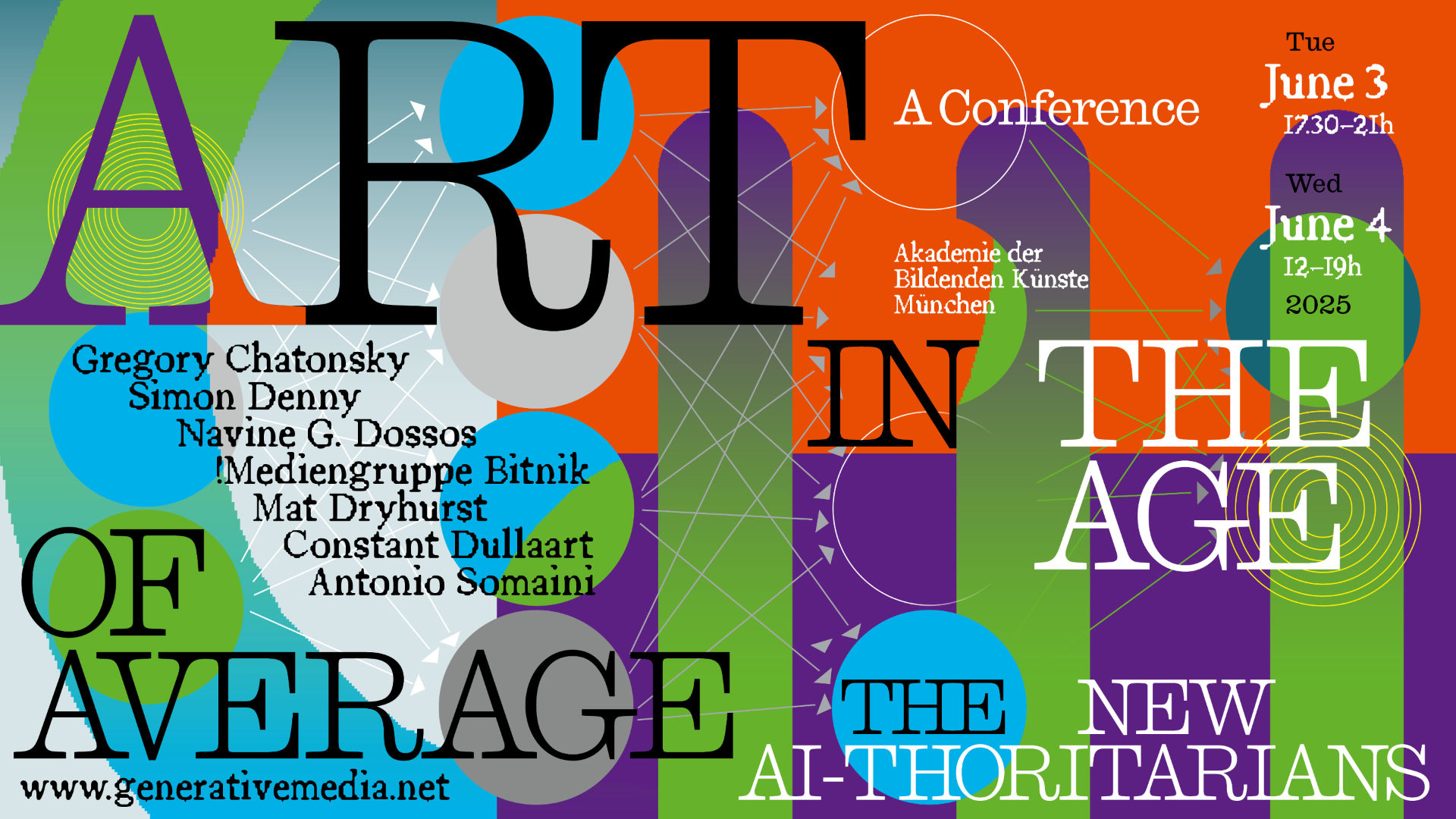
Techno-optimist Manifesto and American Dynamism, VC Marc Andreesen’s forward-looking and influential texts, provide a shorthand for how his increasingly prominent community frames their thinking.
Andreessen: “I was inspired by a lot of prior manifestos, one in particular that I enjoyed tremendously, which is the Futurist Manifesto from the Italian Futurist Art Movement and maybe around 1910. So I don’t know that I hit the bar of the Futurist Manifesto, but that was kind of my inspirational starting point.“
Denny’s presentation contextualises the vibe of Andreessen’s pitch, revisiting Futurism through the Bronze-Age Deco AI spirit that has captured this community.
Read full transcript (generated by Whisper)
Please let's welcome Simon. Wow. Thank you so much, Boris, for that generous introduction. And thank you for inviting me here. It's a real honor to present among such esteemed peers. Thank you also to my class coming along with me. I really appreciate you guys being here as well. Yeah. It's a pleasure. So my talk is called Vibe Coding the Future, and it jumps around a bit in order to give some context to some of the art references being invoked by influential technologists today. It's also a bit of an intro into how my artwork interpolates that interest and their interest. It distills that so that we can see what is being done, which I think is a challenge today, given all the context already mentioned by other speakers. So. This image. Yeah. Vibe coding. This Reddit meme is a kind of stand-in for the spreading of vibe coding. I'm going to talk more about this image in a bit. But yeah, just to address the title of my talk, I think vibe coding is a new package in the way that AI is being naturalized into creative processes. And that kind of art and creativity are being used as a touchpoint for this highly assisted coding form.
Actually, the idea of art and ideas from art, are doing a lot of work in the community adjacent to the vibe coding business world, I would say. Yeah. And just to situate my practice a little bit for those who don't really know it. This is an image of my Venice presentation that Boris mentioned for Aotearoa New Zealand Pavilion in 2015, which also shows a little bit my approach to art making in general. For this pavilion, I focused on the Snowden leaked internal documents from various US agencies that became visible, in the media from 2013 onwards. But with this show, I tried to put images that were in those documents that were leaked, in dialogue with art from another art place and time. I made sculptures using graphics from those documents and monumentalized them, and exhibited them in the Marchana Library in San Marco. Oh, sorry. Which actually is interesting to look back at those graphics because they were very, they were very, very art pixie, like, what is it called? Microsoft kind of pick art, which has also kind of come back. It's interesting to look now and see that this kind of aesthetic is still widely contemporary used in the US government.
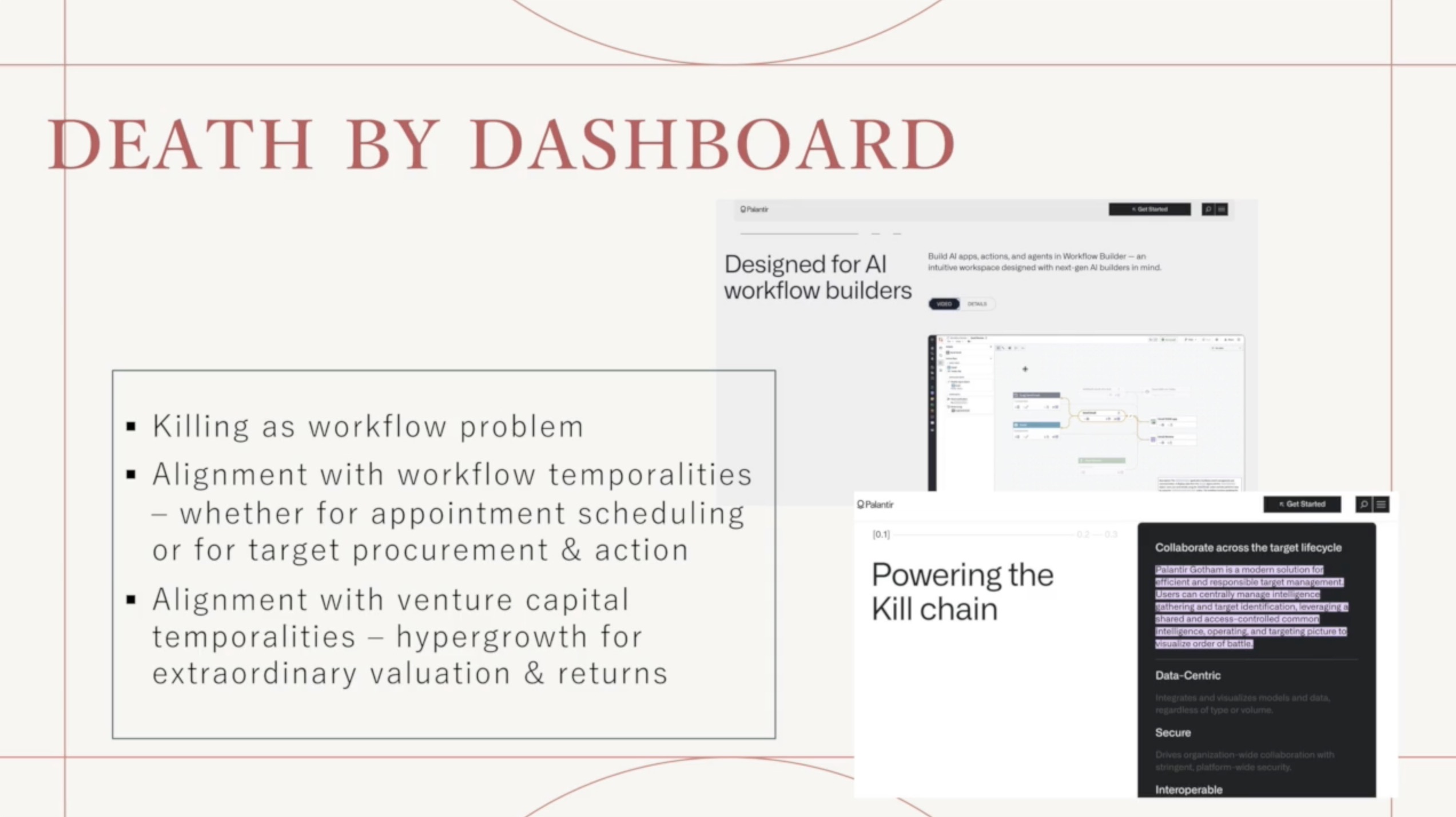
It's not something that was retrograde actually at all, or maybe it is, but continues to be. This is the logo that Musk used for his activity that's now seemingly ended in government. That, and I think this logo, vibes with the logos of the documents, that I think the basic premise was that came out of the Snowden leaks was that, commercial tech was very integrated with government. And I think that's only accelerated today, maybe like this aesthetic. Yeah, I didn't actually realize it when I made the show back in 2015, but one of the pioneers of this type of collaboration with the government from private tech, is of course the company Palantir, named after an all-seeing orb from the Lord of the Rings, co-founded by Peter Thiel and Alex Karp, and a few of their friends. Yeah, I went on later to make artwork about Karp, in a kind of similar direction a few years later. This is one of my favorite photos of Karp, and a senior team at one of the Palantir offices, with an image of Foucault on the wall taken for a New York Times article. It shows another kind of version of his trollish communication strategy mentioned in yesterday's presentation. I think he's very aware of the irony of this image.
One of Karp's earlier narrative plays was to claim that he was to be completely ideologically at odds with Thiel. He was the liberal, Thiel was the conservative. And I think this is less effective today for reasons I'm going to go into. But this is a relief I made of Karp in 2021. 3D printed using an out-of-date failed paper 3D printer. The raw material being a Palantir patent, for facial recognition. As you probably, many of you have read, this was a patent that was highlighted in Kate Crawford's work, which has often been a touchpoint for me. I exhibited that relief in 2022 in Auckland, alongside collages actually made by Karp's mother, 40 years before that. So this is an image of an artwork made by Alex Karp's mother, Leah Jaynes Karp. That same Times article the Foucault images was from revealed that Karp's mother was an artist. And after some quick Googling, I found some beautiful collages by her in the collection of the High Museum in Atlanta, which take the Atlanta child murders that happened between 1979 and 1981 as their very charged subject matter. These two, yeah, of the four devastating works that we borrowed and showed alongside my collages, the red one is called Rewarded.
Rewarded. Reward for Information Victim Eulogized Yesterday, which I think has an incredible relation to Karp's work today, Alex Karp. We exhibited her works in a group exhibition called Creation Stories that I co-curated with an indigenous space scholar and architect and friend of mine, Karamia Mulla. And here they're an installation alongside a collaborative works that Kara and I produced together. So maybe another mode of working is often collaborative. These were cable assemblages that were mining cryptocurrency, Ethereum, which also geographically mapped our family stories alongside the development of several businesses that our families were intertwined with between Europe and the Pacific from the 19th century onwards. It was kind of an artistic technological weaving of a social graph. And the whole show was trying to reflect kind of value production in terms of linkages, which is basically what Palantir is. Palantir does. Anyway, Alex Karp. He's also one of these entrepreneurial kind of influencers slash academics. He studied in Frankfurt, actually. And he released recently a very influential book this year, which also uses art to argue his cultural and political position. One that aligns with Musk and other contemporary technologists enmeshed in the US government under the second term.
I think that the epitaphs are an important indicator here of the position of the book, which is basically advocating for a new, harder version of nationalist liberalism in his terms that critics have called authoritarianism. Here's a few quotes from Quinn Silbodian, a professor of international history at Boston University, with his recent critique of Karp's book that came out in the last few days. Quinn's a scholar of neoliberalism and argues that the Trump iteration of politics is not a departure away from classical, hierarchy and neoliberalism, but rather a bastardization of it. That these new neoliberals are against the emergent nature of capitalism and against the unknown, and more comfortable with a predictable authoritarianism that they can work strongly with. He says that the invocation of hardware production and new national factories has replaced an older Silicon Valley ideal of the emergent swarm as that group's dominant metaphor for society, aligning with new militarism and a kind of protectionism that we see among the ruling class in the US. So, to Karp's book. He ends his book, actually, it's his mini-chapters, but he ends his book with a claim that aligns with this reading of Quinn's. In a chapter called An Aesthetic Point of View, he argues that we can't be wishy-washy and tolerant anymore of anything goes cultural policy.
We need to decide on a cultural position, keep it, and defend it aggressively. This is the position of an artist, he claims. So he uses the artist as a metaphor for this stance. And this invocation that we need aesthetic communities to build this cultural one in a newly confident and aggressive us. Which implies a them, of course. He also uses art often in this book, not just in that last chapter. And he constantly complates the role of the artist with the role of the contemporary company builder. He has a chapter that talks about the ideological bankruptcy of 1990s and 2000s Silicon Valley culture, claiming that they got lost in toy land. And using the famously failed dot-com company etoys.com as the exemplar of companies that did unimportant stuff, like selling toys. And contrasting that instead with true innovators that work today defending the West, like Palantir. He's also used the innovation of Basquiat, the painter, creating a new aesthetic language by incorporating street art into his work as an analogy for this difference between real work and frivolous work. Which is a bit of a shame, because there was an amazing art group that many of us in this room know and love, called Etoy, who did this incredible network performance work starting in the 1990s in the form of Toy War with that company, Etoy, that he uses.
They organized a kind of a mass art world DDoS attack on the company who first tried to buy their etoy.com domain. And then… And then tried to aggressively take it over by other means. The artist group actually produced a swarm of artists and users all over the world that clogged the Etoy checkout. And it ultimately made the website basically non-functional and contributed to its crash in the dot-com era. So arguably, this aesthetic community, Etoy, the art community, would be a deeper artistic idiom for technologists, I think. But I guess it supports the older, swarm metaphor that Carp is now no longer keen on foregrounding. Which brings me to the internet of the 90s and how it's grown from today. So entrepreneur Mark Andreessen invented the first commercial browser which etoys.com built its business on, Netscape, which was also the first browser that I used as a child. Mark is also the California… of A16Z or Andreessen Horowitz, maybe the most influential VC firm today and a prominent leader of the tech right influences, I would say. The VC company does a lot of public-facing publishing. You know, they'd have their own kind of media ecology.
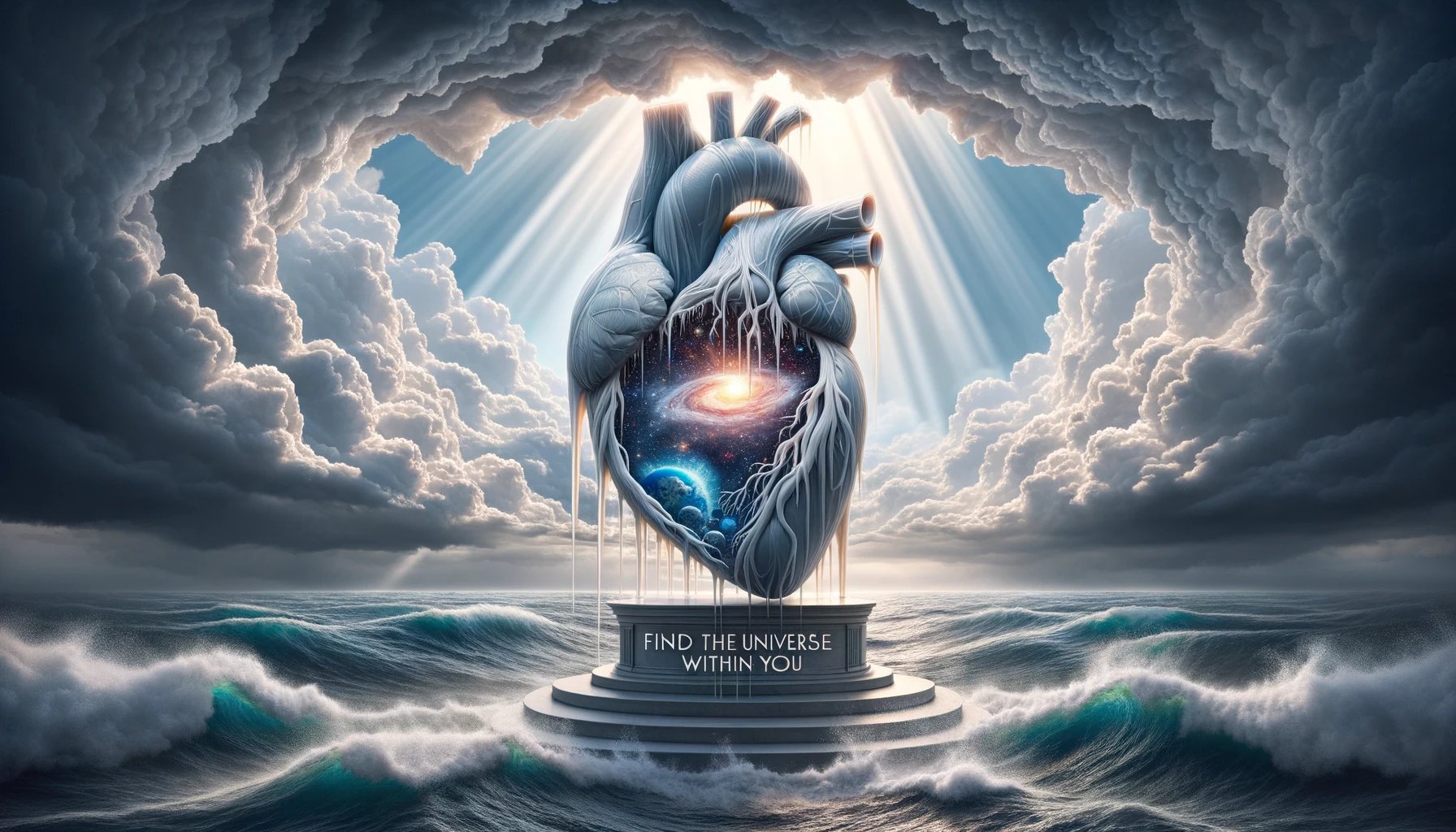
And I've even been on one of A16Z's podcasts talking about the possibility for NFTs as networked art formats. So I've been adjacent to this process. I also presented my paintings of metaverse property tokens at A16Z's launch for another of their possibly less influential business books, which just shows you the scale of the publishing, last year's ReadWriteOn, at South by Southwest in March. But yeah, the co-founders of A16Z do their own show, the Ben and Mark show, which I think has maybe the most reach by now of all their media output, again, which is substantial. And that brings us back to this image, because the last show that they did was with, indeed, this man, Rick Ruber, the kind of infamous music producer, influencer, author, podcaster, kind of guru. And it's funny, they start with this banter where Mark back and forths with them and talks about sending Rick this image, which he thought was A16Z, and then he was like, I don't know, I don't know, I don't know, I don't know, I don't know. And then they kind of celebrate it, reverse AI generated, and then it turns out it wasn't AI generated, he was actually at a conference in Berlin, but they kind of celebrated reverse AI generated into a meme.
And this apparently inspired Rick to produce this book, which, and yeah, it's an AI-assisted, vibe-coded reanimation of the Lao Tzongs writing The Way of Life. And it's sort of promoting the idea of creative coding and the de-skilled access to writing code, that the core claim of the podcast episode being that vibe coding is the kind of punk rock of software. That in the same way that punk musicians didn't have to play instruments well to make great music, now we can all code. You know, Rick also has an idea of what creativity is, and he advocates for a kind of intuitive creativity, ignoring the kind of rational and going with the vibe, as evidenced in this quote. And he also makes the point several times, claiming the process is not intellectual at all, that the artwork as agent shows us, tells us what it wants to be. The text itself has a kind of mystification poetics to it, I think. The model is the mystery, the gateway to all understanding is one of the claims in it. To me, it reads as a kind of contemporary futurist poetry. It can be read to mystify and poeticize code and the idea of AI in and of itself.
And sticks alongside these interesting animated vector art frills that sort of go through the whole book and website. You know, to me, they were immediately reminiscent of the kind of artwork made using mainframe computers and early plotting machines in the 1960s, like those shown in the seminal exhibition that many of you probably are familiar with, Cybernetics Serendipity, that happened at the ICA in London in 1968. An incredible show of art by artists that were, yeah, technology literate and excited to make work using computational processes. Arguably, you could also say that some of this work maybe also poeticized and even mystified what was going on at the time in those large liberal research institutions that artists had to enter to make these works. Alongside celebrating intuition in the process of working with AI, Ruben, in the interview, also strays into politics. And there's quite a lot of political content alongside the banter. And, yeah, he also… This also kind of vibes, I think, with Carp's way that he speaks about hubris of old in the technological republic, saying, like, who's to say this way or that way is the best way? We don't know. Who's to say democracy is best?
You know, it's an experiment. Which brings me to another invocation of art from this community, which came out a couple of years before the recent chat between Andreessen and Ruben, in a conversation of Ruben's podcast Tetragrammatran in 2023. Speaking about his being inspired by the Italian Futurist Manifesto in 1909. Here Andreessen is referring to writing perhaps that is now best known text, the Techno-Optimist Manifesto. So this is by Andreessen, just to say that VC I mentioned earlier. This is a physical copy of the manifesto that founders from A16Z are gifted when they get funded by Andreessen. It's again using, now for the third example, a kind of plotter drawing style in the slipcase cover, and also a kind of a Lord of the Rings font in metal on the second cover, something I imagine Carp would also love. But it's also published on the VC website for all to read. And it comes with a list of patron saints of techno-optimism, which indeed name-check among many other people, the order of the first Futurist Manifesto, Marinetti. And he highlights it a couple of times in there by using a quote from the 1909 manifesto on its body, which feels again in tune with the turn that Slobodian highlights in the community, becoming more comfortable with hard power and more authoritarian in approach.
To paraphrase the manifesto, this is Andreessen speaking now, of a different time and place, beauty exists only in struggle, there is no masterpiece that has not an aggressive character, technology must be a violent assault on the forces of the unknown, to force them to bow before man. So a few people have responded to this text. As I say, it's very, very influential. Jill Lepore, keeping with podcasts, people that use podcasts, but are also kind of serious intellectuals, which I think have a lot of reach today. Jill Lepore, who is the professor of, American History at Harvard, said of the manifesto, Andreessen is the author of a triester called the Techno Optimist Manifesto. It consists of a list of statements. We can advance to a far superior way of living and being. We have the tools and the systems, the ideas. We have the will. We believe this is why our descendants will live in the stars. If only we place our face in the techno capital machine and recent promises, we will become technological supermen. We are the apex predator. We believe in greatness. We believe in the ambition, aggression, and persistence, and relentless strength.
Andreessen cites, as I mentioned before, Marionetti, and she goes on to speak about that relationship. In 1909, Marionetti wrote what he called the Futurist Manifesto. It's also a list of statements. She says, we want to sing the love of danger, the habit of energy and rashness. We want to exalt movements of aggression, feverish, sleeplessness, et cetera. So she says it's the same mojo, fists raised to the stars, but ten years after that, Marionetti also famously co-wrote the founding document of the movement made by Mussolini, the Manifesto of Fascism, to address that. Mark also, like any reasonable person, hates it when people call him a fascist, if they disagree with him. But here, he cited the author of the fascist manifesto as a major inspiration for his own manifesto, which is why, to Lepore at least, the future envisioned by techno libertarians happens to look chillingly like the very worst of the past. So that's what Jill says. She also says something that I found really useful to think about, also in terms of the framing of this conversation. You know, earlier in that podcast, in reading her manifesto, she identifies a problem that I want to pause on, the idea that it frankly seems hard to know how to deal with identifying and making parallels between the fascism of the past and contemporary political developments towards the right.
It's hard not to feel a bit stuck always talking about fascism when those… when those it applies to shrug it off, weaponize the accusation in a series of kind of boy-who-cries-wolf maneuvers. It's also hard to know, as many public commentators from both left and right have said, how useful the analogies with the past are for reading the world today. It's a helpful context or a distraction for what's going on. It could be either. I think this is part of the stasis in the face of these developments that I find challenging to deal with also. You don't want to just talk about fascism all the time, but you also don't want to not talk about it. Especially when the figures you are trying to understand are invoking the culture that is closely aligned with its birth and history. As mentioned before, Andreessen, Rubin and Karp's book, they all use these motifs on the cover that are at least modernist and early computer art reminiscent to me, but put alongside some of the work of the futurist art movement that Andreessen alludes to in his manifesto here, drawing from Giacomo Bella from 1912, it's something that I think is helpful to go into deeper.
As kind of a participant in the NFT art world, I'm referring to myself now in the last few years, which is in some ways, I think for me, like a parallel art world. And also noting its proximity to the Andreessen world. Many people in that world are in the NFT world. Some of the developments in that world I follow. And the community there mostly exists on X. Most of the sharing is done on that social media platform. And recently a plotter moment has happened where artists who used to make NFTs also produced plotting. This is a screen grab of what is referred to as plotter Twitter. And if you go to X from within the hashtag, you'll see how big that community is. It's coincided with another development in hardware world, a kind of post-Shenzhen cheap and innovative hardware explosion that has given way to a wider ability of tech tools, availability of tech tools. So from 3D printers to CNC machines, drawing machines, and like these, maybe the younger cousin to the plotters from the cybernetic serendipity era. And with these tools, NFT artists have been experimenting and making plotters do all sorts of things.
And this is one of my favorite, an artist based in London named Litsia He. This is their setup with four plotters kind of painting. This is Litsia. And this is her work and the plotters painting. There we go. So she also like there's also kind of content produced video content produced of the kind of the making of this, which I think has something relevant to the idiom as well. And these are kind of the works that they make. When I saw them for the first time, while reading and thinking about the Techno-Optimist Manifesto, I couldn't help but think of their embeddedness to to futurism, intended or not. I've not heard he speak of their work in terms of the language of historical modernism and certainly not in terms of futurism, nor do they speak in political terms, frankly, about their work at all. But for me, the associations opened up a whole thought process in my mind. Yeah, and this is the flatbed printers that were the type that were used in organizations around the cybernetic serendipity era. And this is one of the most famous works of that era, just for those who are not familiar with it.
And I think for me, I'm just going to cycle through a few more. There's, you know, there's a political context that's they come from, which has kind of, I think, been historicized as kind of opposite to the beginning of Italian futurism. It was embedded in mostly liberal research organizations. Recently, there's been some attempt to kind of re-historicize this period as well in the art world with a recent show, for example, Radical Software, focusing on art made by women with computers before the commercial web, which was an amazing show that happened in Luxembourg and in Vienna, curated by Michelle… I forget. Michelle Cotton. And works like this by Charlotte Johannsen were also seen in the Venice Biennale group show by Cecilia Alemani a few times ago as well. So there's been a kind of revisiting of this time and a kind of inscribing of it as this has this kind of liberal history. But I also kind of looked further into those histories and thinking about the context of the work that was made within those plotter environments in the 1960s, especially those that were more overtly political, like this one by Kennedy and Shuri… of President Kennedy.
After he was shot shortly. Of Scuri and Schaefer. Yeah, so a very poetic look at that moment. There was also much more explicitly… things much more explicitly alluding to the military made in that context. So I guess the military in some ways must have been in the background of these artists' lives at the time anyway, as often the research institutions produced by these machines were often funded by military programs, especially in computing. And also how the plotter drawings like this also felt like they owe something to futurism, particularly Giacomo Bella. Here's a Bella drawing from the 1910s that uses the motif of a bird moving through space as a starting off point for capturing dynamism of movement as an abstract form. And here's something else from that series. Here's something else from that series. Here's something else from that series. As it was shown in maybe the most visible liberal framing of futurism that happened in the post-World War II period, the first US exhibition of futurism was explicitly at the MoMA in 1961. This is the catalogue from that show. It's interesting to think of how futurism was framed at this time, which was not that long after the end of the Second World War in some ways.
It kind of separated a liberal politics for innovation and… Sorry, it celebrated futurism for its potential as showing an innovation within modernism, rather than kind of looking at its relationship to fascism explicitly. Here's some more installation from that show. Yeah, actually, maybe I'll just go back to that one. There's a trope that's been important in futurist historiography, which is perhaps typified in this exhibition, actually, the separation of pre-World War I and World War I adjacent futurism from that of more fascist adjacent futurism, in the second wave. The 1961 MoMA show explicitly doesn't show the second kind, but celebrates it as a kind of central part of the story of progressive modernism, like I said before. Having said that, this is not to say that there's not militarist works that were included in that first progressive story of futurism, like these canonical works by Severini and Boccioni, kind of depicting the glory and dynamism of armoured trains and cavalry. Right from the beginning, futurism was anti-feminism, pro-war, imperialist, nationalist. These were creative metaphorical ideas, but they were also lived ideas. And artists fought and died during World War I for these ideas, including Boccioni, who was the author of the image on that side.
So, this does bring up an interesting question for me, because it's also about this historicisation and contextualisation of futurism in the 21st century. Because the next biggest New York show of futurism happened quite recently, at the end of the Obama era, in 2014, at the Guggenheim. And this is the cover of its show, foregrounding one of those second wave futurists. This is a work, a very famous work now, by Tullio Crelli, who's only made his first works in the late 1920s, when futurism was fully embedded with the fascist Italian regime. This brings me also to another exhibition, which is the only one of these ones that I've seen, which was a much more recent one that's just closed a few months ago, at the National Museum of Art in Rome. The only big futurist show, exactly, that I was able to see. And this is what that show looked like. It included also both kinds of futurism, and this room that focused on the most important part of second wave futurism, as it most associated with the Mussolini regime, and its most explicitly military propagandist work, that of Aero Pertura, or Aero painting, of these artists like Crelli.
And it was notable that that show also put objects like these planes in that show, which I think again, to me, spoke to kind of Carp's invocation of the, and I think Quinn's idea, that the kind of production, the hardware, is again becoming important as part of the story. Yeah, here is that painting that was in the Guggenheim in that show, alongside a couple other Aero Pertura pieces. But just to kind of show you, it even went, I think, a step further than my understanding of what happened at the Guggenheim. In an adjacent room, you also got things that were, yeah, I would say, left out even until now. This is an explicit bust of Mussolini, in kind of constant movement, done by Renato Battelli. And just to give you a sense of like how aggressive these Aero Pertura movements and how explicit they were in terms of kind of clear propaganda, you can see, yeah, another painting that wasn't included in that show by Crelli. You can also see other works that he did later. I mean, he lived until 2000, and something that wasn't represented, wasn't representational, also became part of his work.
He did these more kind of abstract pieces, which for me remind me again of the Ballard drawings that I mentioned earlier, often framed as the most innovative of the first wave futurists. Another work that wasn't in that show but is on show in Italy, I think maybe until this day, is this piece of Ballard's at the Fiat car factory, a car company. A car company, of course, that's associated with nationalism and various different types of histories of Italy, including its fascist period. And interestingly, on the back of this piece is another work that Ballard did much later by… Just to maybe, I guess, confuse this notion of this claim that's been made with first wave and second wave futurism. This is clearly a very propagandistic piece, a painting of the March on Rome that Ballard did on the back of his earlier work in the 1920s. Yeah. Anyway, so in a time of futurism, it got quite some negative commentary from the international press, which apparently invited and uninvited a number of prominent international futurist historical scholars, summarised in this review from Art Forum published in April. So they kind of opened things up and then kind of closed things down.
It's also had a lot of kind of news speculation, both within and without Italy, of the kind of bringing this kind of adjacency with the Maloney government. Yeah. Lots of these types of articles were produced. And commentary about the government explicitly controlling the narrative about that show and playing down the violence of the work of Ero Pertura, for example, and focusing instead on kind of naturalising a progressive narrative that leads from Mussolini to Maloney. Here's a couple of books that I also bought when I was at the museum. Because, yeah. There was an earlier show that also kind of focused on this type of narrative from a different angle, promoting the Lord of the Rings and Tolkien as a figure. So this is… Yeah. Man, professor, author. Okay. Yeah. To move back to the US, another recent and recent text from 2024, so an updated text from the Techno-Optimist Manifesto, seemingly doubles down on his futurist themes. American dynamism is maybe the most… explicitly nationalist and militarist of his texts to date, which is an investment framework that bundles defence tech investments with infrastructure and domestic production and strategic assets like AI chips, etc. Again, going to that Quint's LeBodian thing.
A signature investment, or maybe the signature investment of American dynamism is another company modelled on Palantir, even down to being named after another Lord of the Rings object, Anduril, which is an AI weapon and a weapons company co-founded by Palmer Luckey, who was also the founder of Oculus Rift, bought by Meta, who was then fired from Meta from funding a Trump super pack during the first Trump election. And indeed, vibes have truly shifted since then in Menlo Park. He's now collaborating again with Facebook. Yeah. And this is some advertising imagery that Anduril produces of its AI-equipped weapon systems. Here, kind of so you can see the image. And they're kind of embedded in a billboard that includes a quote by Trump. So it's really a very, very explicit association that Anduril has also with the new regime. Exactly. And this is Jen Dahibuchi, the creative director of Anduril. I see her as a kind of analogous figure to the NSA director that I focused on, David Darchicourt, for my Venice project, but for the kind of American dynamism movement. She is kind of responsible for all this very… innovative advertising and image making that they are doing, and a lot public facing.
This is another image of weapons here. I think they have a strong relationship to the AeroPortura images of the Crowley works and the other artists I showed back then. These artists are created… These artworks are created with computer graphics programs and then AI combined as well. But they use a kind of painterly patina and dynamic lines of force can be seen in them as well. Like, you know… resonant of the late futurist idiom. This is not only with the graphic production, also they do a lot of video production. And again, I think some of the ways that these things are framed are also very reminiscent of those types of images. Yeah, here are some more under the sea, so it's not just in the air. They also do a lot of, as I say, like public facing publishing, which I think is a real difference, for example, from other defense company primes, so they're called, like Lockheed. You never see advertising from Lockheed, advertising from Anduril's. It's everywhere in the US. Yeah, this is another one which also comes with text, which again advocates for Silicon Valley that should work on actually important things like defense instead of frivolous things like consumer apps.
A little bit, again, in this carp idiom. They're often also more explicitly like models on World War II rearmament imagery, also evoking the kind of emergency of that time. Yeah. Actually, I think this is a new style of weapons marketing that has become a sort of international defense tech trend in communication. And I think everybody in Berlin that I knew was very surprised to see this kind of painterly imagery on German AI weapons startup quantum billboards around Berlin some months ago. I don't know if you guys saw these images, but they again kind of speak to the same image idiom. Yeah, some very strongly nationalistic. These were all over billboards in Berlin. Um… Um… Whoops. I lost my… Oh, yeah. Oh. Uh-oh. So, yeah, this is another example as well of the type of imaging that's done rather here in Germany, which is a little bit different. But, I mean, you can imagine why, right? Language and attitudes towards defense here is changing. With pressure from threats of the Trump administration, abandoning NATO, Germany has raised its debt ceiling, and some of the prime people that are going to receive that money are indeed these AI companies.
Um… You know, and it's not just one threat that's sort of being invoked to kind of make the spending more socially acceptable and naturalized. Um, also, yeah, when Merz has committed to putting, you know, production facilities for more long-range weapons into Ukraine, Russia responded with a direct threat to bomb Berlin. Right? So it's… You understand why weapons are being reached for also. Um… Anyway, so to kind of, like, work with these ideas and to kind of work through these processes, I started to kind of think about bringing this language together in some way. Um, and I've been taking cues from this NFT community that I mentioned before, but also kind of trying to work through more explicitly charged material. Like I said before, I was challenged by the NFT kind of adjacent work, but I found it not addressing the politics. And this is one of my early drawing experiments with a plotter. Um… This is a Severini work, again, from this kind of first wave futurism. Um… A very famous work, kind of glorifying the value of war. And I made this kind of first translation into it. I translated the English… French into English.
I updated some of the idiomatic language. I changed the country's patriotism that was supposedly represented into the language that I was representing. I subbed out the canon for a contemporary Andral drone, and I added an Andral logo. And to me, it was a sort of chilling image that has something between the liberal cybernetic serendipity research era plotter art, meme culture of today, and, of course, the Severini work. Um… Scientific or kind of operational images like these photographs by Marais were a well-documented influence. I think that's a good point, because they obviously had a lot of influence on the futurists as well, especially Bala. Um… And, uh, yeah. He made these images with this object, which was also stuck in my mind when kind of rethinking through this history. Um… Obviously resonating… This is a gun, which is also a camera. It's actually a camera gun that captures movement. Um… And it's an operational image object, if we use that language here. Um… Yeah. resonates with that. Anyway, as I say, I had this object in mind when I was target marketed a small handheld inkjet printer on Instagram, which led me to buy an industrial one that is literally used for making packages legible to machines.
Its primary use is being printing QR codes directly on boxes and warehouses. This is what that object looks like. Upside down. It's weird. Yeah, exactly. It really also looks like a gun. And when you go to print it… Exactly. Yeah. It's hard not to capture traces of movement in it. It's actually kind of a printer that contains some of the dynamism of the movement, let's say. Here's a canvas that I made. Using promotional images from the German drone company, Halsing's website of the HX2 drone with that device. And here you can see the marks of the printer dragging across the primed gesso surface, tracing the gesture from me having misused the machine to produce large scale images. Dividing up the picture plane in violent jagged sections coming from maximum size of the printer output and the shape of the toner cartridge it uses. So these relics kind of come from the process. It's really hard to make anything that doesn't have them. And this is the image that I made that object from. It's from their website. And here's another image of flowers that they use as a metaphor for democracy. Halsing also that I made that same gesture with.
And here's another canvas depicting one of the U.S. company Anderle's core products. The company I mentioned before whizzing through the air, also taken from its website and again kind of interpolated through this weird operational gun movement. And here the image that I started with the cover of Carp's book. So directly reminiscent of both the Ballard drawings mentioned before and the cybernetic serendipity era computer plots. Yeah, I'm yet to show these works. In fact, I'm going to mention that later. But this early, this is an early experiment I made with that machine. An image of neoliberal economist Friedrich Hayek which has made it out into the world already in some form. It's now on the back of Quinzel Bodian's new book speaking to some of these narratives that I've touched on here. So this was kind of the beginning of publishing this project for me. I not only worked with drawing with plotters, I've also tried painting with them and like Litziahi has. Here an early experiment with an Anderle promotional composition, which is technically, I guess, in light of some of what was highlighted yesterday, a way of taking a complex vector output and interpolating them into more simple ones, simplified vectors.
And yeah, here we can see some later. I've been using the Axidraw and Bantam tools plotters to paint as well in much more complex ways. Gradually working on a kind of language of painting that both included this kind of operational origins of plotters by making kind of JPEG like square blotter, square brush, plot strokes, if you can say that, an allusion to pixels, but also rendered in a kind of divisionist or or pontilist set of strokes. So this is this is that machine working away. Exactly. And I also covered it, converted a larger machine made for CNC tooling to be able to work in a bigger, bigger brushes. Also has a much more intense sound to it, this one. These machines are, here we go, paint side by side in my studio at the moment. You can kind of see it's quite weirdly ASMRish watching this. And actually a lot of the content that comes out of this plotter Twitter world has this kind of ASMR quality to it. I've also been altering kind of comfy lores using Bala and Crowley paintings and mixing them in with a few of these new defense tech images.
And I ran a series of outputs, exactly, that kind of work with some of these compositions. And this is the type of output I got from this, a kind of sloppy synthetic futurist painterly image. And that had kind of all parts of those origins in them. And I've been using those painting machines to make paintings from those outputs, using those vectors to tell the machine where to move the brush, but also mixing it back in with the original image. So printing the image back onto it here with a kind of UV printer that also prints over the top of those strokes. Exactly. So what comes out is a kind of a weird, fake futurism. For me it's both conservative and contemporary, containing the language of today's defense tech, a mix of first and second wave futurism as well as a kind of a post-futurist, post-futurist, post-futurist kind of thing. a post-futurist, post-futurist kind of thing. liberal visual language of plotter art, mixed with the kind of contemporary plotter Twitter's more ambiguous posting. So it's kind of mixing up their politics, it's mixing up those histories. Here's another of those images. They're rough, they're fractured, they're mechanical, but they're also gestural. They're printed and painted at the same time, digital and analog, futurist and I would say also retrograde. They're also quite lyrical. They have a kind of odd poetry to them for me, and they contain a more chilling fracturedness of the moment that I think was captured in a couple of these first talks. It's an awful kind of reckoning of the past as well as the future of the world today. They contrast to me with this glossy slop outputs of AI. They're clunkier, they're tougher and they're stranger.
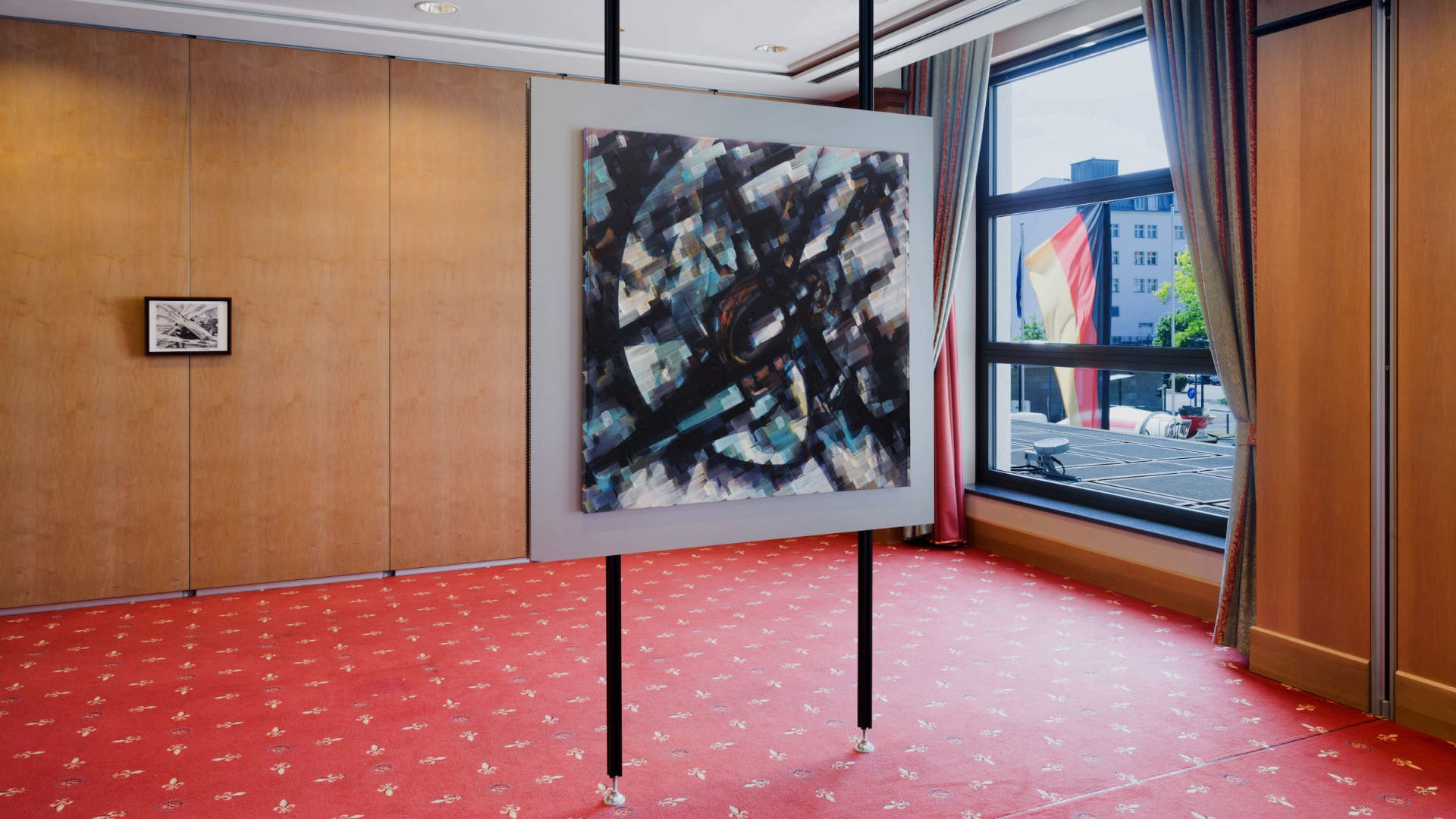
Okay. I'm going to show some of these works for the first time next week in Berlin, in a show inside a hotel room near Potsdamer Platz on Stauffenbergstrasse. This is the room that I'm going to show it in. It's a conference room which faces across the street the German Defense Department headquarters known as the Bandler Block. And across the street from the Bandler Block there's also, and that looks onto the hotel and indeed onto that room, is the office of the guy that shares the name of that street, Mr. Stauffenberg, who organized this coup against Hitler at the same time. That place is now a museum against resistance. So it's called the German Resistance Memorial Center or Gedenkstätte Deutscher Widerstand. Interestingly enough, I think that it's also on the same street as the Shell House, which is a 1920s international museum. It's a very interesting place. It's a very interesting international style modernism that is also used by the Defense Department today and it's the only other building on the part of the street that's not in use by the Defense Department. So this building, the Bandler Block and then the hotel. It's interesting also because it contains a history of, a local history of futurism.
So this is a book that was produced after the first Futurist show in Germany which was in 1912 at a version of the Sturmgallerie. that it's now in a site that actually is not, weirdly, the address on this. It was in a site that is now the Saudi embassy and an SPD-adjacent stiftung. But it's also just across the river from where there was also the site of the second futurist show in Berlin, one that focused on the later Eropatura and became a kind of symbol for the rejection of the futurist from Nazi-approved art. Hitler famously denounced futurism. Although era painting was highly contested, obviously, and many people supported it also within the Nazi party. Exactly. So here's the view from that conference. So you can imagine that situation that I'm going to do next week. And here's a kind of bad model that I've made, also to show how the kind of inside and the outside of those materials will kind of dialogue with each other. And here's the material for scale, sitting around in the studio on the material, that I'll install as well. Yeah. So I'm not the only contemporary artist picking up on these voices from entrepreneurs that celebrate futurism.
There's a whole contemporary art world happening in artist circles that are aligned with the community that I'm speaking about. And they make clever, networked, lyrical and medium-specific works that fit the futurist mold probably better than my retrograde fake futurism. These are images from, perhaps, the most successful, lasting NFT PFP project, Milady, a kind of cute accelerationist collectible that was embraced by the Dime Square, world famously now adjacent to the emergent new right. This is what, yeah, exactly. They have, I think, outshone and outlived louder and more successful earlier NFT PFP projects like Bored Apes and CryptoPunks. And their founder community, the artist group, Milia, have, Romilia, have explicitly, endorsed new right figures and philosophies emergent in Dime Square and kind of urban adjacent worlds. And their connection to kind of futurism has been highlighted also in the media. I mean, spectator obviously, but this article makes a claim to their futurism. And I think, you know, there's a convincing argument that it is an invocation of similar things. This is another image. Yeah, that I also want to start with. And this is the last kind of part of my talk. Just a couple slides more.
I want to make a claim that not all art that has a pro technology vibe to me is the same. And that some of my peers make, you know, use of productive use. I would say a futurism past with work that I find helps me navigate this present somehow. I don't think that this tragic history, and it is a tragic history of futurism and its political journey, leaves us with nothing to work with if one is not of those politics. This is a snapshot of an artist. A friend of mine, John Rathman, that I took when we were showed in a group show together in Rome at the Maxi Museum in 2022. The Maxi also coincidentally takes care of the estate of Giacomo Bella. And this is his apartment studio that we went on as visitors as a kind of part of being hosted by the museum. And it kind of contains some interesting kind of post-futurist clues in there as well. One of the things that we saw together there were these images made in the 1970s by Elika Bella, his daughter, who was also a very poetic artist. And to me, I kind of really connected with these paintings of just the sky, no machines.
It was kind of a post-era Perturbo. It was made in a moment when Italy had gone back to the liberalism that we know from the Dolce Vita, etc. John uses some mid-journey models, actually the same ones that I did for one of my NFT projects, Dotcom Seance, tweaked and adapted to output a kind of devastating and tragic realism. That's what I would call John's work if I had to describe it. It tells stories of kind of media warped self-making and dark experiences that explore the present in strange and moving ways. It also has kind of an air of transgression around it. And I think that that tone is really important for John's work. He's also written about AI and again, maybe mystifying terms, but I find the way that John speaks about that, the language of collaborating with models and his kind of valuing of relics of previous models, I think also that Constant alluded to to be really compelling. Another artist that I think makes really productive use of the history of Futurism is another artist peer of mine, Avery Singer, that here kind of framed her connection to that with a quote by critic Isabella Graf, whose work actually resembles some of this later second wave Futurism that was not era Perturbo.
You know, like this piece by Nikolay Dulekov. I can't pronounce the Bulgarian. He was Italian Futurist, but originally Bulgarian. And this Defero language as well. So just to say that there's work, productive work, I think being done in a contemporary idiom. Again to like challenge a little bit the kind of the ambivalence that I see in the situation. I guess I want to close with, with a couple things. Another Jill Lepore quote from the Elon pod that I quoted earlier, where she says that while she rejects the retrograde models of the future that figures like Musk and Andreessen may have in their heads, the products they have made also, of course, are engineering marvels. And there's something about this weird thing where we're all using these systems, but we're all kind of also querying them and the politics behind them that I think is really important to kind of sit on. And this is another later Giacomo Bella piece, Optimism, and pessimism. And I'll end on this slide. I wonder if there's a way to use what has been compelling to telling other stories about technology and the unknown that can be salvaged and productively used.
That we don't just give technologies cultural narratives to authoritarian adjacent storytellers. That we find a way to use transgressive appeals of these histories of futurism to open up other stories. As the 20th century's post-war, liberal aligned artists and art historians once did for first-wave futurism. I close with a couple of works that I installed in Petzl Gallery in New York a year ago in a group show that I curated called Dungeon. It's a painting that Avery Singer made for the show, also called Dungeon, alongside an eToy Collective Share Certificate plexiglass print with an embedded RFID chip from their year 2000 toy war against eToy.com. Thank you very much. Well, thank you so much, Simon, for this extremely rich and brilliant lecture, taking us through a whole history of links, basically of genealogies. I cut a section in my introduction which was dealing with a very similar lineage, but I arrived it. From a different character. Let's put it basically from brain rot from the meme series Italian brain rot, which is the character Bombardino Crocodilo, which is introduced, which is a mixture between a crocodile and a fighter plane, which is introduced by a song which claims that it's on its way to bomb the children in Gaza and Palestine.
And then it occurred to me action. This really links to your talk that if you look at this, crocodile from a different angle, then you see this parachutist, you know, from the IOP to Riaz series, et cetera, et cetera, basically linking into that same aesthetic lineage of Italian futurism, et cetera, et cetera. And I think what I really found very clear and illuminating in your talk is that you also connected it right with the outside effects. It's not just. Slop. It's not just, you know, generative AI. It is of course a destruction of meaning that's happening in their complete holding out irony or stuff that degree also pointed out in his lecture yesterday. But there there is, you know, a sort of backlash into reality that the latent space turns into a manifest space in guys of the drone Wars the development of drones. You mentioned companies like under real, for example, I mean, I've been in Ukraine where basically this linkage between image production and drone production is very, very strong because a lot of our colleagues are involved into actively designing and producing. Let's DIY drones and then along comes Eric Schmidt and White Stalk.
I mean the US basically drone companies who siphon up all these sorts of bottom-up weapons knowledge production. And then channel it into for example, this German Ukrainian weapon drone collaboration that is happening now. So I mean there is this constant, you know, back and forth between the latent space and the manifest space because as you have already also shown the manifest space of weapons production then gets channeled back into art production and also taken up enthusiastically by new Futurist like Remilia. Etc. Etc. So I think that was really fascinating because it also connected, you know, several strands that we have been talking about today. Maybe Boris, you want to ask a question because thank you. Yeah, thank you. Sure. Thank you. First a non question. This was such an excellent Futurism summary and the way ideologies work and so on. Are you trying to get art historians out of jobs? Like this? This will be very easy. To contextualize. I think I mean I as it's maybe evident in the way I put the talk together. I place a lot of value on on art history. I'm against people that poo poo art history in service of stem.
Let's let's say that and I'm pro institutions. I spent a lot of time in educational institutions and mentoring program. I found it Etc. So I yeah, I think art history is key and frankly like when I you know, I didn't know a lot about Futurism before I started this project. I've been working on it for like, a year and yeah, I was sort of keyed into it because I follow figures like Andreessen and then the more I went in the more I found that my art historical literacy that I have from being embedded in this community was actually a really good shorthand to understand what they were trying to invoke even though maybe their invocation is whatever misreadings of various kinds could be claimed still. It was I think the depth and art history really helped me map what was happening in now. So again this this tension between. Are we paying too much attention to the past when we graphed, you know, let's say the ideas around fascism onto interpreting the present politics. I think those same questions can be filtered throughout history and this is sort of what I'm interested in. Yeah. Yeah, excellent.
Maybe we have questions from the audience. Did you want to respond? Anybody intrigued? Then I have while you think quick question about I think we have one. We might have one. Okay, then first of all, dance. Thank you. I'm also. For the very deep and interesting lecture of drawing these parallels. I have a very simple question. Do you plan on showing the new work in Italy? I don't have any immediate plans to show it in Italy. And I think that would be a challenging place to show it actually because and there's probably Italians in the room. I know there's at least one but yeah, the invocation of this history does I think read very differently there as far as I can understand it again. I'm not Italian. I've only visited a handful of times. I have a gallery that I show there with but I'm also in touch with artistic colleagues. I've worked very closely with the with the Cura magazine people who I think are really great organizers in Rome actually, and I'm on a board for a you know, that they're putting together and we talked about exactly this problem, you know, like how does this work get rid in different environments and I think context is really important, which is one of the reasons why I chose this very loaded adjacency venue to kind of launch.
The series so to speak because I think that yeah, I often as I have shown I use sites as a part of the meaning of meaning making of work and the first images that will go online in bulk with the story from you know, authored by me on my social media of what this will be contained within that site, you know, so yeah short answer. I don't know. Yeah, good question. Very interesting. And we have another couple over here. But we have too many for me then I will keep in touch. No, no, no, I want your question. Too. But yeah, I don't want a small question for you. And can you elaborate on the term vibe coding? Like what does mean vibe coding? What is fine? Sure. Yeah, I'm sorry. I should have started with the definition. That's that's an oversight. So vibe coding is the kind of slang term that is used to for essentially AI assisted coding where you rather than writing coding language like C++ or whatever you instead kind of prompt as you do these kind of images. production systems and it writes the software for you, you know, so it's it's yeah, it's it's become a very common term also associated somehow with Rick Rubin.
But but yeah, that's my understanding of vibe coding very short. Now we have lots of questions, maybe two. Hi, thank you for the excellent talk. I'm very glad I came from Berlin to hear this and to see the conference. One question. You sort of excuse yourself for being part of the NFT space and I know some people in the room are very critical of NFTs, but then we also have I don't see Matt right now. Matt's here. Yeah. So basically Matt and you and then we have Mario Klingerman here and some students. So speaking of the future, how do you see the future of artists and maybe also the art market because you said there's this new online art world and then there's a traditional art world. So any ideas on that and what role AI can play? Thank you. That's a really good question. I'm glad I'm given the opportunity. To elaborate on that a bit. It's hard to know which things to give weight to and talks, but I think that's a really good question. So I introduced my activity within this art world as an NFT art world and I tried to kind of make a distinction between the kind of art world that we're maybe sitting in here in the NFT art world.
That might not be fair, but I think a lot of people within the kind of museum art school, whatever Canon world do consider NFTs a bit other and when I tried to kind of like, you know, I was made a kind of a number of NFTs, tried very hard. To get involved in that world as best I could because I found it a very dynamic place to work. No pun intended, but like it's yeah, it is somehow a bit separate and I always don't know how to address that also within my own work. I've made work that is NFTs that doesn't read at all with with my so-called Trad Art community. I've made I've made kind of Trad Art that reads not at all with my maybe NFT adjacent digital art community. I find bridging that gap very difficult, but I find myself nevertheless, compelled to do it. So it's not a just to clarify on my part. It's not a degenerate like I'm not trying to say it's not a cool art world. It is a cool art world, but I think it is somehow separate in my experience at least. Does that answer your question?
Yeah. Thank you Simon for this great conference and lecture and also for this wonderful work. I really do hope you will exhibit it in Italy as well. Yeah, and as an Italian I can tell that that exhibition was a scandal. Yeah, also in Italy was really, extremely surprising. Absolutely this Intel for the Futurismo. So let's not take that to reread Futurism as the official new Italian interpretation of it because many people were stunned and yeah, really stunned by such an operation. But my question actually I wanted to ask you because we could state that in the vector space of early Futurism, there was also very important reference which was chronophotography. For Ballon. Moreno. Yeah. So I wanted to know how if you thought also of that legacy in this work that you are redoing. Absolutely. What role it played. Yeah, great question and thanks for the Italian context. I never want to kind of speak on behalf of things that I don't know about. But anyway, yeah, so I did include a little slide there of this this Murray gun, this chromographic gun and for those of you who don't know the history of kind of photography and moving photography in particular the big figures are often told to be Murray and Muybridge.
And there's also an interesting kind of Silicon Valley Europe connection in that as well because Murray was working in France producing these kind of images and Edward Muybridge was famously working in California on Stanford on Leland Stanford ranch working for with Leland Stanford's horses with a with a with a camera that was bought by Leland Stanford to make these very very famous moving images, which then of course became Stanford University. One of the most influential. Kind of think spaces I think for this world. So this this history is actually kind of like deep on many many levels and exactly. So there's a there's actually a great book called Palo Alto that was done by remind me the author of Palo Alto, but it's a history that talks a lot about this especially going with the eugenicist thing and this idea of kind of yeah, the scientification of knowledge and measuring being a part of that operational images, etc. And and for me when I got kind of Target marketed this bizarre kind of like, direct 3D printed gun thing. It just reminded me of this Murray object and I thought somehow this fractured photography was sort of a weird reverse of that chrono photography.
That was kind of the way I was thinking of making those more photographic appropriated imagery. Yeah. Okay, maybe as a was there another question? No as a closing remark sense. Thanks also going back to this vibe coding question for pointing out this irrational. No instrument. So irrationality that's also baked into this discourse. It's not only instrumental rationality, but you know the instrumental irrationality the orientalism, you know that immediately sort of wallows up whether it's blockchain or you know, generative AI space is kind of fantastic how irrationality is also instrumentalized and maybe just a tiny remark to because I'm not an art historian, but maybe to all the artists. I'm not an art historians in the space. I was wondering it's a question maybe to art historians because we know we have these very link backs to futurism, etc, etc. I was wondering actually that's something I started discussing with Kunzeli Yeltsinkaya whether all basically genres of generative AI whether it's brain rot or slop are the same. I think we can apply almost art historical. Categories to them some of which relate more to data to surrealism than to futurism keeping in mind. Also that many people some people from data and surrealism also ended up being fascist in the end, you know, but we can make start making distinctions, you know between slop brain rot and other forms of generative AI.
It's not all the same. It's super ambivalent, which is also scary because it gives it an added power. Thanks a lot Simon for this brilliant lecture. Thank you. Thank you so much.