Conversation between Fred Ritchin and Hito Steyerl
Read full transcript
Senior executive at Google, recently said that if your memory is different than what the photograph says, just change the photograph. We're in an era right now where those in power want us to know as little as possible about the world. They're very happy when media become chaotic, when social media allows everybody to contradict each other, to weaponize it, to intimidate with it. And they don't want, you know, in the United States, the fourth estate, this idea that media companies can stand up to the three branches of government and be a reference point that's credible. So credibility is not what they want. Fred Ritchin is a writer, an editor, educator, and one of the most important thinkers on photography and technology for the past half century. For over 50 years, he has been asking a question that now feels more urgent than ever. What happens to truth when images can be made to say just about anything? Fred was a picture editor of the New York Times magazine in the late 70s and early 80s, then went on to become a professor of photography and imaging at NYU Tisch School of Arts and dean of the ICP, International Center of Photography.
And along the way, he created the first multimedia version of the New York Times in 94, built a Pulitzer-nominated website on the Bosnian War with Gilles Peres, the famous photographer. And founded Pixel Press, an organization dedicated to multimedia documentary work on humanitarian issues. And among all of this, he also published four books on the crisis of the photographic image. In Our Own Image, which already came out in 1990, warned about digital manipulation before most people had even seen a digital photograph. After photography followed in 2008 and then bending the frame. In a few years he came to a more imperialization of us. He's destroyed and weaponized prominent newspapers in the internet by Kamala Harris and drunk politicians. To address the challenge, I'd like to take a moment now to discuss research that funky and macho makers again Okay. Both면 said, once a man may homme joie au corps, yet a masterste peer does. And theRevolution is of a fine misunderstanding about his conception of human existence. The frameless inventor of the словage, John divers, sketched an experimental somnambulism in 18 dish Stilles' encyclopedia, very stumble. That idea of neo-philosophy��.com is now only out in research.
But Bacon himself has a term now, сорvex.arty م væłè що condition. Sorry for the very, very long introduction, but I couldn't make it any shorter. I've tried very hard. I think right now the AI-generated imagery is coming top down in a big way from the government. I think that the respectable journalistic institutions are afraid to use it, even though it influences their imagery. I think that what AI is doing is it's learning from the most conventional imagery. It's not learning from the most idiosyncratic imagery at this point. And newspapers, magazines are generally not known for use of idiosyncratic imagery. It's very conventional stuff that basically says there's a demonstration, so here are the people holding the signs. It could be AI-generated. It's not. The problem the AI-generated right now is NGOs, the humanitarian organizations, the smaller ones, with less money, it's cheaper for them and more efficient to have a child starving in some country AI-generated because it illustrates their point, which is creating an enormous difficulty in the NGO community because if the person we're supposed to care about doesn't exist, they're AI-generated. Why should we care? Amnesty International has had that problem with the smaller ones and the larger ones, but I think the government has weaponized it.
You know, they just had a U.S. hockey player say really terrible things about Canada, and he actually plays in Canada. It was without his permission. He hates it, but you could do that easily. And I think it's a free-for-all for the government at this point. There's no boundaries. They could do anything they want to do with AI. Parenthetically, what's important is that photography is about the present to be seen as the past, but AI-generated imagery can be about the future. So, for example, when the White House used these AI-generated video of Gaza being made into a kind of a Rubriera resort, what they're saying is this is what we can do in the future. AI is showing you the future, and in fact, unfortunately, that seems the way that they're going, that they could create a sense of the future, visualize the future, intimidate with it, weaponize with it, terrify with it, whereas you cannot use photography to show what's going to happen five years or 10 years or six months from now. In the case I wrote about in the Substack, it was a woman who was being arrested and was very proud. And smart and strong.
And they turned her into a woman who was weeping, a woman who was vulnerable, a woman who showed weakness. And they did it in a subtle enough way to make it photorealistic. And that's the key thing here, is if it's explicitly AI, and there's two Martians sitting on her shoulder, we're not so concerned about it. But when they're borrowing from the currency of photography, the perceived credibility of photography, they get away with stuff. And I referred it back to OJ Simpson in 1994, when he was arrested on suspicion of double murder. And Time magazine then immediately darkened for their cover image, the image of OJ Simpson. They put him under what looked like a spotlight. They judged him guilty. And they got 800 letters to the editor. And 790 of them accused them of racism. Because, you know, when he was a celebrity and a football player, and he did advertisements for Hertz rental cars, he was a lighter skinned. As soon as he was a potential criminal, he was darker skinned. And they were using a kind of a racist trope. And so I think that the people in the White House, you know, and I'm sure many of them are quite young, are just playing with tropes.
You know, this idea of the meme. You know, it's, you know, the argument here that we're referencing was, how can you do this? And then the response of one of the young people in the White House was, all we're doing is creating a meme. They don't even see the photographic reality credibility. They see it as a meme currency, that you can make anything into a meme. And at that point, you appropriate it in any way you want. You divorce it from its context, and you weaponize it. And that's really what we're seeing. You also wrote that Google's Gemini had a hard time even identifying the forgery in this image. It first detected AI alteration, and then it didn't. So basically, does this mean perhaps that the introduction of these machine learning tools also alters expectations of viewers towards even photorealistic images? Because I think that's a very important question. Yeah, absolutely. Because if even AI can't detect an AI fake, then, you know, I mean, then probably all images could be forged, right? Do you think that the expectations of the public will shift into that direction? That you're pointing to the enormous problem, which is, you know, we call poisoning the well.
Once you've seen two, three, four AI generated images that are photorealistic, you're skeptical of all images, including the image. And you're skeptical of the photographic. So then what do you do about it at that point? And I think that's, in fact, again, the intention of all this is to get us to a point where we're skeptical of all photography, because it may be AI generated. We don't trust it. And at that point, there's no reference point of the real, of the actual. Again, I'm not arguing that photography is the truth. It's always subjective. But it is. You know, it's a John Berger idea. It's a quotation from appearances. And as a quotation, you cannot change a quotation. It's no longer a quotation. And then you're no longer sure what it is. So a lot of the work I've been doing, you know, going back 2004 is the Four Corners Project, and which we're now turning into a software where you're adding context to every photograph. You know, when you want to, so that every corner of the photograph has a different kind of, you know, what's the backstory? What are the related imagery? What's the code of ethics of the photographer?
What are related links and so on? So that people, because when I worked as a curator on an exhibition of 40 years of Magnum of Photos, which was 400 photographs, the history of the world for over, you know, that period of time, I realized that we were only looking at four seconds of history. 400 photographs at a hundredth of a second is four seconds of history. One second for every decade. It's not very much. So I've always wondered why in the digital realm where it's so easy to add layers versus on, you know, analog paper, you can do it. Why we don't add context to it. Why don't we add the point of view of the photographer? You know, so it's not always third person. It could be first person and third person. You know, I arrived in Ukraine. This is the way I felt. So that there's an authenticity of the witness, you know, as opposed to pretending that this is some kind of objective medium. You know, it's like Cartier-Bresson said to me a long time ago. He said, photojournalism is keeping a journal with a camera. It's a diary. And I think part of that is really helpful to convey a sense of authenticity, a sense of context to a photograph.
We cannot be like in the 20th century with the mythology that the camera never lies. It doesn't work at all. And we have to reinvent the field. And that's the sadness is that so few in the field are trying to reinvent it. You know, they're just saying, oh, we want the 20th century back. You're never going to get the 20th century back. It's finished. And, you know, your point is well taken. We've poisoned the well at this point. And we need to resist. And if I remember correctly, this was embedded in the metadata, right? And also confirmed through a blockchain system. Do I remember that? Yes. Do you remember correctly? Well, the one I'm working with on is each corner, you know, you roll over every corner or click and each one will then tell you it's up to the reader to engage. You know, it's the old idea of the active reader, you know, the idea that you really have to be part of the determination of meaning. It's not like a bedtime story where somebody reads it to you. You have to interrogate the photograph. And if the photographer says, yeah, this is an image in Ukraine, I arrived yesterday, you understand it differently than if a Ukrainian photographer says, I've lived here 20 years and this is what I saw.
So that the reader themselves is then forced in a good way to ask the question of, is this helpful? Maybe there's a video embedded which shows a 360 perspective, a powerpoint. I mean, I can't imagine a panoramic of the same scene. You know, I came upon a massacre and here's a 360 that shows the forest behind me and the tank next to me. So the interested reader can get more information, more context. I think it's very simplistic at this point and even juvenile to expect that the photograph itself, you know, with just the caption is enough. In certain cases, it may be. If it's my family, you know, birthday party and we all know each other, caption, that's Uncle Harry, that's enough. But it may not be enough for world events, for things that are contested. You know, what's happening in Gaza? You know, what's happening in Sudan? For those of us who don't speak, let's say, Arabic or whatever, who haven't been there, it may be important to have more context, you know, to give an understanding differently. And that gets at some of the issues of inside or outside. That's interesting because this is also actually how military intelligence works right now.
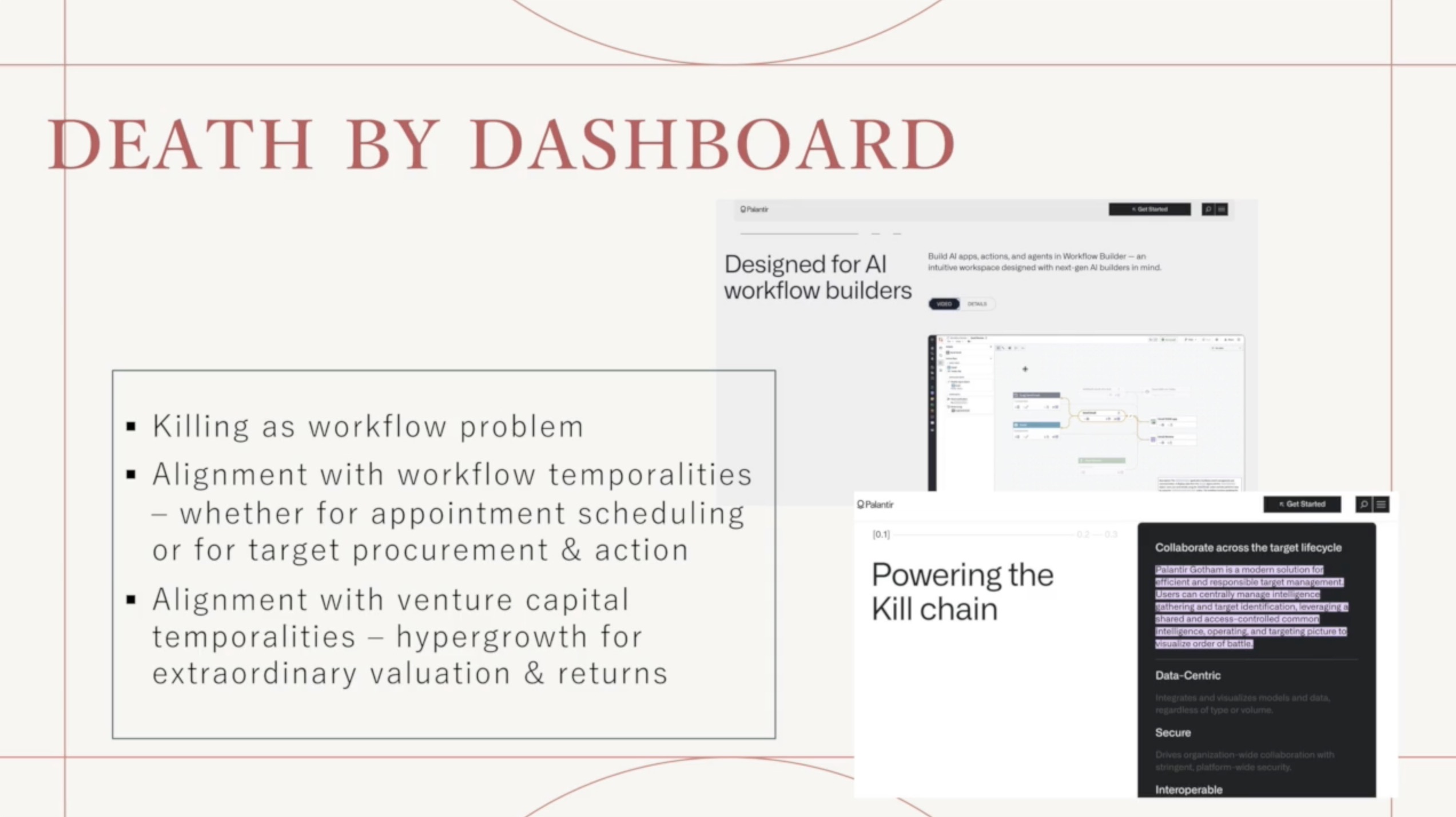
These big, you know, data crunching machines like Palantir software, they basically establish a picture of the whole context of a battlefield by, I don't know, scraping social media maps in real time, blah, blah, blah, and so on. And what you're actually suggesting is to do the same but in a civilian way. Right? To establish a context for every photograph with supporting materials, supporting evidence, etc. Depending on the situation. But I think that there are some, you know, if I'm photographing a speech by Donald Trump, we've already seen hundreds or thousands of images. You know, there may be different requirements. You don't have to use all the four corners. You can use the whole picture. You can use certain ones. But, for example, when Trump, the attempted assassination, supposedly where he got shot in the ear, you know, what we saw on the front pages were his fist raised, you know, fight, fight, fight kind of thing. And that was performative. That was what he wanted. You shouldn't then accede to it. You shouldn't allow it. You should show also the images where he's looking terrified on the ground. You know, where he's lost his shoes.
Where the Secret Service is holding him up, looking like a scared old man. That was part of the same scene. And I think it's a real abnegation of responsibility on the part of journalists, including the New York Times and others, to put that on the front page. The argument is that helped him win the election. That is not journalism. You have to show the context. You can't just, you know, you can't just go like it's a wrestling game. Like it's a wrestling match and he won. That's not journalism. You have to provide those sorts of context. And we can do it easily online at this point. Digitally. You can add three more pictures. You know, and you click, click, click. You see them. The single image is just, you know, it's the old McLuhan. We're, you know, going 150 kilometers an hour looking through the rearview mirror. We're just doing it the way it used to be done, not realizing there are so many other ways to do it. Yeah. Now I would like to zoom out a little more and try, ask you to contextualize these precipitous changes that we're seeing now with machine learning based tools and generated imagery.
I would like you to set them into the context of the 20th century, basically. Is this really so new, the changes we are witnessing? Weren't there other changes before, let's say, with digital, which were equally, you know, in the 20th century? Which were equally profound and upsetting for the whole technology? How do you see this? Or have we now reached a real moment of rupture where we cannot even speak of photography any longer? I think all of the above, in fact. I think it's been a transitional period going from analog film to computational photography. You know, that the… In the, let's say, a cell phone camera, you know, they may be making eight, nine images and then combining them without you knowing it. They may be lightening a dark spot. They may be making the person thinner, change their skin color, all because the camera manufacturer thinks that this is what you want as a consumer. Let's just go back to the word user, which I've hated since the beginning. That the digital set us up as users, as addicts. Basically. And then by being these users over these decades at this point, we became addicted to certain ways.
We lost our bearings. So in the book I wrote in 2008, 9, after photography, the first page is saying that we're basically emigrating at this point. What it's set up is a kind of a virtual space. Where the… Where they want us to go as users. In that virtual space, we're… We created an alternative universe of sorts. And all the pain and injuries of the physical universe, of the inequalities, of the political takeovers, of the power imbalances, you know, and down the line. We're inured to it because we have a virtual space. That was the idea. And we went for it as users. Because it was basically free. Anything that's free to that extent, you have to be very skeptical of. Why are they making it free? It's like when you're a heroin addict, the first few times it may be free and then you're addicted. But we went for it. And we didn't pull back. And reality itself is not as malleable. You know, if you don't have enough money for dinner, you can't then have dinner. It's not so malleable. But in a virtual space, it's all malleable. And photography being made… The argument I had was digital photography is making a mosaic of the image.
And every square of the pixel can be changed as you want. It's… At an architectural, at a fundamental level, it's not the same medium. It's not the same image. It's not the same image. It's not the same image. It's not the same image anymore. I started calling it an image at that point, not a photograph. You know, going back to 1990, 35 years ago, it stopped being what we thought of as photography. It's photo-like. But it's not photography. And I think AI is, to use your word, the rupture. The paradigm shift. And it's now, you know, we get whatever we want all the time. And the interesting thing with AI, because I've been using it for quite a while, I've been using it for quite a number of years now, it was really interesting at the beginning. AI-generated imagery. You put in a text prompt. And, you know, for example, I asked… The prompt was something like, I want Trump's favorite dictators. And it did. It put, like, three generals in the background. And then it gave me two Trumps. I didn't ask for two Trumps. But obviously, Trump's favorite dictator in the foreground was Trump.
It understood what I didn't understand. It was giving me… You know, I asked the perfect family. It gave me two kind of English guys in bowler hats with two kids. There's no woman. I said, this is brilliant. I didn't even know you would do that. You know, and down the line, I asked for the most beautiful woman in the world. And I got a black woman in the street talking on a cell phone. Her hair wasn't combed. And I said, wow, this is amazing. This is better than, you know, what you see in photography and magazines. It's always the same kind of, you know, Caucasian woman, blonde, da-da-da. And it had whole different ideas. And I can't get that anymore. It's become more and more conventional. You know, it's trying to please the user. And what it's doing is the imagery is more and more mainstream and less, you know, less volatile. In the book, The Synthetic Eye, I wrote about how, again, as a picture editor, I'd often know when I made an assignment what the photographer would bring back as an image. I could guess. And I was, you know, often right. But with the AI, I was being surprised and surprised and surprised.
And it was interesting, but it no longer is. So to me, there's not one idea of AI-generated imagery. You know, in some ways, like, it's not. You know, it can be. If I can show, you know, Paris in 30 years from now, if we don't do something, you know, the flooding that will happen and so on using AI according to scientific projections, it could be proactive and it could be helpful in a way photography cannot. And I think there are some useful ways for it to be really helpful because you can depict a potential future. Not to say it'll happen, but it might happen. So that instead of photography, which is reactive, you wait for the massacre, you wait for the war, you wait for the flood, you wait for the destruction, and then you win all these awards for your amazing pictures. I've always been in favor of proactive imaging in which you show what might happen so the worst does not happen. And AI can be useful that way in many circumstances. So I don't want to just say that it's good or bad. I think it has multiple uses. And if it's used by civilians.
So when I teach and I lecture, the whole point of it is to let people into what's going on. So they make models, they use it in ways that are constructive. Because we have to take it over. The corporations are not going to do it for us. The governments are not going to do it for us. We have to use it in constructive, interesting, illuminating ways. Instead of just saying it's good or bad. It's both. Yes, I agree. But you said that when digital image making started happening, you stopped using the word photography and started using the word image. So would there be a similar change of term for whatever it is that AI is doing now? Are these still… I always use synthetic image. Now, photography is analytic. You're framing. And it's synthetic. And when I caption these synthetic images, the way I do it is this is a synthetic image, comma, not a photograph, comma, generated in response to a text prompt. Because saying synthetic image by itself, a lot of people don't know what you're talking about. You know, painting is synthetic. There's all kinds of… But I want to be clear, it's not a photograph, that they understand that right away.
It's the deception. It's like in China now, South Korea, they have this idea that there's two kinds of AI, the implicit and the explicit. And, you know, the explicit, you know, when it's, you know, seven elephants flying, you know, you should put it in the metadata for sure. But it's the implicit one. It's the implicit ones where you're showing something that could happen, that you think might have happened. You have to be explicit. You have to let people know right away what's going on in terms of it. Because that's where it could get malicious and destructive. So, you know, where it's obvious, you just put it in the metadata. Where it's not obvious, you have to label it front and center so people know. But a lot of people don't know what artificial intelligence images are and what the difference is at this point. Nor do they want to know, which I think is the key point. They don't want to know the difference between the reality and the unreality because they, in fact, prefer the unreality. And part of that is, I think, desperation. I think given that we have so little control over our political and economic systems at this point, the unreality of the AI is pleasurable.
Because at least there we get to be, you know, in quotation marks, in charge of our own destinies. Which, of course, we're not. But we have the illusion of it for that moment. It's like going to Disneyland or something. You have these, you know, it's like travels in hyperreality. You have this sense that in the unreality you found a home which is more welcoming than, in fact, the reality you live in. Which is you have a government that is so cruel and destructive. And the alternative of the artificial reality is you could vent your anger, you could see other things. It's, you know, a little like going to a bar where if you have enough drinks the kind of unreality takes over. Speaking of taking control of your own destiny, can you give us some examples of people who have been personally impacted in the field like photography? Photographers or photo editors or other people who used to do this for a living professionally. Have you already seen the impact in the field? Or is it silently happening? Because it is happening. It depends. It's completely happening. But again, let's just go back to, do I want to go to a war zone and make pictures when people don't believe them?
I mean, right there is a question. Do I want to risk my life? Do I want to do all these things when there's little impact? That's partly AI. It's partly the fact there are no more front pages, print media, where you could put a girl burning from napalm in Vietnam War on the front page. And the following year, the US pulled out all its soldiers from Vietnam. It's anecdotal. It's not cause and effect exactly. But I remember interviewing a woman who was covering a photographer who was covering the Israeli bombing in Beirut. And he said there's a kind of an implicit understanding with your subject that by them being photographed, you will try to get it published and it may help them at some level. Otherwise, you feel like you're a voyeur. You feel you're taking advantage of them. You're getting paid. You're a mercenary of sorts. But there's a kind of a contract that's implicit. It's not stated that you're helping. And this has been failing for quite a number of years before AI, given the fact the print media isn't there, the front page isn't there, given the weaponization online, that whatever you…
I'd be afraid to put the picture of the girl burning from napalm on social media because it would turn into something pornographic. Somebody would take it and do something with it. And at that point, there was a study recently actually in England of teenagers that they would prefer nude photographs of themselves being put online even though they hate it rather than deepfakes, AI-generated, because that's even more dangerous. You don't have control. You don't know how it's going to be used. It's malleable. You could be put in any situation. And even as teenagers, they're already more afraid of AI than they are of actual photographs. So I think that this transition has been happening for quite a while. And I think that basically when you're publishing photographs online, even for reputable publications, you have very little space, real estate. It's when you do a double page in a magazine, you could really change the… Here's a big picture, a small picture. You group them. You aggregate. They work. One plus one is more than two. There's a third effect. There's all kinds of stuff. And you could direct it. You could say something important. You could control it.
It's on print. It can't be changed by somebody else. And then when you're putting it on a social media and people are looking on their cell phone, the pictures are usually simplistic. They can't have much nuance. They can't have much complexity. It's on a cell phone. So then what you're doing is, you're making sort of emblematic images. Here's a little girl running down the street, but you can't see the whole street anymore. You can't see all of it. And a lot of what photography, the way it works is, if you allow the viewer to read the picture, look at the different parts of it, and make up their own mind is what's going on, as well as the caption, it's much more effective than just saying, here's a burning car, or here's a policeman beating somebody. That's top-down in a way. It's not engaging the reader. And it's actually discarded. Almost all the images I find online, except for the videos now, and I think that's the transition. But the single images, so many of them are just almost simplified memes at this point. Whereas the videos, like we saw in Minneapolis by the onlookers, where you hear the background noises, you hear their responses, how could they do that?
You're a murderer. This is horrible. I don't believe it. That's much more experiential. And for the moment, that's an avenue for the viewers to experience, to participate, to have a sense of the reality of what does it mean to kill Renee Goode, or to kill somebody in the street, or jump on them, arrest them. That's working on a cell phone much better than photography is at this point, with or without AI. How long do you give it? I think it will be one more year before the video generation will have caught up with that level of photorealism. In video also. I think you're right. But I think the other question though is, what do we do about it? How we, who care about these things, seeing a year or two in advance, what are we coming up with to replace it? What are we coming up with that will work? Because living in the United States right now, for me and for many, I think, the cell phone videos were the line that prevented a kind of a, more and more of a fascist takeover. At that point. The cell phone videos worked. And unlike the Arab Spring, where there was citizen journalism in a big way, and then the crushing of so much of that, there was a moment of enormous hope.
In the United States, for the moment, the cell phone videos are what they're scared of. Because they still communicate enough realism for people to be anti-Trump immigrants. And they're not anti-immigration policies at this point. And so to me, the issue really is, can democracy survive? It's interesting how you describe, sorry, let me just interject. It's interesting how you describe the videos almost like a platoon in the Spanish Civil War, able to hold the line against fascism. Anyway, I didn't want to interrupt you. Please continue. That's exactly what Robert Capa's book and Spanish Civil War was about. He was not the objective observer. He was pro-democracy and so on. And if your pictures aren't good enough, you're not close enough, all that. It was the empathy for the people and trying to use, in the day of the small cameras and the faster film, 1930s, that kind of idea that the image itself, in a non-violent way, could help democracy survive and the rights of the people. And I think similarly now, we're seeing that with cell phone videos. So the interesting thing then is, how does the professional observer, the photographer, videographer, coexist with and amplify each other, the citizen journalist and so on?
How do those two work together as a synergy? And I think that's what we're seeing play out right now here. So I think, you know, going back to the Washington Post, the failure of the professional class, which is the lack of funding, the lack of people buying the publications, as well as all kinds of corporate interests that we talked about, you know, the citizens are taking up the slack. And they're doing it at great risk to themselves and so on. And you're right. You know, how long is this going to last is unclear. Certainly we're not counting on it. But then what do we do for the future? And I think again, that with the cell phone videos, part of it is that there are so many observers. It's not just one observer. And so the tendency is, if so many people are recording similar, you know, issues, similar events, and from different perspectives, you know, there's a kind of a belief in that reliability, and that's what we're seeing. There's a belief in that reliability at that point. The bigger question then is, to me, is there going to be emergence of a sense of a…
This is a weird expression, but almost a return to realism. You know, are we going to realize that when the government says, the economy is better, everything's better, it's great, it's the best in history, is there going to be a return to a sense of the reality of really what's going on on the ground? And, you know, how do we find the, not only the imagery, but the platforms, which are reliable, that we can count on to tell us what's going on? Because right now it's… The social media platforms, as we know, have, you know, are not publications, and they're not responsible for, you know, filtering work, or editing work, or for the most part, they're not rejecting even much of the… inflammatory work. You know, and again, laws could change that. It can be changed by, you know, four-sided governments. Can there be a penalty, for example? You know, if I give somebody a 100 euro bill and it's a counterfeit, I could go to prison. But if I give you a counterfeit image, nothing happens to me. Can there be rules to legislate that there's a penalty? It's a fine, you get kicked off the platform.
What happens? These are not the hardest issues to figure out. Except in the case of pornographic deepfakes, that's about the only place that governments seem interested in intervening. They don't understand that democracy is at risk because of all this. And, you know, and we just stand around, you know, like you said earlier, I've been writing… The first piece I wrote was New York Times Magazine, 1984, says 42 years ago, I've been waiting for somebody to step up and say, what do we do about this? And for the most part, it's just not happening, either from the photographic industry, from governments, from lawyers, you know, from… And so on. Nobody seems to want to intervene in the sense of there should be penalties, certainly in Western governments, that there should be penalties for misuse, malicious use of photorealism. One other very important aspect of reality is that usually people need to make a living when they contribute to, I don't know, public knowledge, let's call it like this, and photographers for, you know, quite some decades, that was a profession that used to be paid, which is also something which changes very rapidly, already with digital photography, but now also with generative AI dramatically.
Do you have any examples of how professional photographers react to that? What do they shift to? What kind of strategies do they have? Do they just change profession, or they don't? What happens? I think it's very difficult for them at this point. You know, I had coffee with a friend in Paris recently, and he told me there's only four publications that still give assignments. You know, he's a photojournalist. And so there's this… And so there's a sense that this generation now, other than some grants and so on, is… It's very, very difficult to make a living at all. It's… You know, when I wrote a… I curated the first retrospective of Sebastiao Salgado in 1990, and I wrote the text about him, the Museum of Modern Art in San Francisco, the lyric documentarian, he was really a poet, you know, working years in the Latin American countryside with the peasant population and so on, that, you know, you don't get paid for that. You know, if he had an assignment, he'd do the assignment, then he'd stay for another matter of months working. But he was like a poet, and poets don't get paid. And, you know, I think then what you saw was the movement of photography, from something quite concrete, factual, into something much more poetic and visionary.
You know, Robert Frank, The Americans, you know, there have been examples of it. And some of those photographers then were able to exist on the borderline between being an artist, being a journalist, you know, the hybrid approach. So they were showing in museums, they could sell prints, they had exhibitions, galleries, books, which in many ways funded the other kind of work, the long-term work. I think where we're, you know, and some of that still goes on, but I think the place where people are really being heard is the day-to-day press kind of work, because there's fewer and fewer publications, their budgets are smaller, and also the photo editors, because they were the key people, you know, having been one myself, you know, who are corroborating the imagery, contextualizing it, making the assignments, working with the photographer, and there are fewer and fewer of those. So the Washington Post cut half their photo editors as well as the photographers. If you're in fashion photography, for example, you know, there's now AI-generated fashion. You don't need a model, you don't need makeup, you don't need a photographer. And there was a very well-known fashion company that argued that's good, we're using AI, because that way we could show diverse models, you know, different races, ethnicities, heavy people, skinny people.
We could never afford it, but AI, we could do it. So they were arguing that that's liberating. Of course, the people don't exist, nobody gets paid, and so on and so forth. But I think in some of the fields, you know, AI is really going to take over, and for the most part, they're finished. But I think to your point, what's interesting and important is the human in the Washington Post photographer, the human observer. People often diminish that and just think of the camera, just think of the mechanics of it. You know, you're just carrying a camera. Why do we need you? You know, anybody could carry a camera. You know, photography is done by billions of people now with cell phones. What do we need you for? The reporter could carry a camera. You know, just to illustrate the text, they don't see the humanity in it, the interpretation, the subjectivity, the sensitivities, and so on and so forth. That's not high on the hierarchy. So now the interesting thing is you have thousands of small photo books being published every year, you know, many of them with circulations of 300 or 500 or 100, you know, making not much money, if any.
So it flourishes as more of a poetic medium, but less as a kind of a, you know, mainstream recounting of world events in that sense too. And I think also the economic model for a lot of the, for some of the big agencies, you know, so far, if you license the imagery that they have in the archive to AI companies, to other people, to learn from, they make more money than selling the images as photographs. You know, it's a warehouse. The licensing rights to the warehouse is where the money is. And I think some of them now pay a few cents to the photographer if their images are used to, you know, to be scraped, to be learned from AI, but that's where the money is. It becomes a, you know, like a raw material, kind of like, you know, you know, a portrait, and then our country shipping the raw materials to be refined by the AI company, or whatever it would be. It's very top-down, and it's just very much part of the idea that, you know, I think when Kodak, for example, I think had 25,000 employees, and when it went out of business, I think Instagram, I may be wrong, had something like eight employees at the beginning.
So that on an industrial scale, on a labor scale, you're going from 25,000 to eight, or 100, or 50, or whatever the number is. And it's, you know, I think AI facilitates that and makes the, you know, the person, you know, with the legs and hands and a heart and a vision, more the province of museums and, you know, and photo books, art books, and so on. So that's the reason why so many photographers over the last, you know, 20 or so years have gone, have taken the label of either photographer or artist, because as a journalist, your print may be worth, you know, 200 euros, but as an artist, it may be worth 2,000 euros, same print. And so for that vision, you get paid more. So you use the system in those ways. I see. So I have two more questions. Okay. Firstly, you said that photography as a technology is kind of over because there's now been a big rupture. So I'm certainly not going to imply that there will be no other photographs produced in the future. But from, seen from today, which one would you say was the last photograph, the last important photograph?
I'll answer two things. First, I think that we will flourish, but in different ways. In other words, as a boutique industry, you know, I still look at, you know, when painting was assaulted by photography in the 19th century, you know, then you got Impressionism, Cubism, and so on. So my hope is that photography, going back to its roots with film, with paper, with physical presence, will be able to reinvent itself, in ways that are constructive and illuminating, amplifying. And I think a lot of the point and shoot idea of photography is over. But I think the more creative uses of it are just beginning. So I'm going to say that I think the last… The king is dead. Yeah, that's it. I think the last photographic iconic image, that had an international global impact, the way we saw, you know, the Vietnam War, you know, we've seen many times, was in 2015, the photograph of Aylan Kurdi, the two-year-old boy from Syria, who tried to escape with his family, and he and other members of the family died, and he drowned. He was on the beach in Turkey. And… governments responded, people responded, more refugees were let in, people gave more money, a lot more money, and they felt it.
And the question at the time was, why that image? And the response I found the most important, or essential, was because Aylan, face down in the sand, reminded them of the fact that, he was on the way of, they dressed their own children to go to school. You know, that he was part of their family. And so, I think that what needs to happen, which I alluded to before, is we've used photography to look at the other, like third person. And then there's this sort of artist, who are first person, me. You know, and they illuminate the personal, and they illuminate the family, and they illuminate, their vision. And I think that what we need is a hybridized photography, which is first and third person, which ends up as second person. In other words, it's about us. And I think Aylan Kurdi was about us, for a lot of people. Of course, you know, there's all kinds of issues of, people, you know, from different parts of the world, might see it differently, and so on and so forth. But, I think what we're looking for, and that's what The Four Corners is about, is the combination of the, you know, I saw the boy on the beach, you know, I'm the photographer, I thought of my own kids, my nephew, whatever it would be, and I started crying, and I crawled all night.
I'd seen other dead bodies, but this one got me, and you're reading that along with the image, and it becomes about us. And so it's okay for the photographer to have a response, to be emotional. It's not this sort of, quote unquote, objective, which never existed. You know, this myth that it can be objective. It never existed. It's okay to be a kind of a subjective, as well as factual, at the same time. And I think, then become us. And I think that's what we saw in Minneapolis. Those videos became us. It wasn't them, or it wasn't me, it was us. And I think if we put us into it, you know, we all often talk about the me-gen, the us-generation. I'm looking for the metamorphosis into the us-generation, at this point. You know, I'm living in New York. We have a Democratic Socialist mayor. It's about us. It's not about them or me. You know, it's not about my wealth or their wealth. It's about us together. And we're just as good as, you know, the least privileged parts of the society. It's us. These are our responsibility. And I think that's where the whole legacy of humanistic photography, comes in.
Because it's always been about us. It's been, you know, the marginal. They should be mainstream. The civil rights movement. It's us. We're not good as a people, unless everybody's treated with dignity and respect and, you know, awarded the economic needs that are there. So, I think it's a moment then to reaffirm some of these principles in reinventing the medium. So, I am very hopeful that this is going to happen. That's why what I do every day, basically, is try to find ways to reinvent, reaffirm the medium as a medium of us. And deal with AI, deal with all these other things in that context. So, I don't want to be mechanistic. It's AI or not AI. It's this or not. We all know that you could set up a photograph that's not AI, and be completely misleading and racist and horrible. Or whatever. You know, you could say to 12 people who are very tall, you know, smile. We're trying to illustrate the idea that tall people are happy. Well, tall people are not always happy. That's just invented. But it's an actual photograph. You know, that's been done forever. So, it's not just AI or not AI.
That's the last question I wanted to ask. So, photography has lasted for 200 years. Let's say in its traditional era, it's been a long iteration. So, how do you want to project, you know, these qualities you just mentioned, the us qualities, into the next 200 years? How, how, what can we hope for? I've given many lectures where the first sentence is, I don't care about photography, I care about the world. And I believe that. I think photography is the means to a better world. You know, whether it's illuminating, a tree of flowers, or illuminating, you know, the joy of children, or stopping wars, or helping us with climate change, or whatever it can do. It's a nonviolent medium. You don't, I hate the word shooting, or you shoot photographs, I think it's the wrong word. You know, the idea of your subject is hierarchical. We should probably rethink that. Taking photographs is aggressive. Maybe we should be making photographs. You know, there are other ways to conceive of it, in a kind of a spirit, which needs to underlie it, and has underlied much of it, much of what we celebrate in photography is exactly this.
You know, that sense of, of collaborating with the world to make it better. So, for example, one thing I do, you know, in teaching, is I have my students make interactive portraits. And what they do is they make a portrait of somebody, show it to them, and record their voice, asking the question, is this you? Does this represent you adequately? And the person says, oh, you show me serious. I'm a funny guy. It's not me. It's not me. You know, you see a guy who doesn't have any place to live. Is this you? He said, of course it's not you. There's no place to shave. There's no place to shower. There's no place to, and it becomes a collaboration between the viewer and the viewed, in which they each learn a lot in the process, and we learn a lot. Like, you know, my student who did the person in New York City in the middle of the night who had no shelter, no home, I see all people differently because of that image and because of his response. So I think, you know, when sometimes I've shown that to professionals, and they say, oh, you're taking away my power.
I say, I'm giving you power, because now you're able to get the other person to collaborate with you in the making of the image. You open it up, the us, not the them and the me kind of thing. So I think in that spirit, it's not only a good idea, but it's necessary for us to go forward as people at this point, to use media in that way to have a respect for others, respect for self. You know, John Sarkowski a long time ago had mirrors and windows. The artist is mirrors, and the documentarian is windows. To me, that's insufficient. You can be the artist and the documentarian at the same time. You probably have to be. You know, I always start with the James Baldwin quote, the purpose of art is to reveal the questions that are concealed by the answers. And I think that's really what photography has to do. It has to be an interrogation filled with good questions as much as it gives answers. And that's a different paradigm. And I think the challenge of AI is going to make us rethink photography to make it better, more sophisticated, more interesting, more nuanced, and based upon the principles that we believe in as opposed to the idea of, you know, the mechanical ideas, the camera never lies and all, you know, which are too easy.
It's been too simplistic. You know, it's the argument, you know, anybody could, you know, photograph. Well, that's not true. You know, anybody could write. Anybody could make a grocery list. You know, I'm buying milk, I'm buying tomatoes. But they're not writers. And I think we have to make those differentiations in photography too, so it elevates to the point where it's a much, much more sophisticated medium than it has been. So I hope that answers your question. Well, thanks a lot, Fred Ritchin, for spreading so much hope for all the beautiful and illuminating answers you gave. And also specifically reminding everyone of the Alain Cudy photo. That was very, very moving. Thank you for that. Thanks for your time. And I hope to speak to you again soon. My pleasure. Thank you. Thank you. Bye-bye. Bye. You Thank you.